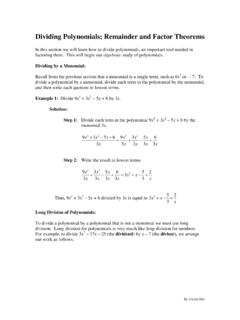
Transcription of 11.Remainder and Factor Theorem (A)
1 : THE REMAINDER AND Factor Theorem Solving and simplifying polynomials In our study of quadratics, one of the methods used to simplify and solve was factorisation. For example, we may solve for x in the following equation as follows: Hence, x = 3 or 2 are solutions or roots of the quadratic equation. A more general name for a quadratic is a polynomial of degree 2, since the highest power of the unknown is two. The method of factorisation worked for quadratics whose solutions are integers or rational numbers. For a polynomial of order 3, such as the method of factorisation may also be applied. However, obtaining the factors is not as simple as it was for quadratics.
2 We would likely have to write down three linear factors , which may prove difficult. In this section, we will learn to use the remainder and Factor theorems to factorise and to solve polynomials that are of degree higher than 2. Before doing so, let us review the meaning of basic terms in division. Terms in division We are familiar with division in arithmetic. The number that is to be divided is called the dividend. The dividend is divided by the divisor. The result is the quotient and the remainder is what is left over. From the above example, we can deduce that: 489 = (15 32) + 9 Dividend Quotient Divisor Remainder Thus, from arithmetic, we know that we can express a dividend as: Dividend = (Quotient Divisor) + Remainder When there is no remainder, =0, and the divisor is now a Factor of the number, so Dividend = Quotient Factor The process we followed in arithmetic when dividing is very similar to what is to be done in algebra.
3 Examine the following division problems in algebra and note the similarities. Division of a polynomial by a linear expression We can apply the same principles in arithmetic to dividing algebraic expressions. Let the quadratic function ( ) represent the dividend, and ( 1) the divisor, where ( )=3 - +2 From the above example, we can deduce that: 3 - +2=(3 +2)( 1)+4 Dividend Quotient Divisor Remainder Consider ( 1)=0, ( )=(3 +2) 0 + 4=4 But, ( 1)=0 implies that =1 Therefore, when =1, ( )=4 or (1)=4.
4 We can conclude that when the polynomial 3 - +2 is divided by ( 1), the remainder is (1)=4 We shall now perform division using a cubic polynomial as our dividend. x2+5x+6=0 (x+3)(x+2)=0 x+3=0, x= 3x+2=0 x= 2 x3+4x2+x 6=032 4893215 169 160 9 x 1 3x2 x+23x+2 (3x2 3x) 2x+2 (2x 2) 4 Quotient Dividend Remainder Divisor Remainder Dividend Quotient Divisor Copyright 2019. Some Rights Reserved. 1 of From the above example, we can deduce that: 4+12 - 3 +4=( -+14 +25)( 2)+54 Dividend Quotient Divisor Remainder Consider ( 2)=0, ( )=( -+14 +25) 0 + 54=54 But, ( 2)=0 implies that =2 Therefore, when =2, ( )=54 or (2)=54.
5 We can conclude that when the polynomial 4+12 - 3 +4 is divided by ( 2), the remainder is (2)=54 Now consider another example of a cubic polynomial divided by a linear divisor. From the above example, we can deduce that: 2 4 3 -+4 +5=(2 -+ +18)( +2) 31 Dividend Quotient Divisor Remainder Consider ( +2)=0, ( )=(2 -+ +18) 0 31= 31 But, ( +2)=0 implies that = 2 Therefore, when = 2, ( )= 31 or ( 2)= 31. We can conclude that when the polynomial 2 4 3 -+4 +5 is divided by ( +2), the remainder is ( 2)= 31 The Remainder Theorem for divisor ( ) From the above examples, we saw that a polynomial can be expressed as a product of the quotient and the divisor plus the remainder: 3 - +2=(3 +2)( 1)+4 4+12 - 3 +4=( -+14 +25)( 2)+54 2 4 3 -+4 +5=(2 -+ +18)( +2) 31 We can now formulate the following expression where, is a polynomial whose quotient is and whose remainder is R when divided by.
6 If we were to substitute = in the above expression, then our result will be equal to , the remainder when the divisor, ( ) is divided by the polynomial, ( ). We are now able to state the remainder Theorem . The Remainder Theorem If is any polynomial and is divided by , then the remainder is The validity of this Theorem can be tested in any of the equations above, for example: 1. When 3 - +2 was divided by ( 1), the remainder was 4. According to the remainder Theorem , the remainder can be computed by substituting =1 in ( ) ( )=3 - +2 (1)=3(1)- 1+2 (1)=4 2. When 4+12 - 3 +4 was divided by ( 2), the remainder was 54. According to the remainder Theorem , the remainder can be computed by substituting =2 in ( ) ( )= 4+12 - 3 +4 (2)=(2)4+12(2)- 3(2)+4 (2)=8+48 6+4 (2)=54 x 2x3+12x2 3x+4x2+14x+25 (x3 2x2) 14x2 3x+4 (14x 28x) 25x+4 (25x 50) 54 x+2 2x3 3x2+4x+52x2+7x+18 (2x3+4x2) 7x2+4x+5 (7x2 14x) 18x+5 (18x+36) 31 f(x) Q(x) (x a)()()()fxQxxaR= -+ f(x) f(x) (x a)().
7 FaCopyright 2019. Some Rights Reserved. 2 of 3. When 2 4 3 -+4 +5 was divided by ( +2) the remainder was 31. According to the remainder Theorem , the remainder can be computed by substituting = 2 in ( ) ( )=2 4 3 -+4 +5 ( 2)=2( 2)4 3( 2)-+4( 2)+5 ( 2)= 16 12 8+5 ( 2)= 31 Example 1 Find the remainder when ( )=3 4+ - 4 1 is divided by ( 2). Solution By the Remainder Theorem , the remainder is (2). ( )=3 4+ - 4 1 (2)=3(2)4+(2)- 4(2) 1 (2)=24+4 8 1 (2)=19 Hence, the remainder is 19 The Factor Theorem for divisor ( ) Now, consider the following examples when there is no remainder. We can express the dividend as a product of the divisor and the quotient only, since =0.
8 ( )=3 - 2=(3 +2)( 1) ( )=8 4 10 - +3=(8 - 2 3)( 1) We can now formulate the following expression where ( ) is a polynomial, ( ) is the quotient and ( ) is a Factor of the polynomial. ( )= ( ) ( ) The above rule is called the Factor Theorem , it is a special case of the Remainder Theorem , when =0. The validity of this Theorem can be tested by substituting =1 in each of the above functions. ( )=3 - 2 (1)=3(1)- 1 2 (1)=0 ( )=8 4 10 - +3 (1)=8(1)4 10(1)- 1+3 (1)=0 In the above examples, when we let ( 1)=0, or =1, ( )=0 because the remainder, =0. The Factor Theorem If is any polynomial and is divided by , and the remainder then is a Factor of Example 2 Show that ( 2) is a Factor of ( )=3 4+ - 14 Solution By the Factor Theorem , if ( 2) is a Factor of the remainder is zero.
9 We now compute the remainder, (2). ( )=3 4+ - 14 (2)=3(2)4+(2)- 14(2) (2)=24+4 28 (2)=0 Hence, ( 2) is a Factor of ( ). The Remainder and Factor Theorem for divisor ( + ) When the divisor is not in the form, , but in the general linear form ( + ), the remainder can no longer be ( ). This is because the coefficient of x is not equal to one. Consider the following example, where the divisor is of the form, ( + ). Let (2 +3) be a divisor of ( )=2 4+7 -+2 +9 We perform the division as shown below and note that the remainder is 15. x 1 3x2 x 23x+2 (3x2 3x) 2x 2 (2x 2) 0 x 1 8x3 10x2 x+38x2 2x 3 (8x3 8x2) 2x2 x+3 ( 2x2+2x) 3x+3 (3x+3) 0 f(x) f(x) (x a)()0fa= (x a) f(x) (x a)Copyright 2019.
10 Some Rights Reserved. 3 of We can deduce that: 2 4+7 -+2 +9=( -+2 2)(2 +3)+15 Consider (2 +3)=0, ( )=( -+2 2) 0 + 15=15 But, (2 +3)=0 implies that = 4-. Therefore, when = 4-, ( )=15 or A 4-B=15. We can conclude that when the polynomial 2 4+7 -+2 +9 is divided by (2 +3), the remainder is A 4-B=15 Now consider the example below. We can deduce that: 9 4+15 - 9 +1=(3 -+6 1)(3 1) Consider (3 1)=0, ( )=(3 -+6 1) 0 =0 But, (3 1)=0 implies that =C4. Therefore, when =C4, ( )=0 or AC4B=0. We can conclude that when the polynomial 9 4+15 - 9 +1 is divided by (3 1), the remainder is AC4B=0. So, (3 1) is a Factor of 9 4+15 - 9 +1 From the above examples, we can formulate the following expression: ( )= ( ) ( + )+ where, is a polynomial whose quotient is and the remainder is R when divided by ( + ).