Transcription of 16. Electrophilic Aromatic Substitution
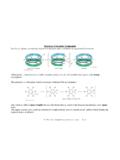
1 Experiment 16 Electrophilic Aromatic Substitution Page 1 of 8 16. Electrophilic Aromatic Substitution A. Introduction Aromatic compounds are especially stable and despite having p-bonds do not react like typical alkenes. For example, the p-bond in 1-hexene undergoes bromination to give 1,2-dibromohexane, while benzene does not react under similar conditions (figure 1). Figure 1. Bromination of Alkenes Aromatic compounds are extremely important for their industrial and pharmaceutical use. A few prescription drugs containing one or more Aromatic rings are shown in figure 2. With their immense value as synthetic targets, it is important to understand both the properties and the reactivity of Aromatic rings. By tapping into the reactions of Aromatic rings, a simple benzene ring can be highly functionalized to provide complex organic molecules.
2 The focus of this experiment is on Electrophilic Substitution of benzene rings (shown in blue in figure 2), however, a variety of other Aromatic rings (shown in red in figure 2) do exist, and bring an entirely different breadth of properties to these molecules. Figure 2. Pharmaceutical Compounds Containing Aromatic Functionality Although benzene does not react with bromine alone, it was found that by adding a Lewis acid (FeBr3) to the reaction mixture, benzene could be mono-brominated in relatively high yield. Addition of the Lewis acid enhances the electrophilicity of the bromine to such a degree that one can overcome the low reactivity inherent to benzene. The reaction mechanism first involves generation of the active electrophile by coordination of bromine with iron tribromide. This Lewis acid-base adduct provides a source for the highly Electrophilic bromonium ion (Br ).
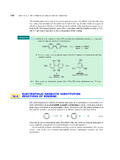
3 The Br2 BrBrBr2 NoReactionOOHOHOHNFNHOL ipitorused for treating high cholesterolNHNSONOON exiuma proton pump inhibitor used to treat acid refluxHNClClZoloftused for treating depressionExperiment 16 Electrophilic Aromatic Substitution Page 2 of 8 second part of the mechanism involves reaction of the benzene p-bond with either the Lewis acid-base adduct (shown) or simply with Br to provide a carbocation intermediate. This step temporarily breaks the aromaticity in the ring. Bromide (Br ), from FeBr4 then acts as a base removing a proton from the ring to form a p-bond and reestablishing aromaticity. This overall process is referred to as an Electrophilic Aromatic Substitution (EAS) because a hydrogen on the Aromatic ring is substituted with an electrophile, such as Br. (Figure 3) Figure 3. Electrophilic Bromination of Benzene A variety of conditions can be employed to obtain severed different mono-substituted benzene rings.
4 Table 1 lists the five most common Electrophilic Aromatic Substitution reactions. Table 1. Typical Conditions for Electrophilic Aromatic Substitution Br2 FeBr3 BrBrBr+FeBr3 BrBrFeBr3 Reaction Mechanism1. Generation of the active electrophile2. Reaction of benzene with the active electrophileBrBrFeBr3+H+HBrBrFeBr3Br+ HBr+ FeBr375%BrFeBr3+BrBr2 FeBr3 PhHConditionsActive ElectrophileProductCl2 FeCl3 HNO3H2SO4SO3H2SO4R-ClAlCl3 BrClNO2SO3 HRPhBrPhClPhNO2 PhSO3 HPhRPhHPhHPhHPhHExperiment 16 Electrophilic Aromatic Substitution Page 3 of 8 Disubstituted Benzene Terminology The terms ortho, meta, and para are frequently used to describe the locational relationship between two substituents on an Aromatic ring. Two substituents in a 1,2 relationship are said to be ortho, two substituents in a 1,3 relationship are said to be meta, and two substituents in a 1,4 relationship are said to be para.
5 (Figure 4) Figure 4. Ortho, Meta, and Para Terminology Directing Group Effects When an Aromatic ring contains a substituent, that substituent affects the nucleophilicity and therefore reactivity of the Aromatic ring. Some substituents activate the ring, making it more reactive than benzene alone, while other substituents deactivate the ring, making it less reactive than benzene. Figure 5 lists some common activating and deactivating groups. These groups can be generalized in the following way: Activating groups typically contain a lone pair on the atom that is directly attached to the Aromatic ring. Alkyl groups are one exception, however, and are only weakly activating. Deactivating groups on the other hand have a halogen or electron withdrawing group, such as C=O, directly attached to the Aromatic ring. Figure 5. Common Activating and Deactivating Groups Activating groups enhance the nucleophilicity and reactivity of the ring by resonance donation as shown in figure 6a.
6 Deactivating groups on the other hand, decrease the nucleophilicity and reactivity of the ring by resonance and/or inductive withdraw of electron density from the Aromatic ring as shown in figure 6b. CH3CH3CH3CH3CH3CH312341,4-dimethylbenzen epara-diemthylbenzene121,2-dimethylbenze neortho-diemthylbenzene1231,3-dimethylbe nzenemeta-diemthylbenzene*dimethylbenzne is also called xyleneOHNH2 NHRNR2 ORNHROORORHFClBrIOHOORCNNO2SO3 HNR3 Strongly ActivatingModerately Activating(Benzene: Standard of Comparison)ActivatingGroupsDeactivatingG roupsortho, para directorsmeta directorsExperiment 16 Electrophilic Aromatic Substitution Page 4 of 8 Figure 6. Resonance Effect of Activating and Deactivating Groups It is also important to note that when an Electrophilic Aromatic Substitution reaction is performed on a mono-substituted benzene ring containing an activating group, the new electrophile will add to the ortho and the para positions of the ring (figure 7a).
7 In the case of most deactivating groups on the ring, the electrophile will add to the meta position (figure 7b). The origin of this selectivity will be discussed in the next section. Figure 7. Directing Group Effects in Electrophilic Aromatic Substitution Aromatic rings containing very strongly activating groups such as OH (phenol) and NH2 (aniline) can actually be halogenated in the absence of a Lewis acid catalyst. In fact, these strongly activated Aromatic rings are so highly activated that it is difficult to stop at mono-halogenation. When three equivalents of bromine are used, the compound is tri-halogenated at both ortho positions and the para position as shown in figure 8. In the first part of this laboratory experiment, you will brominate phenol to produce tribromophenol. Figure 8. Halogenation of a Strongly Activated Aromatic Ring In the second part of the laboratory experiment you will perform an Electrophilic nitration on two substituted benzene derivatives.
8 Like bromination, the first step of nitration involves generation of the active electrophile, which is a nitronium ion (NO2 ). The Aromatic compound then reacts with this electrophile. You will investigate the relative reactivities of methyl benzoate and OHOH(a) Activating Group - Resonance donation into the ring.(b) Deactivating Group - Resonance withdrawal out of the = Activating GroupDG = Deactivating GroupEEDGEAGAGEE+(a) Electrophilic Aromatic Substitution with an Activating Group on the Ring(b) Electrophilic Aromatic Substitution with a Deactivating Group on the RingNH2OH3 Br23 Br2NH2 OHBrBrBrBrBrBranilinephenolExperiment 16 Electrophilic Aromatic Substitution Page 5 of 8 acetanilide under Electrophilic nitration conditions to determine experimentally which of the two substrates is more reactive. (Figure 9) Figure 9. Nitration of an Aromatic Ring Ortho/Para Selectivity with an Activating Group When an activating group is present on the benzene ring, Electrophilic Aromatic Substitution occurs such that the new group adds ortho and/or para to the activating group.
9 This selectivity can be understood by investigating the reaction mechanism. In both ortho and para additions of the electrophile, aromaticity is temporarily broken and a carbocation resides on the ring. This carbocation can be delocalized over the ring s p-system (blue arrows, figure 10). Additionally, the lone pair on the activating group is delocalized (green arrows, figure 10) giving a fourth resonance structure which is a major contributor to the resonance hybrid due to all atoms in this resonance structure having an octet of electrons. Para addition is analogous, giving four similar resonance structures. You will explore the mechanism for para addition in pre-lab question 3. Figure 10. Ortho Addition of an Electrophile to an Activated Aromatic Ring While there is nothing especially bad about meta addition to an activated Aromatic ring, it is simply a much slower process due to the mechanistic pathway being higher in energy than ortho/para addition pathway.
10 The meta addition pathway (figure 11), has only three resonance structures stabilizing the intermediate carbocation. In comparison, the ortho/para pathway has four resonance structures. ONOOH+HOSOHOOONOOH2-H2 OONOOCH3 OONOOCH3 ONO2 HNONOHNOONO2 Generation of the Nitronium IonNitration of a Methyl BenzoateNitration of an AcetanilideNH2E"ortho attack"NH2 ENH2 ENH2 ENH2 EAdditional resonance structure where all atoms have an octet. This helps to stabilize the ortho 16 Electrophilic Aromatic Substitution Page 6 of 8 Figure 11. Meta Addition of an Electrophile to an Activated Aromatic Ring Mechanistically, the pathways for both ortho and para nitration of acetanilide are essentially equivalent, yet when the reaction is performed, the para product is obtained selectively. This selectivity is due to the substrate s large/bulky activating group which sterically hinders (blocks) the ortho sites, making para addition preferred.