Example: dental hygienist
2.3 Multiplying and Dividing Rational Numbers
Section 2.3 Multiplying and Dividing Rational Numbers 63 Work with a partner. Write a story that uses addition, subtraction, multiplication, or division of rational numbers. A t least one of the numbers in the story has to be negative and not an integer. Draw pictures to help illustrate what is happening in the story. Include the solution of the problem in the story.
Information
Domain:
Source:
Link to this page:
Documents from same domain
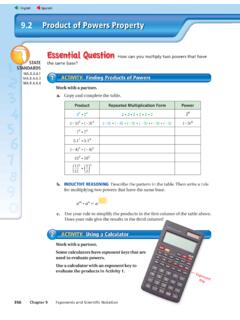
9.2 Product of Powers Property - Big Ideas Math
www.bigideasmath.comUse what you learned about the Product of Powers Property to complete Exercises 3 – 5 on page 360. 4. ... Words To multiply powers with the same base, add their exponents. ... (x ⋅ x ⋅ x) Group like bases using properties of multiplication.
resources by chapter - Big Ideas Math
www.bigideasmath.comThe Resources by Chapter book contains blackline masters of support material. Here is a list of resources ... resource is provided in three languages: English, Spanish, and Haitian Creole. ... Microsoft Word - resources_by_chapter.doc
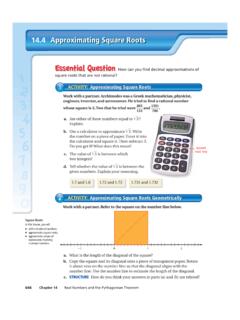
14.4 Approximating Square Roots - Big Ideas Math
www.bigideasmath.com14.4 Approximating Square Roots How can you fi nd decimal approximations of square roots that are not rational? Work with a partner. Archimedes was a Greek mathematician, physicist, ... and 8 squares wide. The area of each square is 14 square centimeters. Estimate the perimeter of the checkers board to the nearest tenth of a centimeter.
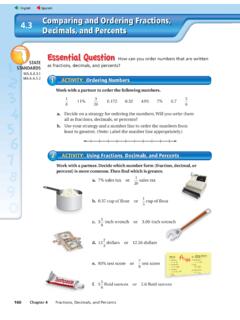
4.3 Comparing and Ordering Fractions, Decimals, and Percents
www.bigideasmath.com162 Chapter 4 Fractions, Decimals, and Percents 4.3 Lesson When comparing and ordering fractions, decimals, and percents write the numbers as all fractions…
6.2 Surface Areas of Prisms - Big Ideas Math
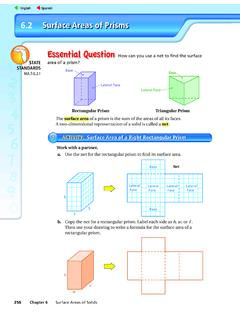
www.bigideasmath.comSection 6.2 Surface Areas of Prisms 257 Work with a partner. Find the surface area of the solid shown by the net. Copy the net, cut it out, and fold it to form a solid. Identify the solid.
6.5 Surface Areas of Cones - Big Ideas Math
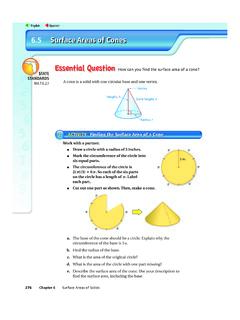
www.bigideasmath.com6.5 Surface Areas of Cones How can you fi nd the surface area of a cone? A cone is a solid with one circular base and one vertex. Slant height, Vertex Height, h Radius, r 1 ACTIVITY: Finding the Surface Area of a Cone Work with a partner.
10.1 Properties of Exponents - Big Ideas Math
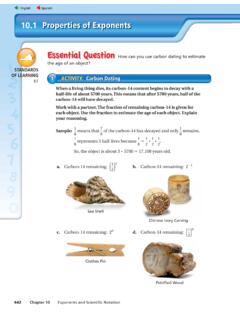
www.bigideasmath.comSection 10.1 Properties of Exponents 443 Work with a partner. a. Explain how to draw a graph that shows the percent of carbon-14 that remains in an object after it has died.
Skills Review Handbook - Big Ideas Math
www.bigideasmath.comSkills Review Handbook BigIdeasLearning.com ® Each exercise set ends with “mixed review” exercises that we call Fair Game Review.The title indicates
2.1 Rational Numbers - Big Ideas Math
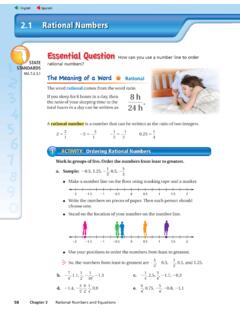
www.bigideasmath.com2.1 Lesson 52 Chapter 2 Rational Numbers and Equations Rational Numbers A rational number is a number that can be written as a — b where a and b are integers and b ≠ 0. Key Vocabulary terminating decimal, p. 52 repeating decimal, −p. 52 rational number,
4.2 Percents of Increase and Decrease - Big Ideas Math
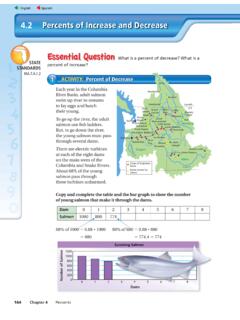
www.bigideasmath.comSection 4.2 Percents of Increase and Decrease 167 EXAMPLE 2 Finding a Percent of Decrease The bar graph shows a softball player’s home run totals. What was the percent of change from 2007 to 2008? The number of home runs decreased from 2007 to 2008.
Related documents
Decimals and Decimal Operations
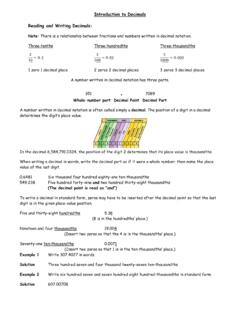
www.mcckc.eduMultiply: 2 decimal places Note: Two zeros must be inserted between the 2 and the decimal point so that there are 5 decimal places in the product. Multiplying by Powers of 10: To multiply a decimal by a power of 10 (10, 100, 1000, …), move the decimal point to the right the same number of places as there are zeros in the power of 10.
Grade 4 Multiplication Worksheet - Multiply in columns - 1 ...
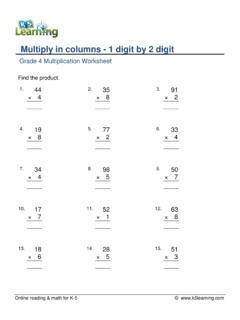
www.k5learning.comMultiply in columns - 1 digit by 2 digit Grade 4 Multiplication Worksheet Find the product. 1. 44 4 176 × 2. 35 8 280 × 3. 91 2 182 × 4. 19 8 152 × 5. 77 2 154 × 6. 33 4 132 × 7. 34 4 136 × 8. 98 5 490 × 9. 50 7 350 × 10. 17 7 119 × 11. 52 1 52 × 12. 63 8 …

Grade 5 Multiplication Worksheet - Multiply in columns -2 ...
www.k5learning.comMultiply in columns - 2 digit by 3 digit Grade 5 Multiplication Worksheet Find the product. 1. 257 × 50 2. 642 × 50 3. 517 × 82 4. 690 × 52 5. 942 × 17 6. 511 × 98 7. 748 × 50 8. 575 × 50 9. 902 × 78
Grade 3 Mathematics Vocabulary Word Wall Cards Table of ...
www.doe.virginia.govFraction: Models for two-thirds Fraction: Models for five-sixths Fraction: Models for three-eighths Numerator/Denominator Proper Fraction Improper Fraction Mixed Number Computation and Estimation Addition Subtraction Regroup/Rename Multiply: Product Multiplication: Set Model Multiplication: Array Model Multiplication: Area (array) Model
Two-Way Independent ANOVA - Discovering Statistics
www.discoveringstatistics.comand gender; to get any interaction term you simply multiply the variables involved. This is why you see interaction terms written as gender ´ alcohol, because in regression terms the interaction variable literally is the two variables multiplied by each other. For more detail about how all of the coding works read Field (2013), Chapters 10 and 12.
Sum of Two Sinusoids - dspGuru
dspguru.commeans multiply.) So, Eq. (5) tells us: the sum of two equal-frequency complex exponentials is merely a scalar magnitude factor multiplied by a unity-amplitude complex exponential term. Next we use Eq. (5) to obtain the expressions for the sum of two real-valued sinusoids. The Sum of Two Cosine Functions
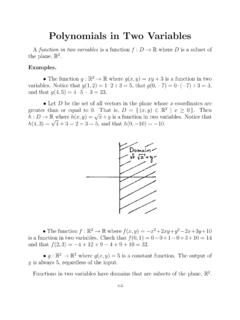
Polynomials in Two Variables - Math
www.math.utah.educan multiply any collection of numbers, and you can add any collection of numbers. There are no restrictions. The domain of any polynomial in two variables is the entire plane, R2. Coecients and terms If we have a polynomial such as p(x,y)=a2,0x 2 +a 1,1xy +a0,2y 2 +a 1,0x+a0,1y +a0,0 then we call a2,0x 2 the x2-term of p(x,y). Similarly, we ...

Steps for Solving Absolute Value Inequalities
www.everettcc.eduThere are two types of absolute value inequalities; Greater than (Or statements) and less than (And statements). All an absolute value inequality does is talk about the distance away from zero so when working with these inequalities you have two methods depending on whether it is a less than statement or a greater than statement

Chapter 5 - Benthic Macroinvertebrates - Indiana
www.in.govTwo to three people work together to perform the method. Carefully read the procedures, and follow them as closely as possible. 1. Locate a “typical riffle.” Such a riffle is a shallow, fast moving mud-free section of stream with a stream