Transcription of 2011 Edition - Pima County
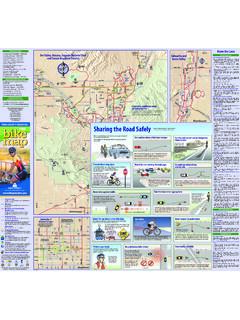
1 Pima Co u nty Bicycl e and Pe d estrian Pro gramTucso n - Pima Co u nty Bicycl e Adviso ry Co m mitte eCity o f Tucso n D epartm ent o f Transpo rtatio nPima As so ciatio n o f Govern m ents2011 EditionA Guide for Bicyclists & MotoristsThis pocket guide has been prepared to illustrate how bicyclists and motorists can Share the Road legally and safely within Pima County . Please take a moment to read through these safety tips to get a better understanding of the other person s view of the road and to learn more about cycling and driving more safely in our great more we understand each other s needs, the better we can respect and cooperate with each other on the fourth Edition of the bicyclist and motorist pocket guide has been brought to you by the Pima County Department of Transportation Bicycle and Pedestrian Program.
2 Funding for this guide has been provided by the Department of Trans-portation and Pima the Road Legally and SafelyThe Tucson-Pima County Bicycle Advisory Com-mittee, the Tucson Department of Transportation, and the Arizona Department of Transportation have also provided generous support in the development of this special thanks is due for PAG Regional Trans-portation Authority (RTA) funding and Federal Transportation Enhancements and other local and state funding sources that have been instrumental in the development of bicycle facilities throughout the Tucson-Eastern Pima County , illustration and photography were provided by the Pima County Graphic Services refer to pages 44 through 55 for a listing of relevant Arizona revised Statutes ( ) and local laws pertaining to the operation of bicycles and motor respect to othersBe polite and be smart.
3 Show respect for all users of the road, and you ll get respect back as a and Drivers: Same roads, same rules, same rights and I C Y C L I S T SWear white or brightly colored shirts and consider reflective clothing for nighttime use. A white front headlight and red rear reflector are required on your bike if you ride at night. ( 28-817). You should also use a red rear I C Y C L I S T S3 Riding without a headlight at night could get you a fine of $115!According to national studies, 85% of brain injuries can beprevented by wearing a County and City of Tucson laws require all bicyclists under the age of 18 to wear a yourself4B I C Y C L I S T SHelmet and bicycle mirrors can improve your overall awareness and allow you to see following vehicles.
4 However, all mirrors have blind spots, so always scan over your shoulder before changing your line of travel or before making a left Word About Stop Signs Arizona traffic law defines a stop as Stop, if required, means complete cessation from movement. While bicyclists are required to stop at stop signs, it is not necessary to put your foot on the ground to comply with the stop signs on major streets is dangerous and can result in a fine of $212 with points added to your driver s through stop signs sets a bad example for younger riders and hurts the image of all I C Y C L I S T S5 Watch for cars turning through gapsRiding too fast past a line of stopped cars can get you clobbered. When passing a line of vehicles SLOW DOWN AND BE ALERT, especially near driveway entrances.
5 Motorists often can t see past the line of vehicles and won t know you re I C Y C L I S T SBe polite and be smartUse hand signals to show your intentions and ride in a predictable fashion ( 28-756).ORTurningleftRemember, the laws are there to make it safer for I C Y C L I S T S7 Watch ahead for hazardous railroad tracks. Look behind you to make sure it s safe, signal your intentions, then cross tracks as close to a right angle as possible ( 28-815).Cross tracks carefully8B I C Y C L I S T SRide on the right with the flow of traffic NEVER ride against traffic on the road, in a bike lane, or on a sidewalk. Drivers turning from the side cannot see you, and approaching drivers will not expect you to be riding the wrong way ( 28-815).
6 Never ride against trafficNEVER!NEVER!ALWAYS!B I C Y C L I S T S9 Take the lane whenappropriateRemember that you may take the lane if the lane is not wide enough for both a car and bike to safely share ( 28-815). Check behind to make sure it s safe, signal your intentions, and take the lane by riding 1/3 to 1/2 of the way into the lane. When safe and possible, move to the right to allow a following vehicle to out for glass, grates, loose gravel, cattle guards, and oily I C Y C L I S T SRiding in bus/bike lanesWhen using the bus/bike lanes, ride near the center of the lane to make yourself as visible as possible. When approaching an intersec-tion, move to the left before proceeding through. Bus drivers are required to pass cyclists outside of the bus/bike I C Y C L I S T S11 Crosscattleguards carefullyBe sure to watch for gaps be-tween the grates parallel to your direction of travel.
7 These can cause a serious crash. The edge of the cattleguard my also be higher or lower than the road surface. Be especially careful if the cattleguard is wet and is in a corner or approaching a stop sign. Watch outfor gaps!12B I C Y C L I S T SBe cautious when riding two abreastRiding two abreast is permitted by law ( 28-815). You can help drivers pass on two-lane roadways without bike lanes by riding single-file when safe to do so (stay at least 2 to 3 feet from the edge of the road). It s always nice to give a friendly wave when drivers pass safely. B I C Y C L I S T S13Be careful when riding by parked carsLook for people in parked cars ahead of you and ride in a straight line at least 5 feet away from the car. Someone may open the car door unexpectedly.
8 Be predictable: don t weave in and out between parked I C Y C L I S T SB I C Y C L I S T S15On a shared pathway reduce speeds when approaching pedestri-ans, give a verbal warning such as Passing! when you re about to pass, and provide at least 5 feet of passing distance. Remember! The pedestrian you treat well on the pathway may be the driver who treats you well when you re riding on the pedestriansBicycle bells are a polite way to alert people to your presence!5 ft. I C Y C L I S T SYou may make a left turn like a vehicle by looking over your shoulder, signaling, and moving into the left turn lane when it s safe ( 28-815). You may make a left turn by going to the far side of the intersection, turning your bike and using the may make a left turn by going to the far side of the intersection, turning your bike, and using the legal ways to turn left123B I C Y C L I S T S17 Ways to ride a roundaboutStay right to makethe first right to the left ifyou are going to the inside lane if you are making a left turn or can exit the roadway on the bike ramp and cross at the to traffic already in the roundabout!
9 18B I C Y C L I S T SAll of the laws that apply to bicycles also apply to motorized bikes, which can be either gas powered or electric. Motorized bikes may have a motor that has a maximum size of 48cc. You must be at least 16 years old to drive a motorized bicycle. Riders and passengers under the age of 18 are required to wear a certified bicycles may be ridden in bike lanes as long as themotorized bicycle operates at amaximum allowable speedof 20 miles per bikes and the lawB I C Y C L I S T S19Be a defensive bike driver Be aware of your surroundings and especially ofturning and side traffic. Make eye contact with drivers and be sure to get their attention. Even with eye contact the person may not really see you or realize the speed you are going, so be prepared!
10 20B I C Y C L I S T SWhen a bike lane mergesUse extreme caution when merging across right turn only/drop lanes. These lanes can be dangerous for bicyclists. Well before the intersection, scan over your left shoulder and signal your intentions to merge left across the lane. Always watch for fast moving drivers who may not see over leftshoulder and signalB I C Y C L I S T S21 Headphones and cell phones cause distraction and reduce your ability to hear traffic, which could cost you your life. Don t use any kind of headphones or a cell phone when riding your attention22B I C Y C L I S T SWatch for oncoming carsPrepare for an emergency exit off the roadway!B I C Y C L I S T S23 When riding on narrow, two-lane roads, always be on the lookout for oncoming cars attempting to pass.