Transcription of 26 Expand Inferences and Conclusions
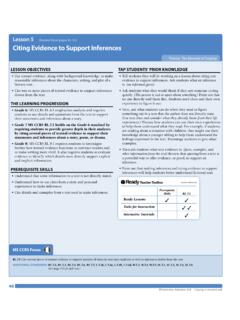
1 Perfection Learning All rights An inference is a guess that a reader makes by combining details from a text and personal knowledge. A reader makes an inference about what is happening. A conclusion is a judgment about what something means based on facts and details. 26 Inferences and Conclusions The audience applauded as Yolanda walked onto the stage with her violin. She did not fi dget while the pianist found the correct page of the score. Yolanda squinted into the bright lights of the auditorium. She couldn t see her parents and friends, but she knew they were there supporting her. After a few rippling notes sounded on the piano, Yolanda began to play. Her bow glided across the strings as if it had a mind of its , use details and personal knowledge to make an inference .
2 Finally, put the facts together to draw a conclusion about the passage. Remember: As you read, think about the details that the author presents. Compare them with what you already know about the subject or setting. Use your knowledge to make an inference or draw a conclusion about what is happening in the , decide what is happening in the passage. Look for details that set the 346/4/08 1:39:50 PM6/4/08 1:39:50 PMComprehension Strategy Assessment Grade 6 2006 Benchmark Education Company, LLC82 For centuries, Native Americans of the Great Plains relied on wild buffaloherds for their food, shelter, and tools. In 1865, more than 12 million buffalolived on the Great Plains. But then more and more settlers moved west. By 1890,most of these animals were gone. There were only 750 buffalo left.
3 Fortunately,the number of buffalo has grown since then. The animal that we call buffalo is also called American bison. Today thereare about 80,000 of these big, shaggy animals in the United States. They livein parks and reserves. One herd of free-ranging buffalo lives in YellowstoneNational Park. Free-ranging means that the animals are allowed to roam throughout the park. This is their natural way of life. Many people hope thatthis herd will continue to grow. Some cattle ranchers who live near Yellowstone do not like having the buffalothere. They worry that the buffalo could come onto their land and make theircattle sick. Because of this, the government has slaughtered more than 3,500buffalo. But many people do not believe the buffalo can actually pass diseases to cattle.
4 In 2003, a law was passed to make it harder for the government to kill buffalo once were the center of many Native Americans way of life. Theywere the source of most of the things that these Native Americans needed to the buffalo is important. It preserves part of our natural : Read the passage. Then use the information from the passageto answer questions 1 the Buffalo RoamOngoing Comprehension Strategy Assessment 23 Name_____ Date_____ 2006 Benchmark Education Company, LLCC omprehension Strategy Assessment Grade 6831. You can infer that buffalo live in parks and reserves so that will not have to travel muchoBthey have protection while their numbers growoCit is easier for people to see themoDthey do not hurt people who want to watch them2. You can infer that millions of buffalo disappeared in the late 1800s because Americans hunted themoBthey caught a disease from cattleoCherds of buffalo moved awayoDthey were killed by are there more buffalo now than there were in 1890?
5 The third paragraph of this passage, you can tell that people thought the government was wrong to slaughter buffalooBranchers value the buffalo herd more than their own cattleoCthousands of buffalo have been moved away from YellowstoneoDthe buffalo carry diseases that can be harmful to humans would cattle ranchers living near Yellowstone National Park disagreewith the last two sentences in the passage?_____Name_____ Date_____Comprehension Strategy Assessment Grade 6 2011 Benchmark Education Company, LLC84 Most people have heard of the Nobel Prizes. Some of the most talented people in the world receive these prizes, which honor great achievements in medicine, chemistry, and other fields. But not many people have heard of the Ig Nobel Prizes. The name is a pun on the word ignoble.
6 These prizes are given to people who do very strange work and whose studies might even be called a little goofy. The prizes were first given out in 1991, and they get more popular every year. All the prize winners were serious about their work when they did it. It s just that the subjects they studied were a little odd. For example, one prize went to two scientists in Norway who discovered that sour cream makes leeches hungry. Another scientist studied toast because he wanted to know if it always lands butter side down when you drop it. Another prize went to the country of Liechtenstein for offering to rent the entire country out for weddings! The Ig Nobel Prize ceremony is held at Harvard University in Massachusetts every October. Sometimes the people who receive the prizes aren t too happy about it, but usually they are good sports.
7 Often they have to travel a very long way to get their prizes. When they receive them, they give a speech, but they can only speak for one minute. If they talk longer than that, they are booed. The Ig Nobel Prizes are kind of silly, but they have a somewhat serious goal of trying to encourage real science. Above all, they prove that science can be fun. One winner came up with a new way for men to comb their hair. Another one studied how tadpoles taste when you eat them. No matter what the subject, these prizes show the lighter side of : Read the passage. Then use the information from the passage to answer questions 1 Science PrizesOngoing Comprehension Strategy Assessment 24 Name _____ Date _____ 2011 Benchmark Education Company, LLC Comprehension Strategy Assessment Grade 6851.
8 You can tell from this passage that the word ignoble probably means not nobleB like a noble personC very nobleD in a noble way2. The third paragraph says that the people who receive an Ig Nobel Prize aren t always too happy about it. What is the most likely reason for that?A They have to stop their important work to go to They don t want to be They are embarrassed because the prizes poke fun at They are afraid someone will copy their What is one thing that all the work done by these prize winners has in common?A It is extremely It is meant to improve It is all done by It is kind of The second paragraph mentions leeches. How can you tell from the paragraph that a leech is a kind of animal instead of a rock? _____ _____5. Do you think most scientists would rather get a Nobel Prize or an Ig Nobel Prize?
9 Tell why you think so. _____ _____Name _____ Date _____ Paired Texts, pp. 10-13 Happy CampersTwo articles show ways people help kids with cancerStep-by-Step Lesson PlanClose Reading, Critical Thinking, and Skill Building 2. Close ReadingRead and Unpack the Text (25 minutes) Have students read Happy Campers as a class, pausing to discuss questions that arise with each section. Then ask students to read the informational text Bald Heads Raise Big Bucks in small groups. Groups should then answer the close-reading and critical-thinking questions, rereading the text to find answers. Close-Reading Questions(activity sheet online) Reread the first four paragraphs, comparing the first three with the fourth. What is the 2 Lesson1. Preparing to Read Preview vocabulary (10 minutes, activity sheet online) Project or distribute the vocabulary activity to preview the highlighted words, which have to do with illness and treatment.
10 Highlighted words: chemotherapy, donations, thrive, chronic, diagnosed, health insuranceSet a Purpose for Reading (5 minutes) Have students study the text features, including the headline, captions, and especially the pictures. Ask them to discuss in small groups what mood the text features create. Have a volunteer read aloud the Up Close box on page 10. Featured Skill:Making Inferences Preview: Children battling cancer need more than medical interventions. These articles demonstrate how the empathy of others helps too. Learning Objective: Students will infer how people have shown empathy for kids with cancer, and how empathy helps such children and their families. Content-Area Connections: Science: health; social issues Other Key Skills: vocabulary, text features, mood, close reading, author s craft, problem and solution, text evidence, key detail, evaluating, explanatory writing T5 NOVEMBER/DECEMBER 2014 MINH UONG author trying to accomplish in the first three?