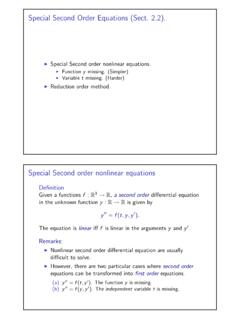
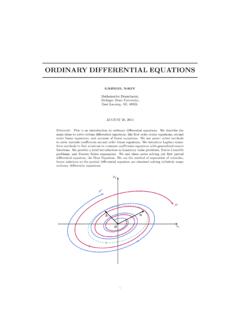
Transcription of 5.1 The Remainder and Factor Theorems.doc; Synthetic Division
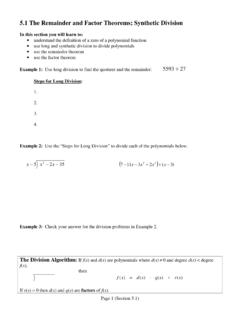
1 The Remainder and Factor Theorems; Synthetic Division In this section you will learn to: understand the definition of a zero of a polynomial function use long and Synthetic Division to divide polynomials use the Remainder theorem use the Factor theorem Example 1: Use long Division to find the quotient and the Remainder : 5593 27. Steps for Long Division : 1. 2. 3. 4. Example 2: Use the Steps for Long Division to divide each of the polynomials below. x 5 x 2 2 x 35 (7 11x 3x 2. ). + 2 x 3 ( x 3). Example 3: Check your answer for the Division problems in Example 2. The Division Algorithm: If f(x) and d(x) are polynomials where d(x) 0 and degree d(x) < degree f(x), then f ( x ) = d ( x ) q ( x) + r ( x ).
2 If r(x) = 0 then d(x) and q(x) are factors of f(x). Page 1 (Section ). Example 4: Perform the operation below. Write the Remainder as a rational expression ( Remainder /divisor). 2 x 5 8x 4 + 2x 3 + x 2. 2x3 + 1. Synthetic Division Generally used for short Division of polynomials when the divisor is in the form x c. (Refer to page 506 in your textbook for more examples.). Example 5: Use both long and short ( Synthetic ) Division to find the quotient and Remainder for the problem below. (2 x 3 11x + 7) ( x 3). x3 + 8. Example 6: Divide using Synthetic Division . x+2. Example 7: Factor x 3 + 8 over the real numbers. (Hint: Refer to Example 6.). Page 2 (Section ). Remainder Theorem Factor Theorem If the polynomial f(x) is divided by (x c), then the Let f(x) be a polynomial.
3 Remainder is f(c). If f(c) = 0, then (x c) is a Factor of f(x). If (x c) is a Factor of f(x), then f(c) = 0. If ( x c) is a Factor of f (x) or if f (c) = 0, then c is called a zero of f (x). Example 8: f ( x) = 3 x 3 + 4 x 2 5 x + 7 . Find f ( 4) using (a) Synthetic Division . (b) the Remainder Theorem. Example 9: Solve the equation 2 x 3 3 x 2 11x + 6 = 0 given that -2 is a zero of f ( x) = 2 x 3 3 x 2 11x + 6 . Page 3 (Section ). Homework Problems: For Problems 1-5, use long Division to find each quotient, q (x) , and Remainder , r (x) . 1. ( x 2 2 x 15) ( x 5) 2. ( x 3 + 5 x 2 + 7 x + 2) ( x + 2). x 4 81 18 x 4 + 9 x 3 + 3 x 2. 3. (6 x 3 + 7 x 2 + 12 x 5) (3 x 1) 4. 5. x 3 3x 2 + 1. For Problems 6 11, divide using Synthetic Division .
4 6. (2 x 2 + x 10) ( x 2) 7. (5 x 3 6 x 2 + 3 x + 11) ( x 2) 8. ( x 2 5 x 5 x 3 + x 4 ) (5 + x). x 7 + x 5 10 x 3 + 12 x 4 256 x 5 2 x 4 x 3 + 3x 2 x + 1. 9. 10. 11. x+2 x 4 x 2. For Problems 12 16, use Synthetic Division and the Remainder Theorem to find the indicated function value. 12. f ( x) = x 3 7 x 2 + 5 x 6; f (3) 13. f ( x) = 4 x 3 + 5 x 2 6 x 4; f ( 2). 1 2 . 14. f ( x) = 2 x 4 5 x 3 x 2 + 3 x + 2; f 15. f ( x) = 6 x 4 + 10 x 3 + 5 x 2 + x + 1; f . 2 3 . 16. Use Synthetic Division to divide f ( x) = x 3 4 x 2 + x + 6 by x + 1. Use the result to find all zeros of f. 17. Solve the equation 2 x 3 5 x 2 + x + 2 = 0 given that 2 is a zero of f ( x) = 2 x 3 5 x 2 + x + 2. 3. 18. Solve the equation 12 x 3 + 16 x 2 5 x 3 = 0 given that is a zero (root).
5 2. Homework Answers: 1. q ( x) = x + 3 2. q ( x) = x 2 + 3 x + 1 3. q ( x) = 2 x 2 + 3 x + 5. 4. q ( x) = x 3 + 3 x 2 + 9 x + 27 5. q ( x) = 6 x 2 + 3 x 1; r ( x) = 3 x + 1 6. q ( x) = 2 x + 5. 7. q ( x) = 5 x 2 + 4 x + 11; r ( x) = 33 8. q ( x) = x 3 10 x 2 + 51x 260; r ( x) = 1300. 9. q ( x) = x 6 2 x 5 + 5 x 4 10 x 3 + 10 x 2 20 x + 40; r ( x) = 68 10. q ( x) = x 3 + 4 x 2 + 16 x + 64. 7. 11. q ( x) = x 4 x 2 + x + 1; r ( x) = 3 12. 27 13. 4 14. 1 15. 9. 1 3 1 1 . 16. x 2 5 x + 6; x = 1, 2, 3 17. , 1, 2 18. , , . 2 2 3 2 . Page 4 (Section ). Roots of Polynomial equations In this section you will learn to: find zeros of polynomial equations solve polynomial equations with real and imaginary zeros find possible rational roots of polynomial equations understand properties of polynomial equatins use the Linear Factorization Theorem Zeros of Polynomial Functions are the values of x for which f (x) = 0.
6 (Zero = Root = Solution = x-intercept (if the zero is a real number)). Example 1: Consider the polynomial that only has 3 and as zeros. (a) How many polynomials have such zeros? (b) Find a polynomial that has a leading coefficient of 1 that has such zeros. (c) Find a polynomial, with integer coefficients, that has such zeros. If the same Factor (x r) occurs k times, then the zero r is called a zero with multiplicity k. Even Multiplicity Graph touches x-axis and turns around. Odd Multiplicity Graph crosses x-axis. Example 2: Find all of the (real) zeros for each of the polynomial functions below. Give the multiplicity of each zero and state whether the graph crosses the x-axis or touches (and turns at) the x-axis at each zero.
7 Use this information and the Leading Coefficient Test to sketch a graph of each function (a) f ( x) = x 3 + 2 x 2 4 x 8 (b) f ( x) = x 4 + 4 x 2 (c) g ( x) = x 4 + 4 x 3 4 x 2. Page 1 (Section ). The rational Zero Theorem: If f ( x) = a n x n + a n 1 x n 1 + ..a 2 x 2 + a1 x + a 0 has integer coefficients p and (reduced to lowest terms) is a rational zero of f , then p is a Factor of the constant term, a 0 , q and q is a Factor of the leading coefficient, a n . Example 3: List all possible rational zeros of the polynomials below. (Refer to rational Zero Theorem on Page 1 of this handout.). (a) f ( x) = x 5 + 7 x 2 12 Possible rational Zeros: _____. (b) p ( x) = 6 x 3 8 x 2 8 x + 8 Possible rational Zeros: _____.
8 Example 4: Find all zeros of f ( x) = 2 x 3 5 x 2 + x + 2 . Example 5: Solve x 4 8 x 3 + 64 x 105 = 0. Page 2 (Section ). Linear Factorization Theorem: If f ( x) = a n x n + a n 1 x n 1 + ..a 2 x 2 + a1 x + a 0 , where n 1 and an 0, then f ( x) = a n ( x c1 )( x c 2 ).. ( x c n ) , where c1 , c 2 , c3 , ..c n are complex numbers. Example 6: Find all complex zeros of f ( x) = 2 x 4 + 3 x 3 + 3 x 2, and then write the polynomial f (x) as a product of linear factors. f (x) = _____. Properties of Polynomial equations : Given the polynomial f ( x) = a n x n + a n 1 x n 1 + ..a 2 x 2 + a1 x + a 0 . 1. If a polynomial equation is of degree n, then counting multiple roots (multiplicities) separately, the equation has n roots.
9 2. If a + bi is a root of a polynomial equation ( b 0 ), then the imaginary number a bi is also a root. In other words, imaginary roots, if they exist, occur in conjugate pairs. Example 7: Find all zeros of f ( x) = x 4 4 x 2 5 . (Hint: Use factoring techniques from Chapter 1.). Write f (x) as a product of linear factors. f (x) = _____. Page 3 (Section ). Example 8: Find a third-degree polynomial function, f (x ) , with real coefficients that has 4 and 2i as zeros and such that f ( 1) = 50. Step 1: Use the zeros to find the factors of f (x). Step 2: Write as a linear factorization, then expand/multiply. Step 3: Use f ( 1) = 50 to substitute values for x and f (x). Step 4: Solve for a n . Step 5: Substitute a n into the equation for f (x) and simplify.
10 Step 6: Use your calculator to check. Page 4 (Section ). Homework Problems: For Problems 1 4, use the rational Zero Theorem to list all possible rational zeros for each function. 1. f ( x) = x 3 + 3 x 2 6 x 8 2. f ( x) = 2 x 4 + 3 x 3 11x 2 9 x + 15. 3. f ( x) = 3 x 4 11x 3 3 x 2 6 x + 8 4. f ( x) = 4 x 5 8 x 4 x + 2. For Problems 5 8, find the zeros for the given functions. 5. f ( x) = x 3 2 x 2 11x + 12 6. f ( x) = 2 x 3 5 x 2 + x + 2. 7. f ( x) = 2 x 3 + x 2 3 x + 1 8. f ( x) = x 3 4 x 2 + 8 x 5. For Problems 9 12, solve each of the given equations . 9. x 3 2 x 2 7 x 4 = 0 10. x 3 5 x 2 + 17 x 13 = 0. 11. 2 x 3 5 x 2 6 x + 4 = 0 12. x 4 2 x 2 16 x 15 = 0. For Problems 13-16, find an nth degree polynomial function, f (x) , with real coefficients that satisfies the given conditions.