Transcription of 5. INSULATION AND REFRACTORIES
1 5. INSULATION AND REFRACTORIES120 Bureau of Energy EfficiencySyllabus INSULATION and REFRACTORIES : INSULATION -types and application, Economic thickness of INSULATION , Heat savings and application criteria, Refractory-types, selection and application of REFRACTORIES , Heat Purpose of InsulationA thermal insulator is a poor conductor of heat and has a low thermal conductivity. Insulationis used in buildings and in manufacturing processes to prevent heat loss or heat gain. Althoughits primary purpose is an economic one, it also provides more accurate control of processtemperatures and protection of personnel.
2 It prevents condensation on cold surfaces and theresulting corrosion. Such materials are porous, containing large number of dormant air INSULATION delivers the following benefits: Reduces over-all energy consumption Offers better process control by maintaining process temperature. Prevents corrosion by keeping the exposed surface of a refrigerated system above dewpoint Provides fire protection to equipment Absorbs Types and ApplicationThe INSULATION can be classified into three groups according to the temperature ranges for whichthey are Temperature Insulations (up to 90 C)This range covers insulating materials for refrigerators, cold and hot water systems, storagetanks, etc.
3 The commonly used materials are Cork, Wood, 85% magnesia, Mineral Fibers,Polyurethane and expanded polystyrene , Temperature Insulations (90 325 C)Insulators in this range are used in low temperature, heating and steam raising equipment, steamlines, flue ducts etc. The types of materials used in this temperatures range include 85%Magnesia, Asbestos, Calcium Silicate and Mineral Fibers Temperature Insulations (325 C above )Typical uses of such materials are super heated steam system, oven dryer and furnaces etc. Themost extensively used materials in this range are Asbestos, Calcium Silicate, Mineral Fibre,Mica and Vermiculite based INSULATION , Fireclay or Silica based INSULATION and Ceramic Fibre.
4 2/23/2005 10:45 AM Page 1215. INSULATION & Refractories121 Bureau of Energy EfficiencyInsulation materialInsulation materials can also be classified into organic and inorganic types. Organic insulationsare based on hydrocarbon polymers, which can be expanded to obtain high void structuresExample:Thermocol ( expanded polystyrene ) and Poly Urethane Form(PUF).Inorganic INSULATION is based on Siliceous/Aluminous/Calcium materials in fibrous, granular orpowder :Mineral wool, Calcium silicate of common insulating materials are as under:Calcium Silicate:Used in industrial process plant piping where high service temperature andcompressive strength are needed.
5 Temperature ranges varies from 40 C to 950 mineral wool:These are available in flexible forms, rigid slabs and preformed pipe worksections. Good for thermal and acoustic INSULATION for heating and chilling system range of application is 10 to 500 :These are mainly used as cold INSULATION for piping and cold storage nitrile rubber:This is a flexible material that forms a closed cell integral vapour barrier. Originally developed for condensation control in refrigeration pipe work and chilled waterlines; now-a-days also used for ducting INSULATION for air mineral wool:This is available in a range of forms from light weight rolled products to heavy rigid slabs including preformed pipe sections.
6 In addition to good thermal INSULATION properties, it can also provide acoustic INSULATION and is fire of Moulded InsulationLagging materials can be obtained in bulk, in the form of moulded sections; semi - cylindrical forpipes, slabs for vessels, flanges, valves etc. The main advantage of the moulded sections is the easeof application and replacement when undertaking repairs for damaged thermal conductivityof a material is the heat loss per unit area per unit INSULATION thicknessper unit temperature difference. The unit of measurement is W-m2/m C or W-m/ C. The thermalconductivity of materials increases with temperature.
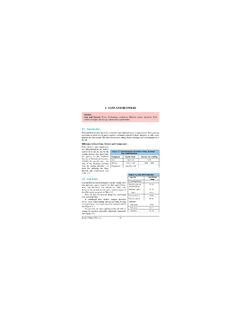
7 So thermal conductivity is always specifiedat the mean temperature (mean of hot and cold face temperatures) of the INSULATION material. Calcium silicate sections Glass Mineral wool Figure 2/23/2005 10:45 AM Page 1225. INSULATION & Refractories122 Bureau of Energy EfficiencyThermal conductivities of typical hot and cold INSULATION materials are given in Table andTable Calculation of INSULATION ThicknessThe most basic model for INSULATION on a pipe is shownin Figure r1 show the outside radius of the pipe r2shows the radius of the Pipe+ loss from a surface is expressed asH = h X A x (Th Ta)Whereh = Heat transfer coefficient, W/m2 KH = Heat loss, WattsFigure Pipe InsulationTABLE THERMAL CONDUCTIVITY OF HOTINSULATIONTABLE THERMAL CONDUCTIVITY OF 2/23/2005 10:45 AM Page 1235.
8 INSULATION & Refractories123 Bureau of Energy EfficiencyTa = Average ambient temperature, CTs = Desired/actual INSULATION surface temperature, CTh = Hot surface temperature (for hot fluid piping), C & Cold surface temperature forcold fluids piping)For horizontal pipes, heat transfer coefficient can be calculated by:h = (A + (Th Ta)) 10 W/m2-KFor vertical pipes,h = (B + ( Th Ta)) 10 W/m2-KUsing the coefficients A, B as given = Thermal conductivity of INSULATION at mean temperature of Tm, W/m- Ctk = Thickness of INSULATION , mmr1 = Actual outer radius of pipe, mmr2 = (r1 + tk)The heat flow from the pipe surface and the ambient can be expressed as follows:From the above equation, and for a desired Ts, Rl can be calculated.
9 From Rl and known valueof thermal conductivity k, thickness of INSULATION can be (r +t )Equivalent thickness of INSULATION for p ipe, E = (r +t ) lnr hasalssH = Heat flow, Watts(TT )(TT ) = =(RR )R +k2ltR Thermal resistance of INSULATION = C m / Wk=o2s1 RSurface thermal resistance = C m / Wh=ohsm(TT )T2+= 2/23/2005 10:45 AM Page 1245. INSULATION & Refractories124 Bureau of Energy Economic Thickness of INSULATION (ETI) INSULATION of any system means capital expenditure. Hence the most important factor in anyinsulation system is to analyse the thermal INSULATION with respect to cost.
10 The effectiveness ofinsulation follows the law of decreasing returns. Hence, there is a definite economic limit to theamount of INSULATION , which isjustified. An increased thicknessis uneconomical and cannot berecovered through small heat savings. This limiting value istermed as economic thickness ofinsulation. An illustrative case isgiven in Figure Each industryhas different fuel cost and boilerefficiency. These values can beused for calculating economicthickness of INSULATION . Thisshows that thickness for a givenset of circumstances results in thelowest overall cost of insulationand heat loss combined over a given period of time.