Transcription of A Frequency Standard for Today’s WWVB
1 QEX November/December 2015 13 John A. Magliacane, KD2BD1320 Willow Drive, Sea Girt, NJ 08750; Frequency Standard for today s WWVBThe author shares the design of his Frequency Standard that s fully compatible with today s WWVB. For over a half century, the 60 kHz carrier from WWVB has served as a popular and highly respected Frequency reference among many scientific, research, and engineering professionals across North America. As GPS-disciplined Frequency standards started gaining in popularity, the use of WWVB in Frequency reference applications began to decline. With this decline, however, came a tremendous increase in the sale and appli-cation of low-cost radio controlled atomic clocks that receive time and date informa-tion from WWVB on a regular basis.
2 This drastic shift in the use of WWVB by the American public forced a realignment of the priorities set for the station by the National Institute of standards and Technology (NIST).With the rapid proliferation of radio-con-trolled clocks came a realization that recep-tion of the WWVB time code by low-cost consumer products was often unreliable. In the eastern United States where signals from the Fort Collins, Colorado WWVB transmit-ter are often the weakest, competition from high noise levels and co-channel interference from British radio station MSF made recep-tion especially difficult. Enhancements were made to the WWVB effective radiated power and modulation depth, but reception dif-ficulties continued to persist.
3 Finally, when attempts to commission a second WWVB transmitter to serve the east coast failed to reach fruition by the end of 2009, thoughts turned toward making more aggressive changes to WWVB broadcasts that would help improve reception reliability while maintaining compatibility with the millions of radio-controlled clocks already in Modulation FormatNIST realized that only through a radi-cal change in time code transmission and greater sophistication in receiving techniques would any further improvement in recep-tion reliability be achieved. They decided to add a new time code to the WWVB car-rier, modulated by means of binary phase shift keying (BPSK), that next generation radio-controlled clocks could be designed to receive and process with improved reliability.
4 While over-the-air tests conducted in 2012 revealed that the addition of the new BPSK time code had little or no effect on the opera-tion of existing radio-controlled clocks, it Figure 1 The author s very successful Frequency Measuring Test results are achieved by using WWVB as a precision Frequency QEX November/December 2015caused every WWVB-disciplined Frequency Standard to lose phase reference with the WWVB carrier, and thus malfunction. With GPS-based Frequency standards in wide use and rising steadily in popularity, and com-mercial WWVB-based Frequency standards out of production for years, NIST decided to permanently add its new BPSK time code to WWVB broadcasts beginning on October 29, 2012, and force all previously function-ing WWVB-disciplined Frequency standards into this WWVB priority shift toward application in consumer products, and away from the scientific and engineering com-munities, the WWVB carrier Frequency is maintained to within one part in 1014, and continues to be derived from a set of four cesium As such, provided that BPSK compatible reception techniques are employed.
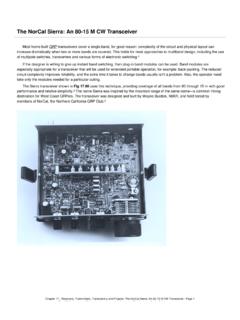
5 Radio station WWVB can con-tinue to serve as a reliable and accurate fre-quency reference, and can do so with a level of precision that far exceeds that of its time BPSK-Compatible Frequency StandardThe Frequency Standard described here employs a combination of linear signal processing, vector demodulation, and super-heterodyne receiving techniques to not only discipline a 10 MHz voltage-controlled, temperature-compensated crystal oscilla-tor (VCTCXO) against the WWVB carrier, but also decode its amplitude modulated time code. A wide variety of calibration signals are available to the user, while an LCD display provides NIST (UTC) date, time, and UT1 offset information. Several audio outputs are provided to help assess reception quality and assist in selecting an optimum antenna placement and orientation.
6 An RS-232 port is also included to provide UTC time and date information to external stability and accuracy of a Frequency Standard are difficult to assess and quantify without making a direct comparison against another Standard of superior precision. Even while lacking a second Standard , however, some conclusions can be drawn based on the performance a Frequency Standard dem-onstrates while being employed in critical applications over the course of many years. For example, the results achieved while employing this Frequency Standard dur-ing Frequency Measuring Tests over the past decade have consistently equaled or surpassed those of most other participants, many of whom employ advanced digital signal processing techniques, commercial GPS-disciplined Frequency standards , rubid-ium oscillators, and other laboratory grade Figure 2 The author s FMT methodology applies a DC tuning voltage to the local oscillator of a direct conversion receiver to lock its audio output in phase with that of a 1 kHz reference.
7 The Frequency of the unknown signal is determined by measuring the Frequency of the LO and factoring in the 1 kHz tuning kHzFrequencyStandardFrequencyDividerVFOF requencyCounter1 kHz1 3 Space and Naval Warfare Systems (SPAWAR) Command computer simulations illustrate how the WWVB 100 mV/m signal level contours contract during the day and expand during nighttime hours. (Images from NIST website.) QEX November/December 2015 15 instrumentation. Figure 1 shows a certificate I received for my participation in the April 2014 the influence of ionospheric pertur-bations and inaccuracies in Frequency mea-surement methodologies are often the largest consistent sources of error in FMTs, these results alone cannot speak to the full per-formance of this Frequency Standard .
8 Using the identical hardware and methodology as those employed in FMTs (Figure 2), I mea-sured the carrier frequencies of many AM broadcast stations received over ground wave paths to a resolution of microhertz (less than one part per billion at 1 MHz). During the process, several transmitters were identi-fied as consistently having no measurable Frequency error, some of which are known to employ GPS-disciplined rubidium fre-quency standards for carrier generation. I believe that transmitters exhibiting very small but measurable Frequency offsets were likely rubidium controlled but not necessar-ily GPS-locked, while others that exhibited larger errors that varied over time might have simply been crystal the GPS-disciplined radio station carriers stood out so clearly among all other stations measured, it follows that the accu-racy and stability of this Frequency Standard probably exceeds the resolution of the mea-surements taken.
9 In fact, they are possibly several orders of magnitude better based on the known precision to which the WWVB carrier Frequency is maintained, and the rec-ognized RF propagation characteristics that exist at low kHz PropagationLF radio propagation is substantially different from that which exists at higher frequencies. Its remarkable stability and reli-ability have often led to the belief that 60 kHz signals propagate great distances over ground wave paths alone. In reality, a combination of surface wave and D-layer ionospheric paths are responsible for WWVB signal propaga-tion. At night, cosmic background radiation supports a level of D-layer ionization that is sufficient for propagating LF (and lower Frequency ) radio signals over long Greater D-layer efficiencies and increased effective height with decreased ionization levels contribute to greater signal coverage during the nighttime hours.
10 See Figure shifts in the height of the D-layer cause changes in the RF path length between WWVB and receivers to occur during the time the RF path undergoes sunrise and sunset transitions. While the accompany-ing Doppler shifts during these periods are generally small, their effects are cyclic and predictable, and can be handled using a priori knowledge. Long-term Frequency accura-cies very closely approaching those of the WWVB transmitted carrier Frequency can be achieved by integrating the diurnal perturba-tions over a day or Signal CharacteristicsWith rare exception, WWVB broadcasts 24 hours a day with a peak envelope effec-tive radiated power of 70 kW. The beginning of every UTC second is identified by a 17 dB reduction in radiated power.