Transcription of AC 120-17B - Reliability Program Methods—Standards for ...
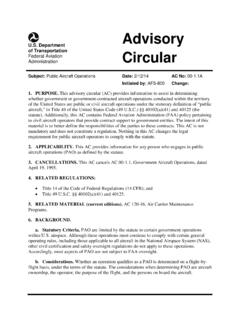
1 Department of Transportation Federal Aviation Administration Advisory Circular Subject: Reliability Program Methods Standards for Determining Time Limitations Date: 12/19/18 AC No: 120-17B Initiated by: AFS-300 Change: This advisory circular (AC) provides guidance for developing and maintaining a Reliability Program as part of a Continuous Airworthiness Maintenance Program (CAMP). The guidance includes information for: Collecting and analyzing operational data, Developing operational performance standards, Identifying and correcting deficiencies, A Reliability Program s data display and reporting function, Maintenance Schedule task and interval adjustments, and Reliability Program management and administration. This AC applies to you if you are a Title 14 of the Code of Federal Regulations (14 CFR) part 121 air carrier; part 135, (a)(2) or (b) air carrier; or a part 91 subpart K (part 91K) operator maintaining your aircraft under a CAMP (part 91, ), and you choose to use standards for determining your time limitations.
2 Your Reliability Program is your standard, and provides compliance with 14 CFR part 119, (a)(8) and (a)(5), as applicable. Robert C. Carty Deputy Executive Director, Flight Standards Service 12/19/18 AC 120-17B CONTENTS Paragraph Page Chapter 1. General Information .. 1- 1 Purpose of This Advisory Circular (AC) .. 1- 1 Audience .. 1- 1 Where You Can Find This AC .. 1- 2 What This AC Cancels .. 1- 2 Legal Basis .. 1- 2 Definitions .. 1- 3 Background .. 1- 5 Chapter 2. Reliability Program Evaluation and Review .. 2- 1 Program Creation and Revisions .. 2- 1 Regulatory Requirements .. 2- 5 Continuous Evaluation .. 2- 5 Chapter 3. Data Collection System .. 3- 1 Identification of Data Sources .. 3- 1 Identification of Data Types .. 3- 1 Data Quality .. 3- 2 Chapter 4. Performance Standards System .. 4- 1 Identification of Performance 4- 1 Techniques for Determining Deviations From 4- 1 Non-Performance-Standard-Driven Requests.
3 4- 5 Chapter 5. Analysis and Recommendation .. 5- 1 Root Cause Analysis of Variations From Performance Standard .. 5- 1 Analysis of Task Effectiveness .. 5- 2 Recommendations .. 5- 11 Chapter 6. Maintenance Schedule Changes Internal Approval and Implementation .. 6- 1 Approval Process .. 6- 1 Implementation .. 6- 1 Chapter 7. Reporting and Display Format .. 7- 1 General .. 7- 1 ii 12/19/18 AC 120-17B Chapter 8. Administrative .. 8-1 Regulatory References .. 8-1 Guidance References (current editions) .. 8-1 Other Source References .. 8-2 AC Feedback Form .. 8-2 Appendix A. Task/Interval Adjustments Top-Level A-1 Appendix B. Failure Effect Category (FEC) 5/8 Tasks ..B-1 Appendix C. Failure Effect Category (FEC) 6/7/9 Tasks ..C-1 Appendix D. Lube/Filter D-1 Appendix E. Zonal/Enhanced Zonal Analysis Procedure (EZAP).
4 E-1 Appendix F. Structure .. F-1 Appendix G. Lightning/High Intensity Radiated Fields (L/HIRF) Tasks .. G-1 Appendix H. Operator Programs and Appearance .. H-1 Appendix I. Regulatory Sourced Requirements .. I-1 List of Figures Figure 2-1. Reliability Program Management and Administration .. 2-3 Figure 5-1. Data Selection Example .. 5-6 List of Tables Table 2-1. Competency 2-4 Table 3-1. Data Types .. 3-1 Table 4-1. Techniques for Determining Deviation From Performance Standards .. 4-2 Table 5-1. Data Sources by Task Type .. 5-9 Table 5-2. Review of Systems/Powerplant Tasks .. 5-10 iii 12/19/18 AC 120-17B CHAPTER 1. GENERAL INFORMATION Purpose of This Advisory Circular (AC). This publication provides guidance for developing a Reliability Program , which are your standards for determining time limitations. When accepted by the Federal Aviation Administration (FAA) and after receiving authorization for its use by operations specifications (OpSpecs), your Reliability Program gives you the authority and the means to adjust your maintenance schedule tasks and intervals without prior approval or acceptance by the FAA.
5 However, these changes are subject to subsequent FAA evaluation for continued acceptability. This autonomous authority granted to operators by the FAA does not relieve the operator or the FAA of their responsibility for the Program s effect on safety, and is not without limitation. Not all maintenance schedule tasks and intervals are subject to the authority granted within your Program . Operators should be knowledgeable of the task s source and must operate within each task s restrictions. Examples where restrictions exist include, but are not limited to: Airworthiness Directives (AD), Certification Maintenance Requirements (CMR), Airworthiness limitations (AL), Fuel Tank Safety (FTS) tasks, Maximum intervals for tasks tagged in the Maintenance Review Board Report(MRBR) (or equivalent) as precluding a candidate CMR (refer to AC 25-19,Certification Maintenance Requirements), Structural sampling periods imposed by the Maintenance Review Board (MRB), Critical design configuration control limitations (CDCCL), and Deleting MSG-3 Failure Effect Code (FEC) 5 and 8 Title 14 CFR parts 91, 91 subpart K (part 91K), 119, 121, and 135 are the regulatory basis for this AC.
6 This AC is not mandatory and does not constitute a regulation. This AC describes an acceptable means, but not the only means, of complying with 14 CFR. Because the method in this AC is not mandatory, the term should applies only when you choose to follow this method. You may elect to follow an alternative method provided your method is accepted by the FAA. When we use we, us, or our in this AC, we mean the FAA. When we use you, your, or yours, we mean you, the air carrier or operator. When we use the term person, it has the same meaning as that in 14 CFR part 1, Audience. This AC applies to air carriers conducting operations under part 121; part 135, (a)(2) or (b); or part 91K operators choosing to maintain programaircraft under a Continuous Airworthiness Maintenance Program (CAMP) who choose touse standards for determining time AC 120-17B Note: Operators who are not authorized by OpSpecs to use a Reliability Program may apply the standards in this AC when proposing adjustments to their time limitations.
7 However, these operators must follow established procedures prior to implementing any adjustments to their time limitations. Where You Can Find This AC. You can find this AC on the FAA s website at What This AC Cancels. AC 120-17A, Maintenance Control by Reliability Methods, dated March 27, 1978, is cancelled. Legal Basis. Title 49 of the United States Code (49 ). Title 49 44701 is the primary authority for all Federal aviation regulations. Section 44701 instructs the FAA to promote the safe flight of civil aircraft in air commerce by prescribing regulations and standards in the interest of safety. Title 14 CFR. The 14 CFR regulatory requirements supported by this AC include: Part 91, (a)(5) and (b)(5). Part 119, (a)(8), (a)(14), (b)(8), and (c)(8). Part 121, (a)(1) and (b)(18). Part 135, (s) and (b). Methods of Compliance.
8 This AC describes processes, techniques, and procedures that will lead to an effective Reliability Program , and will help to ensure a level of safety appropriate to the type of operations conducted. None of the information in this AC is mandatory or constitutes a regulation. This AC does not impose, reduce, or change regulatory requirements. Each operator is unique, and therefore a single means of compliance for developing, implementing , and maintaining a Reliability Program applicable to all cannot be provided. By design, this AC is highly dependent upon the assumption that all elements of your CAMP are established, documented, and effective. The standards described in this AC are in no way intended to account for deficiencies in other areas of your CAMP, and as such, can be considered a minimum standard. The FAA s determination that your proposed Reliability Program is acceptable may differ from this AC to account for deficiencies in other areas of your CAMP.
9 1-2 12/19/18 AC 120-17B Definitions. For the purposes of this AC, the following definitions are applicable: 1. Acceptable Level of Reliability . Maintaining operational performance equal to or higher than a value determined by the operator that supports the operator s operational and economic objectives. Following MSG guidelines, operational failures or a loss of function having a direct effect on safety are never considered acceptable. 2. Airworthiness Limitation (AL). Instructions for mandatory replacement items, inspection intervals, related inspection procedures, and/or configuration control limitations. 3. Certification Maintenance Requirements (CMR), Candidate Certification Maintenance Requirements (CCMR). Refer to AC 25-19, Certification Maintenance Requirements. 4. Data Quality. In a Reliability Program , data is generally considered high quality if it is fit for its intended uses in operation, analysis, decision making, and planning.
10 Data Quality also includes form, format, and accuracy standards necessary to enable the Program s intended uses. 5. Effective. Capable of achieving the desired result. An indicator of scheduled maintenance effectiveness is the availability of your aircraft for flight or operations. 6. Failure. The inability of an item to perform within previously specified limits. 7. Failure Cause. The fundamental mechanism leading to a failure mode. 8. Failure Condition. The effect on the aircraft and its occupants, both direct and consequential, caused or contributed to by one or more failures, considering relevant adverse operational or environmental conditions. 9. Failure Effect. The result of a functional failure. (See also Failure Condition.) 10. Failure Effect Category (FEC) Code. A scheduled maintenance task classification as defined in the MRBR or equivalent manufacturer s documents.