Example: tourism industry
Adversarial Discriminative Domain Adaptation
Adversarial learning methods are a promising approach to training robust deep networks, and can generate complex samples across diverse domains. They can also improve recognition despite the presence of domain shift or dataset bias: recent adversarial approaches to unsupervised domain adaptation reduce the difference between the training and
Tags:
Information
Domain:
Source:
Link to this page:
Documents from same domain
ESRGAN: Enhanced Super-Resolution Generative Adversarial ...
openaccess.thecvf.comESRGAN: EnhancedSuper-Resolution Generative Adversarial Networks Xintao Wang 1, Ke Yu , Shixiang Wu2, Jinjin Gu3, Yihao Liu4, Chao Dong 2, Yu Qiao , and Chen Change Loy5 1 CUHK-SenseTime Joint Lab, The Chinese University of Hong Kong 2 Shenzhen Institutes of Advanced Technology, Chinese Academy of Sciences 3 The Chinese University of Hong Kong, …
Finding Tiny Faces in the Wild With Generative Adversarial ...
openaccess.thecvf.comfaces, which are unfriendly for the face classifier. Toward-s this end, we design a refinement sub-network to recover some detailed information. In the discriminator network, the basic GAN [17, 12, 8] is trained to distinguish the real and fake high resolution images. To classify faces or non-
What Have We Learned From Deep Representations for …
openaccess.thecvf.comwhat these powerful models actually have learned. In this paper we shed light on deep spatiotemporal net-works by visualizing what excites the learned models us-ing activation maximization by backpropagating on the in-put. We are the first to visualize the hierarchical features
Squeeze-and-Excitation Networks - openaccess.thecvf.com
openaccess.thecvf.comSqueeze-and-Excitation Networks Jie Hu1∗ Li Shen2∗ Gang Sun1 hujie@momenta.ai lishen@robots.ox.ac.uk sungang@momenta.ai 1 Momenta 2 Department of Engineering Science, University of Oxford Abstract Convolutional neural networks are built upon the con-
RegularFace: Deep Face Recognition via Exclusive ...
openaccess.thecvf.comRegularFace: Deep Face Recognition via Exclusive Regularization Kai Zhao Jingyi Xu Ming-Ming Cheng ∗ TKLNDST, CS, Nankai University kaiz.xyz@gmail.com cmm@nankai.edu.cn
Protecting World Leaders Against Deep Fakes
openaccess.thecvf.comProtecting World Leaders Against Deep Fakes Shruti Agarwal and Hany Farid University of California, Berkeley Berkeley CA, USA {shrutiagarwal, hfarid}@berkeley.edu
Auto-DeepLab: Hierarchical Neural Architecture Search for ...
openaccess.thecvf.comAuto-DeepLab: Hierarchical Neural Architecture Search for Semantic Image Segmentation Chenxi Liu1∗, Liang-Chieh Chen 2, Florian Schroff2, Hartwig Adam2, Wei Hua2, Alan Yuille1, Li Fei-Fei3 1Johns Hopkins University 2Google 3Stanford University Abstract Recently, NeuralArchitectureSearch(NAS)hassuccess-
PointNet: Deep Learning on Point Sets ... - CVF Open Access
openaccess.thecvf.comPointNet: Deep Learning on Point Sets for 3D Classification and Segmentation Charles R. Qi* Hao Su* Kaichun Mo Leonidas J. Guibas Stanford University
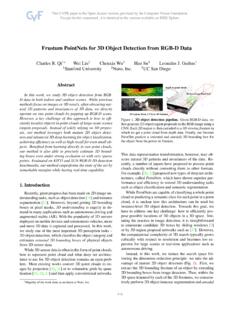
Frustum PointNets for 3D Object Detection From RGB-D Data
openaccess.thecvf.comFrustum PointNets for 3D Object Detection from RGB-D Data Charles R. Qi1∗ Wei Liu2 Chenxia Wu2 Hao Su3 Leonidas J. Guibas1 1Stanford University 2Nuro, Inc. 3UC San Diego Abstract In this work, we study 3D object detection from RGB-D data in both indoor and outdoor scenes.
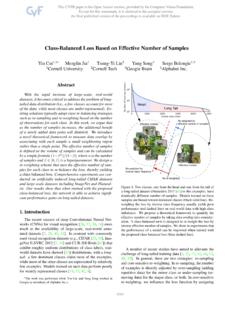
Class-Balanced Loss Based on Effective Number of Samples
openaccess.thecvf.comand large-scale datasets including ImageNet and iNatural-ist. Our results show that when trained with the proposed class-balanced loss, the network is able to achieve signifi-cant performance gains on long-tailed datasets. 1. Introduction The recent success of deep Convolutional Neural Net-works (CNNs) for visual recognition [26, 37, 38, 16] owes
Related documents
Generative Adversarial Imitation Learning - NeurIPS
proceedings.neurips.ccmodeling distributions of natural images: our algorithm harnesses generative adversarial training to fit distributions of states and actions defining expert behavior. We test our algorithm in Section 6, where we find that it outperforms competing methods by a wide margin in training policies for complex,

Generative Adversarial Networks arXiv:1809.00219v2 [cs.CV ...
arxiv.orgThroughout the literature, photo-realism is usually attained by adversarial training with GAN [15]. Recently there are a bunch of works that focus on de-veloping more e ective GAN frameworks. WGAN [31] proposes to minimize a reasonable and e cient approximation of Wasserstein distance and regularizes discriminator by weight clipping.
![arXiv:1411.1784v1 [cs.LG] 6 Nov 2014](/cache/preview/f/a/6/8/3/a/5/7/thumb-fa683a5739b507f70aa173f9c218eee1.jpg)
arXiv:1411.1784v1 [cs.LG] 6 Nov 2014
arxiv.orgthe adversarial training framework allows for considerable flexibility in how this hidden representa-tion is composed. 1 In the discriminator x and y are presented as inputs and to a discriminative function (embodied again by a MLP in this case).

Adversarial Examples and Adversarial Training
cs231n.stanford.eduMay 30, 2017 · Adversarial Training of other Models • Linear models: SVM / linear regression cannot learn a step function, so adversarial training is less useful, very similar to weight decay • k-NN: adversarial training is prone to overfitting. • Takeway: neural nets can actually become more secure than other models. Adversarially trained

“Deep Fakes” using Generative Adversarial Networks (GAN)
noiselab.ucsd.edusarial, and they play two adversarial roles like a forger and a detective literally. After the training period, the generator can produce fake images with high fidelity. In 2015, Rad-ford et al. used a deep convolutional generative adversarial network …

Perceptual Generative Adversarial Networks for Small ...
openaccess.thecvf.comAdversarial Branch Perception Branch Deep Residual Learning Generator Figure 2. Training procedure of object detection network based on the Perceptual GAN. The perception branch of the discriminator network along with the bottom convolutional layers is first trained using the training images that contain only large objects. Then

A Taxonomy and Terminology of Adversarial Machine Learning
nvlpubs.nist.gov180 training data, and adversarial exploitation of model sensitivities to adversely affect the 181 performance of ML classification and regression. AML is concerned with the design of ML 182 algorithms that can resist security challenges, the study of the capabilities of attackers, and the

JOURNALISM, ‘FAKE NEWS’ & DISINFORMATION - UNESCO
en.unesco.orgHandbook for Journalism Education and Training Cherilyn Ireton and Julie Posetti. TABLE OF CONTENTS Foreword by Guy Berger 7 Introduction by Cherilyn Ireton and Julie Posetti 14 Using this handbook as a model curriculum by Julie Posetti 26 MODULE 1: Truth, trust and journalism: why it matters 32 by Cherilyn Ireton