Example: quiz answers
Adversarial Examples and Adversarial Training
May 30, 2017 · (Goodfellow 2016) Adversarial Training of other Models • Linear models: SVM / linear regression cannot learn a step function, so adversarial training is less useful, very similar to weight decay • k-NN: adversarial training is prone to overfitting. • Takeway: neural nets can actually become more secure than other models.
Tags:
Information
Domain:
Source:
Link to this page:
Documents from same domain

Lecture 13: Generative Models
cs231n.stanford.eduFei-Fei Li & Justin Johnson & Serena Yeung Lecture 13 - May 18, 2017 Generative Models 17 Training data ~ p data (x) Generated samples ~ p model (x) Want to learn p

Attention and Transformers Lecture 11
cs231n.stanford.edugraph with shared weights h 0 f W h 1 f W h 2 f W h 3 x 3 y T ... Extract spatial features from a pretrained CNN Image Captioning using spatial features 11 CNN Features: H x W x D h 0 [START] Xu et al, “Show, Attend and Tell: Neural Image Caption Generation with Visual Attention”, ICML 2015 z 0,0 z 0,1 z 0,2 z 1,0 z 1,1 z 1,2 z 2,0 z 2,1 z ...
NaveenAppiah SagarVare - Stanford University
cs231n.stanford.eduNaveenAppiah Mechanical Engineering nappiahb@stanford.edu SagarVare Stanford ICME svare@stanford.edu ... the popular mobile game - Flappy Bird. It involves navi-gating a bird through a bunch of obstacles. Though, this ... the game emulator and learns to make good decisions over time. It is this simple learning framework and their

CNNs for Face Detection and Recognition
cs231n.stanford.edudevelopment of object classification, localization and detec-tion techniques. 2.1. Sliding Window In the early development of face detection, researchers tended to treat it as a repetitive task of object classifica-tion, by imposing sliding windows and performing object classification with the neural networks on the window re-gion.
Vector, Matrix, and Tensor Derivatives
cs231n.stanford.eduErik Learned-Miller The purpose of this document is to help you learn to take derivatives of vectors, matrices, and higher order tensors (arrays with three dimensions or more), and to help you take ... At this point, we have reduced the original matrix equation (Equation 1) …
Lecture 14: Reinforcement Learning
cs231n.stanford.eduFei-Fei Li & Justin Johnson & Serena Yeung Lecture 14 - May 23, 2017 Markov Decision Process 19 - Mathematical formulation of the RL problem - Markov property: Current state completely characterises the state of the

Convolutional Neural Networks for Visual Recognition
cs231n.stanford.eduProgressive GAN, Karras 2018. Models from Single RGB Images”, ECCV 2018 Beyond recognition: Segmentation, 2D/3D Generation. Fei-Fei Li, Ranjay Krishna, Danfei Xu Lecture 1 - 15 March 30, 2021 Scene Graphs Krishna et al., Visual Genome: Connecting Vision and Language using Crowdsourced Image Annotations, IJCV 2017

Fei-Fei Li & Justin Johnson & Serena Yeung Lecture 2 ...
cs231n.stanford.eduFei-Fei Li & Justin Johnson & Serena Yeung Lecture 2 - April 6, 2017 Administrative: Piazza For questions about midterm, poster session, projects,

Lecture 9: CNN Architectures
cs231n.stanford.eduLecture 9 - 22 May 2, 2017 ImageNet Large Scale Visual Recognition Challenge (ILSVRC) winners First CNN-based winner. Fei-Fei Li & Justin Johnson & Serena Yeung Lecture 9 - 23 May 2, 2017 ImageNet Large Scale Visual Recognition Challenge (ILSVRC) winners ZFNet: Improved hyperparameters over AlexNet. Fei-Fei Li & Justin Johnson & Serena Yeung ...
Lecture 11: Detection and Segmentation
cs231n.stanford.eduFei-Fei Li & Justin Johnson & Serena Yeung Lecture 11 - 1 May 10, 2017 Lecture 11: Detection and Segmentation
Related documents

Learning Structured Output Representation using Deep ...
proceedings.neurips.ccAlong with the recent breakthroughs in supervised deep learning methods, there has been a progress in deep generative models, such as deep belief networks [10,20] and deep Boltzmann machines [25]. Recently, the advances in inference and learning algorithms for various deep generative models significantly enhanced this line of research [2,7,8,18].
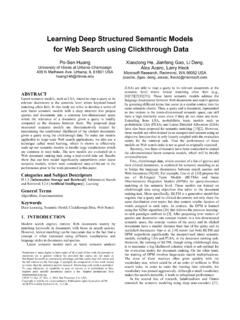
Learning Deep Structured Semantic Models for Web Search ...
www.microsoft.comfor learning latent semantic models in a supervised fashion [10]. The second is the introduction of deep learning methods for semantic modeling [22]. 2.1 Latent Semantic Models and the Use of Clickthrough Data The use of latent semantic models for query-document matching is a long-standing research topic in the IR community. Popular
Deep Learning - microsoft.com
www.microsoft.com“Deep Learning” as of this most recent update in October 2013. • Definition 5: “Deep Learning is a new area of Machine Learning research, which has been introduced with the objective of moving Machine Learning closer to one of its original goals: Artificial

Bootstrap Your Own Latent A New Approach to Self ...
arxiv.org8]. Generative approaches to representation learning build a distribution over data and latent embedding and use the learned embeddings as image representations. Many of these approaches rely either on auto-encoding of images [24, 25, 26] or on adversarial learning [27], jointly modelling data and representation [28, 29, 30, 31].
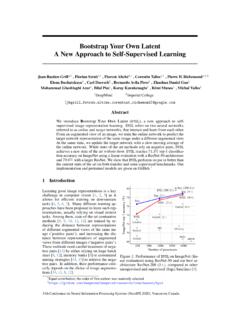
Bootstrap Your Own Latent A New Approach to Self ...
proceedings.neurips.ccdiscriminative [23, 8]. Generative approaches to representation learning build a distribution over data and latent embedding and use the learned embeddings as image representations. Many of these approaches rely either on auto-encoding of images [24, 25, 26] or on adversarial learning [27], jointly modelling data and representation [28, 29, 30 ...

by Gregory Koch
www.cs.toronto.eduMachine learning has been successfully used to achieve state-of-the-art performance in a variety of applications such as web search, spam detection, caption generation, and speech and image recognition. However, these algorithms often break down when forced to make predictions about data for which little supervised information is available.
AAAI-21 Accepted Paper List.1.29
aaai.org! 3!! 147:!Comprehension!and!Knowledge! Pavel!Naumov,!Kevin!Ros!! 149:!Epistemic!Logic!of!Know*Who! SophiaEpstein,!Pavel!Naumov!! 151:!Deep!Switching!Auto*Regressive ...
Introduction to Bayesian Learning
www.dgp.toronto.eduChapter 1 Introduction We live in an age of widespread exploration of art and communication using computer graphics and anima-tion. Filmmakers, scientists, graphic designers, fine artists, and game designers, are finding new ways to