Transcription of ALCOHOLS IV 1403
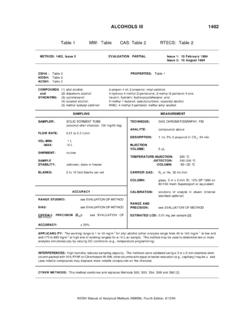
1 NIOSH Manual of Analytical Methods, Fourth EditionALCOHOLS IV1403(1) HOCH2CH2 OCH3 MW: (1) :(1) 109-86-4 RTECS:(1) KL5775000(2) HOCH2CH2 OCH2CH3(2) (2) 110-80-5 (2) KK8050000(3) HOCH2CH2O(CH2)3CH3(3) (3) 111-76-2(3) KJ8575000 METHOD: 1403, Issue 3 EVALUATION: FULLI ssue 1: 15 August 1990 Issue 3: 15 March 2003 OSHA : See Table 1 NIOSH: See Table 1 ACGIH: See Table 1 PROPERTIES:See Table 1 SYNONYMS: (1) 2-methoxyethanol: methyl cellosolve, ethylene glycol monomethyl ether, EGME(2) 2-ethoxyethanol: cellosolve, ethylene glycol monoethyl ether, EGEE(3) 2-butoxyethanol: butyl cellosolve, ethylene glycol monobutyl ether, EGBESAMPLINGMEASUREMENTSAMPLER:SOLID SORBENT TUBE(Coconut shell charcoal, 100 mg/50 mg)FLOW to L/min(1)(2)(3)VOL-MIN:6 L1 L2 L -MAX:50 L6 L10 LSHIPMENT:RoutineSAMPLESTABILITY:30 days @ 5 CBLANKS:2 to 10 field blanks per setTECHNIQUE:GAS CHROMATOGRAPHY, FIDANALYTE.
2 2-methoxyethanol, 2-ethoxyethanol, and2-butoxyethanolDESORPTION:1 mL methylene chloride /methanol (95:5)in an ultrasonic bath for 30 minutes INJECTION VOLUME:1 LTEMPERATURE -INJECTION:225 C -DETECTOR:300 C -COLUMN:40 C (1 min) - 200 C (12 C/min)CARRIER GAS:He, mL/minCOLUMN:Capillary, fused silica, 30 m x ; crossbonded carbowax -DA orequivalentCALIBRATION:Solutions of analytes in desorptionsolventRANGE:(1) 2 to 387 g (2) 2 to 373 g (3) 3 to 361 gESTIMATED LOD:(1) g/sample (2) g/sample (3) g/sample PRECISION ( r):(1) (2) (3) STUDIED:See Table :See Table ( rT):See Table :See Table.
3 The working range for 2-methoxyethanol was to 204 ppm ( to mg/m3) for a 6-L samplevolume, for 2-ethoxyethanol was to 99 ppm ( to 373 mg/m3) for a 1-L sample, and for 2-butoxyethanol was ppm ( to 180 mg/m3) for a 2-L sample. INTERFERENCES: Any compounds having similar retention times as the analytes of interest. OTHER METHODS: This method is an improved update of NMAM 1403, issue 2 (15 August 1994) [1 ]. NMAM 1403 (15 August 1994) previously combined and replaced methods S76 [2], S79 [2], and S361 [3].
4 Other less sensitive methods includeOSHA 79 [4] and OSHA 83 [5]. ALCOHOLS IV: METHOD 1403, Issue 3, dated 15 March 2003 - Page 2 of 5 NIOSH Manual of Analytical Methods, Fourth chloride , HPLC chromatographicgrade.* , HPLC chromatographic grade.* solvent: methylene chloride (HPLC chromatographic grade) containing 5% , reagent , reagent , reagent , purified and , , compressed, purified, filtered.* See SPECIAL : glass tube, 7 cm long, 6-mm OD, 4-mm ID, flame-sealed ends, containing two sections of activated coconut shell charcoal (100 mg/50 mg) separated by a 2-mm urethane foam plug.
5 A silylated glass wool plug precedes the front section and follows the back section. Tubes are commercially available from SKC, sampling pump, to L/min, connected with flexible chromatograph, FID, integrator, and capillary column (page 1403-1). vials, 11-mm glass with crimp , 10- L, 25- L, and flasks, PRECAUTIONS: methylene chloride is a carcinogen [6]. Methanol is very : each personal sampling pump with a representative sampler in line. the ends of the sampler immediately before sampling.
6 Attach sampler to personal sampling pumpwith flexible tubing. at an accurately known flow rate between and L/min for a total sample size of 6 to 50 L(2-methoxyethanol); 1 to 6 L (2-ethoxyethanol); and 2 to 10 L (2-butoxyethanol). NOTE:Maximum flow rate for 2-methoxyethanol and 2-butoxyethanol is L/min. the samplers with plastic (not rubber) caps and pack securely for PREPARATION: the front and back sorbent sections of the sampler tube in separate vials. Place the glass woolpreceding the front section into the vial containing the front sorbent section.
7 Discard the remaining foamplugs. mL of the desorption solvent into each vial. Attach crimp caps to each vial. the sample vials in an ultrasonic bath for 30 minutes. CALIBRATION AND QUALITY CONTROL: daily with at least six working standards to cover the analytical range. If necessary, additionalstandards may be added to extend the calibration curve. known amounts of analytes to 10-mL volumetric flasks and dilute to the mark with together with samples and blanks (steps 11 and 12). calibration graph (peak area vs g analyte).
8 Desorption efficiency (DE) at least once for each lot of charcoal used for sampling in thecalibration ranges (step 8). three tubes at each of five levels plus three media a known amount of DE stock solution directly onto the front sorbent section of each charcoaltube with a microliter IV: METHOD 1403, Issue 3, dated 15 March 2003 - Page 3 of 5 NIOSH Manual of Analytical Methods, Fourth the tubes to air equilibrate for several minutes, then cap the ends of each tube and allow tostand (steps 5-7) and analyze together with standards and blanks (steps 11 and 12).
9 A graph of DE vs g analyte three quality control blind spikes and three analyst spikes to ensure that the calibration graph andDE graph are in control. the gas chromatograph according to manufacturer s recommendations and to conditions given onpage 1403-1. Inject a 1- L sample aliquot manually using the solvent flush technique or with :If peak area is above the linear range of the working standards, dilute with desorption solvent,reanalyze and apply the appropriate dilution factor in the calculations.
10 Peak areas. the mass, g (corrected for DE) of analyte found in the sample front (Wf) and back (Wb)sorbent sections, and in the average media blank front (Bf) and back (Bb) sorbent sections. NOTE: If Wb > Wf/10, report breakthrough and possible sample concentration, C, of analyte in the air volume sampled, V(L):NOTE: mg/L = mg/m3 EVALUATION OF METHOD:Initial Method Development Effort (Issues 1 and 2)Methods S79 (2-methoxyethanol), S361 (2-ethoxyethanol), and S76 (2-butoxyethanol) were issued onFebruary 14, 1975 [2, 7], March 17, 1978 [3, 8, 9], and February 14, 1975 [2, 7], respectively, and validatedusing, respectively, 50-, 6-, and 10-L air samples of atmospheres generated by calibrated syringe stability of these ALCOHOLS was not determined.