Transcription of Ancient Rome - nsms6thgradesocialstudies.weebly.com
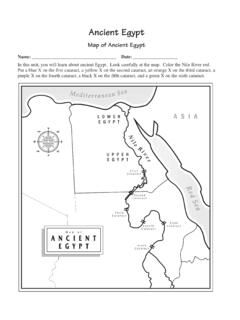
1 Ancient RomeMap of Ancient RomeName: _____ Date: _____In this unit, you will learn about Ancient Rome. Look carefully at the map. Put an X on Rome. Put a Y on Greece. Put a W on Gaul. Ancient RomeVocabulary 1. Augustus first Roman emperor 2. Carthage powerful Ancient city-state located in North Africa 3. Caesar title given to Ancient Roman leaders; means ruler in Latin 4. Christian a person who follows the teachings of Jesus of Nazareth 5. consuls two patricians who lead the government of Ancient Rome 6. Etruscan civilization an Ancient civilization located on the Italian peninsula to the north of Rome 7. Five Good Emperors Roman emperors whose rule was considered effective: Nerva, Trajan, Hadrian, Atoninus Pius, and Marcus Aurelius 8.
2 Jesus founder of Christianity 9. Julius Caesar first leader of the Roman Republic 10. Latin the language of Ancient Rome 11. New Testament a series of books in the Bible that describe the life and teachings of Jesus of Nazareth 12. patricians the wealthy and powerful citizens of Ancient Rome 13. Pax Romana 200-year period of peace and prosperity in Ancient Rome 14. plebeians the merchants, farmers, and artisans of Ancient Rome 15. Punic Wars three armed conflicts between Ancient Rome and Carthage 16. republic form of government in which the citizens vote for the leaders 17. Roman Colosseum an amphitheater built in rome between 70 80 18. Romulus and Remus the mythical founders of Ancient Rome 19.
3 Tribune a man who represented the plebeians in the Roman Republic The Beginning of Ancient RomeBrief #1 When most people think of Rome, they think of a large European city the capital of the country of Italy. Of course, Rome is the capital of Italy. But there was a time, thousands and thousands of years ago, when there was no Italy, and Rome was just a tiny village along the banks of the Tiber River. You may have heard the expression Rome wasn t built in a day. It took centuries for Rome to go from a small town to one of the largest, most powerful empires the world has ever seen. Romulus and RemusThere is a legend that tells about the origin of Rome. It is a story about twin brothers, Romulus and Remus.
4 Romulus and Remus were the sons of Mars, the Roman God of War. Their mother was a princess named Rhea Silva. She was the daughter of King Numitor. Unfortunately, King Numitor had a jealous brother named Amulius who wanted to be king. He stole the throne from his brother, Numitor. Amulius feared the sons of Rhea Silva. They were, after all, the grandsons of King Numitor, and he believed that once they grew up they would challenge his power and claim the throne. So Amulius stole the boys from their mother and put them in a basket. He threw the basket into the Tiber River. A she-wolf found the infant twins and rescued them. She took care of them as if they were her own pups. After Romulus and Remus grew to manhood, they returned to their village and killed their uncle Amulius.
5 They returned their grandfather, King Numitor, to the throne. Romulus and Remus decided to build a new city, but they disagreed on where it should be located. They fought over this, and eventually, they both built their own cities. One day, Remus paid Romulus a visit. Remus made fun of the way Romulus built his city. This angered Romulus, so he killed his brother. Romulus became the first king of Rome. Rome is named for Romulus. Rome in 600 the Roman Republic or Empire, Rome was a small village on the Italian peninsula. Other groups of people lived in the area as well. To the north of Rome was the Ancient Etruscan civilization with its own language and culture. In the south were the Greeks.
6 In North Africa, there was a city-state known as 1. Romulus and Remus 2. Etruscan civilizationFocusThe Roman Empire began as a small village on the Tiber River. The Beginning of Ancient Rome Brief #1 (cont.) Rome in 600 (cont.)In about 600 , the Etruscans invaded Rome and took control. The Romans did not like having an Etruscan king, so they rebelled. In 509 , they overthrew the Etruscans. This marks the beginning of the Roman Republic. The Roman RepublicBrief #2 After Rome overthrew the Etruscans, they instituted a form of government known as a republic. A republic is a type of government in which the citizens are allowed to vote for their leaders. (The United States is a republic.)
7 The Roman Republic operated very differently than the republic that is in place in the United States. The citizens of Rome were divided into two groups. The patricians were wealthy Romans. The plebeians were merchants, artists, and farmers. In other words, all of the Roman citizens who were not patricians were plebeians. Most Romans were plebeians. There were other people living in Ancient Rome who were neither patricians nor plebeians. These were slaves and people who were born elsewhere. They were not Roman the early days of the Rome Republic, there were two consuls. These consuls were patricians who were partly in charge of the government. There was also a senate. The members of the senate were also patricians.
8 The senate members were not elected but appointed by the consuls. There were 300 members in the Roman senate. Once a member of the senate was appointed by a consul, he had the position for life . The plebeians in Ancient Rome made up the Assembly. The Assembly could vote, but the Senate could block their votes. Even though the Assembly had limited power, every year they were allowed to vote on which two Roman senators would serve as consuls. So if you happened to be an ambitious senator who wanted to one day become consul, you had to work with the Assembly and the Rome grew and gained more land, wealth, and influence in the region, the plebeians began to worry that their interests and well-being were not being represented in the government.
9 They began to demand that the government become more representative of 1. republic 2. patricians 3. plebeians 4. consuls 5. tribune 6. Latin 7. Punic Wars 8. Carthage 9. Julius Caesar 10. CaesarFocusAncient Rome had the world s first republic. Fast FactThe Roman Senate met in the Forum, part of which still stands today. The Roman RepublicBrief #2 (cont.)In response to the demands of the plebeians, the Roman Senate appointed tribunes. A tribune was a man whose job was to protect the interests and rights of the plebeians in the government. A tribune could stop the Roman Senate from making a law by simply shouting Veto, which means I forbid in Latin. Latin was the language of the Ancient Romans.
10 The Punic WarsDuring the Roman Republic, Rome got bigger and more powerful. One of the events that led to Rome s increase in wealth and power was the Punic Wars. The Punic Wars were a series of conflicts fought between Rome and Carthage that began in 264 Carthage was a powerful city-state located in North Africa. It developed a huge trading empire. Roman expansion southward created conflict between Rome and Carthage. War broke out over control of trade in the region. The Punic Wars are really three separate wars that were fought within one hundred years of each other. The end result was a Roman victory. Rome conquered Carthage and enslaved the population.