Transcription of API Standard 660 - My Committees
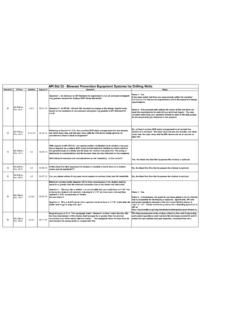
1 API Standard 660 Shell-and-Tube Heat Exchangers for General Refinery ServicesStandardEditionSectionInquiry # of API Standard 660 states that the fixed shell support shall be designed to withstand a longitudinal force equal to 150 percent of the bundle weight applied at the exchanger bundle centerline. In figuring the stress, is it the intent to calculate as follows: Bundle Weight = 150% * Lever Arm Section Mod of Support Since the load is transferred to the bottom of the shell at the interface of the support and shell. The reference paragraph in API 660 ( ) is only intended to provide the force criteria to be used in the design of the shell support.
2 It is not intended to provide a calculation procedure. The Task Force will consider if this type of calculation procedure should be added to the 660 Standard during the next revision process. 660 Fifth Edition, July 1993 clarify API 660, paragraph as it relates to the following question. What is meant by "The unrestricted area at the shell impingement plate as well as the shell entrance?" The first part (unrestricted area at the plate) is clear. This is what TEMA defines as shell entrance area. What is meant by "as well as the shell entrance area?" This implies that there is not a typo for bundle entrance area as this requirement would be too conservative in some cases.
3 The TEMA bundle entrance area requirements are of API Standard 660 reads as follows: "The unrestricted entrance area at the impingement plate as well as the shell entrance shall not be less than the flow area of the inlet nozzle." The two area referred to in are defined as follows: " ..at the impingement plate .." refers to the projected cylinder surface area under the inlet nozzle calculated based on the following equation (Reference TEMA, 7th Edition, 1988, Section 10, and ): Area = (Pi) x (D) x (Havg) + <= if the impingement plate is present, where Havg = (h1 = h2)/2 and D = projected nozzle diameter.
4 660 Fifth Edition, July 1993 to paragraph of API Standard 660, does API 660 recognize tapped lifting devices or does it recognize only welded lifting devices?Paragraph states, "The lifting device shall be a weld-on lug or ring provided with a hole not less than 1-1/2 inches (38 millimeters) in diameter. Whenever possible, the lug or ring shall be located at the top of the component above its center of gravity; otherwise, two lugs or rings suitably located shall be provided. The lifting device shall be designed to support a load at least twice the weight of the component." As seen in the first sentence of this direct quote from the Standard , API 660 recognizes only welded lifting devices.
5 This particular topic in the Standard was incorporated based on the general reliability requirements of users of the Standard . 660 Fifth Edition, July 1993 only welded lifting devices are permitted, does API 660 recognize that the PWHT cycle could extend over 19 hours just for welding on a 1/2-inch thick lifting lug of the same material? The Task Force recognizes that there are special circumstances where this requirement might be waived, but this decision is between the purchaser and the manufacturer to decide and is not within the scope of this Standard . 660 Fifth Edition, July 1993 it the intent that the Liquid Penetrant examination (PT) in this paragraph only be done when there is Post Weld Heat Treatment (PWHT) required ?
6 In otherwards, if there is no PWHT required, there shall be no PT par. does not refer to Liquid Penetrant Examination. We believe your inquiry refers to para. Para. requires Liquid penetrant Examination (PT) after PWHT only. If there is no PWHT the Liquid Penetrant examination is not required by API 660. However PT may required by governing Code. 660 Fifth Edition, July 1993 'd like you to advice for us the meaning "are not axial" of the above paragraph. If a nozzle is located on a channel shell (nozzle direction is perpendicular to the longitudinal direction of tube) and the diameter ratios are less than In this case, Does the postweld heat treatment is required?
7 (Is the "axial" means longitudinal direction of tubes?)Yes, PWHT is required if the nozzle is located on channel shell (nozzle direction perpendicular to the longitudinal direction of tube) and the diameter ratios are less than Yes, the "axial" means longitudinal direction of tubes. 660 Sixth Edition, February 660-I-01/02 Subject para says " Unless otherwise agreed between purchaser and vendor, tube sheets shall be designed for full design pressure on either side, with atmospheric pressure or specified vacuum on the other side". Could you please explain the intent of this para to be used for fixed tube sheets type units.
8 I think it may be one of the following two:Your interpretation of the paragraph of API 660 is correct however the specific reference to TEMA tube sheet design methods may not always be appropriate depending on the pressure design code. The design pressure calculation requirement in paragraph has no relation with type of heat exchanger unlike the referenced TEMA Edition, February 2001Cl. " We would like know the acceptable tolerance for the flatness of gasket face of partition API 660, the tolerance of partition groove is mm for special application ( ). Then the tolerance of normal application could be more mm?
9 Or mm?The API Standard 660, Sixth Edition, dated February 2001, does not address the tolerance of pass partition groove for normal exchanger manufacturer will set the flatness requirement unless the purchaser dictates a value in their requisition. A reasonable value to use should be agreed upon between the two Edition, February & have purchased API 660, 2001 edition from Global Engineering Documents according to your I found that Para. and are the same with previous let me know that the Post Weld Heat Treatment shall be performed for "Tube side only" of Exchanger in condition of a,b and c and of API Standard 660 (Shell-and-Tube Heat Exchangers for General Refinery Services) Section 6, Fifth Edition, June 'm wonder that 'shell side' is not limited to above it were, Does the "channels and bonnets" in those Para.
10 Means only the 'tube side cylinder and head' not shell side?But I can't understand about the meaning of "channels and bonnets" in those interpretate the "Channel".Yes, Paragraph and outlines requirement for PWHT of Channels and Bonnets Channel and Bonnet are defined in standards of the Tubular Exchanger Manufactures Association (TEMA) Figure and Paragraph N-2. Is it the intention of this paragraph to require a pneumatic test of welded tube-to-tubesheet joints on floating tubesheet-type exchangers( , not fixed tubesheet-type)? 2. Is it the intention of this paragraph to require a pneumatic test of welded tube-to-tubesheet joints when only a replacement bundle is being fabricated ( , there is no shell being fabricated in a shop for that bundle)?