Transcription of API Standard 671 - Special Purpose Couplings for …
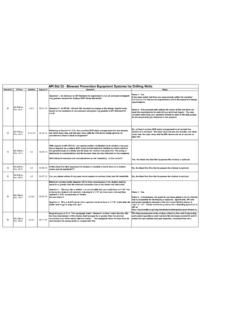
1 API Standard 671 - Special Purpose Couplings for Petroleum, Chemical and Gas Industry Services Last update: November 9, 2006. Standard Edition Section Inquiry # Question Reply 671 3rd - Oct. 671-I-01/05 Question 1: Is applicable to the components of the coupling Reply 1: Section states that the bolting is to be designed to 1998 only, or is it also applicable to the faces of the driver and driven transmit the required torque without dependence on the flange-face equipment? In other words: is API requiring the torque to be friction. Therefore, regardless of the driving method of the coupling transmitted by shear also, such as on the turbine flange or gearbox components, the bolts have to be designed so that if there is no flange?
2 Flange-face friction, the bolted joint will be able to drive the load. Question 2: Are prescription on tolerances and the other Reply 2: Yes. requirements in through applicable to the connected equipment flanges as well? 671 3rd - Oct. 671-I-01/00 API RP 11 PGT, First Edition, May 1, 1992, Paragraph requires Your inquiry is not understood. Paragraph General describes 1998 that Couplings meet API 671. API 671, Section , refers to balance the fact that machines of various designs require differing degrees of tests. There are two kinds of balance test methods, low speed balance precision and describes three methods of balance to deal balance and high speed balance. We understand that API 671 with these needs.
3 Succeeding paragraphs describe the decision requires only a low speed balance and does not require a high speed process for deciding on the appropriate method. There is no balance. Is our understanding correct? requirement for high speed balance. The intent of 671 is balance in a low speed balance machine. 671 3rd - Oct. 671-I-01/04 Background: We use an elastic rubber coupling on an electrical API Standard 671, third edition, does not provide guidance on the 1998 motor driving a piston compressor. The coupling is placed between material requirements for the part you have described. the motor and the piston compressor. The compressor is driven directly. The materials of the housing of this coupling are made either from G-AlSi7Mg-T64 or GK-AlSi10Mg.
4 Question: Does API 671 allow the use of this G-AlSi7Mg-T64 or GK- AlSi10Mg material for this coupling ? If not, what material is permissible in this case? 671 3rd - Oct. 671-I-01/99 Could you please help by giving the preferred MPI Standard and the rd No, API 671 3 Edition does not provide a specific MPI specification, 1998 acceptance criteria required to comply with this acceptance criteria or operator qualification. The only specific accept/reject criteria states is ..Indications of cracks or other injurious defects shall be the basis for rejection of the affected part . When the document is reviewed for the 4th Edition, this question will be reviewed. 671 3rd - Oct. 671-I-01/99 Is the MPI inspector qualification of SNI-TC-A1 Level I acceptable?
5 Rd Since there was no guidance provided in the 3 edition to 1998 qualification criteria for MPI or other inspection techniques, it would be up to the manufacturer to establish their own Standard and review this with their proposal to the customer. This question will also be addressed for the 4th edition. 671 3rd - Oct. 671-I-01/99 Are flange bolts considered to be part of the torque transmitting Yes, paragraph states that all metallic torque transmitting 1998 items requiring MPI? components, bolts, and other major components shall be inspected by wet magnetic particle, or liquid penetrant methods. The word bolts is specifically identified in the paragraph. 671 3rd - Oct. 671-I-01/99 We manufacture bolts from aircraft grade S series steel which is No.
6 The paragraph starts out with the statement After final 1998 MPI and ultrasonic tested in bar form at the mill. Is this considered machining . Therefore, the bolts are to be inspected after final acceptable to API 671 without the need for further MPI testing, after machining. final machining of the bolts? 671 3rd - Oct. 671-I-01/99 What are the ranges of speeds covered by low, intermediate, and rd The 3 Edition of API 671 did away with the concept of intermediate 1998 high speed Couplings ? speed. The definitions of high speed and low speed Couplings are found in the definition of terms, paragraphs and Low Speed coupling : A coupling that is designed to operation at speeds of 1800 RPM or less.
7 High Speed coupling : A coupling that is designed to operate at speeds above 1800 RPM. Please be advised that the API recommends use of current editions of all API standards .