Transcription of AS PURE MATHS REVISION NOTES
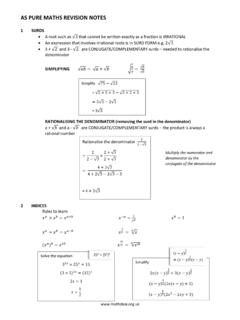
1 AS pure MATHS REVISION NOTES 1 SURDS A root such as 3 that cannot be written exactly as a fraction is IRRATIONAL An expression that involves irrational roots is in SURD FORM 2 3 3 + 2 and 3 - 2 are CONJUGATE/COMPLEMENTARY surds needed to rationalise the denominator SIMPLIFYING = = RATIONALISING THE DENOMINATOR (removing the surd in the denominator) a + and a - are CONJUGATE/COMPLEMENTARY surds the product is always a rational number 2 INDICES Rules to learn = + =1 0=1 = 1 = ( ) = = Simplify 75 12 = 5 5 3 2 2 3 =5 3 2 3 = 3 3 Rationalise the denominator 22 3 =22 3 2+ 32+ 3 = 4+2 34+2 3 2 3 3 = 4+2 3 Multiply the numerator and denominator by the conjugate of the denominator Solve the equation 32 25 =15 (3 5)2 =(15)
2 1 2 =1 =12 Simplify 2 ( )32+3( )12 ( )12(2 ( )+3) ( )12(2 2 2 +3) ( )32 =( )12( ) 25x = (52)x 3 QUADRATIC EQUATIONS AND GRAPHS Factorising identifying the roots of the equation ax2 + bc + c = 0 Look out for the difference of 2 squares x2 a2= (x - a)(x + a) Look out for the perfect square x2 + 2ax + a2 = (x + a)2 or x2 2ax + a2 = (x -a)2 Look out for equations which can be transformed into quadratic equations Completing the square - Identifying the vertex and line of symmetry In completed square form y = (x + a)2 b the vertex is (-a, b)
3 The equation of the line of symmetry is x = -a Quadratic formula = 2 4 2 for solving ax2 + bx + c = 0 The DISCRIMINANT b2 4ac can be used to identify the number of solutions b2 4ac > 0 there are 2 real and distinct roots (the graphs crosses the x- axis in 2 places) b2 4ac = 0 the is a single repeated root (the x-axis is a tangent to the graph) b2 4ac < 0 there are no 2 real roots (the graph does not touch or cross the x-axis) y = (x - 3)2 - 4 Vertex (3,-4) Line of symmetry x = 3 Vertex (2,3) Sketch the graph of y = 4x x2 1 y = - (x2 - 4x) 1 y = - ((x 2)2 4) 1 y = - (x-2)2 + 3 Solve +1 12 =0 2+ 12=0 ( +4)( 3)=0 x = 3, x = -4 Solve 6 4 7 2+2=0 Let z = x2 6 2 7 +2=0 (2 1)(3 2)
4 =0 =12 = 23 = 12 = 23 4 SIMULTANEOUS EQUATIONS Solving by elimination 3x 2y = 19 3 9x 6y = 57 2x 3y = 21 2 4x 6y = 42 5x 0y =15 x = 3 ( 9 2y = 19) y = -5 Solving by substitution x + y =1 rearranges to y = 1 - x x2 + y2 = 25 x2 + (1 x)2 = 25 x2 + 1 -2x + x2 25 = 0 2x2 2x 24 = 0 2(x2 - x 12) = 0 2(x 4)(x + 3)
5 = 0 x = 4 x = -3 y = -3 y = 4 If when solving a pair of simultaneous equations, you arrive with a quadratic equation to solve, this can be used to determine the relationship between the graphs of the original equations Using the discriminant b2 4ac > 0 the graphs intersect at 2 distinct points b2 4ac = 0 the graphs intersect at 1 point (tangent) b2 4a < 0 the graphs do not intersect 5 INEQUALITIES Linear Inequality This can be solved like a linear equation except that Multiplying or Dividing by a negative value reverses the inequality Quadratic Inequality always a good idea to sketch the graph!
6 Solve 10 3x < 4 -3x < -6 x > 2 Solve x2 + 4x 5 < 0 x2 + 4x 5= 0 (x 1)(x + 5) = 0 x = 1 x = -5 x2 + 4x 5 < 0 -5 < x < 1 which can be written as {x : x > -5 } {x : x <1 } Solve 4x2 - 25 0 4x2 - 25 = 0 (2x 5)(2x + 5) = 0 x = 52 x = - 52 4x2 - 25 0 x -52 or x 52 which can be written as {x : x - 52 } {x : x 52} 6 GRAPHS OF LINEAR FUNCTIONS y = mx + c the line intercepts the y axis at (0, c) Gradient = Positive gradient Negative gradient Finding the equation of a line with gradient m through point (a,b) Use the equation (y b) = m(x a) If necessary rearrange to the required form (ax + by = c or y = mx c)
7 Parallel and Perpendicular Lines y = m1x + c1 y = m2x + c2 If m1 = m2 then the lines are PARALLEL If m1 m2 = -1 then the lines are PERPENDICULAR Finding mid-point of the line segment joining (a,b) and (c,d) Mid-point = ( + 2, + 2) Calculating the length of a line segment joining (a,b) and (c,d) Length = ( )2+( )2 7 CIRCLES A circle with centre (0,0) and radius r has the equations x2 + y2 = r2 A circle with centre (a,b) and radius r is given by (x - a)2 + (y - b)2 = r2 Finding the centre and the radius (completing the square for x and y) Find the equation of the line perpendicular to the line y 2x = 7 passing through point (4, -6) Gradient of y 2x = 7 is 2 (y = 2x + 7) Gradient of the perpendicular line = - (2 - = -1) Equation of the line with gradient passing through (4, -6) (y + 6) = - (x 4)
8 2y + 12 = 4 x x + 2y = - 8 Find the centre and radius of the circle x2 + y2 + 2x 4y 4 = 0 x2 + 2x + y2 4y 4 = 0 (x + 1)2 1 + (y 2)2 4 4 = 0 (x + 1)2 + (y 2)2 = 32 Centre ( -1, 2) Radius = 3 The following circle properties might be useful Angle in a semi-circle The perpendicular from the centre The tangent to a circle is is a right angle to a chord bisects the chord perpendicular to the radius Finding the equation of a tangent to a circle at point (a,b) The gradient of the tangent at (a,b) is perpendicular to the gradient of the radius which meets the circumference at (a, b)
9 Lines and circles Solving simultaneously to investigate the relationship between a line and a circle will result in a quadratic equation. Use the discriminant to determine the relationship between the line and the circle b2 4ac > 0 b2 4ac = 0 (tangent) b2 4ac < 0 8 TRIGONOMETRY You need to learn ALL of the following Exact Values Find equation of the tangent to the circle x2 + y2 - 2x - 2y 23 = 0 at the point (5,4) (x - 1)2 + (y 1)2 25 = 0 Centre of the circle (1,1) Gradient of radius = 4 15 1= 34 Gradient of tangent = - 43 Equation of the tangent (y 4) = - 43(x 5)
10 3y 12 = 20 - 4x 4x + 3y = 32 2 sin 45 = 22 cos 45 = 22 tan 45 = 1 sin 30 = 12 cos 30 = 32 tan 30 = 1 3 3 sin 60 = 32 cos 60 = 12 tan 60 = 3 Cosine Rule a2 = b2 + c2 - 2bc Cos A Sine Rule = = Area of a triangle 12 Identities sin2x + cos2x = 1 tan x = Graphs of Trigonometric Functions y = sin y = cos y =tan 9 POLYNOMIALS A polynomial is an expression which can be written in the form + 1+ when a,b, c are constants and n is a positive integer.