Transcription of ASBESTOS by TEM 7402
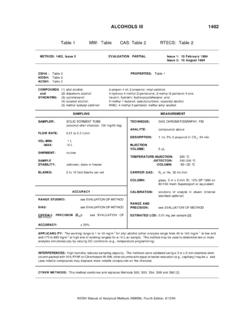
1 ASBESTOS by TEM7402 FORMULA: Various MW: Various CAS: Various RTECS: VariousMETHOD: 7402 EVALUATION: PARTIALI ssue 1: 15 May 1989 Issue 2: 15 August 1994 OSHA ASBESTOS fibers (>5 m long)/cc;1 f/cc/30 min excursion; carcinogenMSHA:2 ASBESTOS fibers/ f/cc (fibers > 5 m long)/400 L; crocidolite; amosite; 2 chrysotileand other ASBESTOS , fibers/cc; carcinogenPROPERTIES: solid, fibrous, crystalline, anistropicSYNONYMS [CAS#]:actinolite [77536-66-4] or ferroactinolite [15669-07-5]; amosite [12172-73-5]; anthophyllite [77536-67-5];chrysotile [12001-29-5]; serpentine [18786-24-8]; crocidolite [12001-28-4]; tremolite [77536-68-6]; amphibole ASBESTOS [1332-21-4].
2 SAMPLINGSAMPLER:FILTER( to m cellulose ester membrane,25-mm diameter; conductive cassette)FLOW to 16 L/minVOL-MIN*:400 L @ fiber/cc -MAX*:(step 4, sampling)*Adjust for 100 to 1300 fibers/mm2 SHIPMENT:routine (pack to reduce shock)SAMPLE STABILITY:stableBLANKS:2 to 10 field blanks per setMEASUREMENTTECHNIQUE:MICROSCOPY, TRANSMISSIONELECTRON (TEM)ANALYTE: ASBESTOS fibersSAMPLEPREPARATION:modified Jaffe wickEQUIPMENT:transmission electron microscope; energydispersive X-ray system (EDX) analyzerCALIBRATION:qualitative electron diffraction; calibrationof TEM magnification and EDX systemRANGE:100 to 1300 fibers/mm2 filter area [1]ESTIMATED LOD:1 confirmed ASBESTOS fiber above 95% ofexpected mean blank valuePRECISION (S r) when 65% of fibers are ASBESTOS ; when adjusted fiber count is appliedto PCM count [2].
3 ACCURACYRANGE STUDIED:80 to 100 fibers countedBIAS:not determinedOVERALL PRECISION (S rT): see EVALUATION OFMETHODACCURACY:not determinedAPPLICABILITY: The quantitative working range is to fiber/cc for a 1000-L air sample. The LOD depends on samplevolume and quantity of interfering dust, and is < fiber/cc for atmospheres free of interferences. This method is used todetermine ASBESTOS fibers in the optically visible range and is intended to complement the results obtained by phase contrastmicroscopy (Method 7400).
4 INTERFERENCES: Other amphibole particles that have aspect ratios greater than 3:1 and elemental compositions similar to theasbestos minerals may interfere in the TEM analysis. Some non-amphibole minerals may give electron diffraction patterns similarto amphiboles. High concentrations of background dust interfere with fiber identification. Some non- ASBESTOS amphibole mineralsmay give electron diffraction patterns similar to ASBESTOS METHODS: This method is designed for use with Method 7400 (phase contrast microscopy).
5 NIOSH Manual of Analytical Methods (NMAM), Fourth Edition, 8/15/94 ASBESTOS by TEM: METHOD 7402, Issue 2, dated 15 August 1994 - Page 2 of 7 (See SPECIAL PRECAUTIONS.)EQUIPMENT: : field monitor, 25-mm, three-piece cassette with ca. 50-mm electrically-conductiveextension cowl, cellulose ester membrane filter, to m pore size, and backup 1:Analyze representative filters for fiber background before use. Discard the filter lot ifmean count is >5 fibers/100 fields. These are defined as laboratory 2:Use an electrically-conductive extension cowl to reduce electrostatic effects on fibersampling and during sample shipment.
6 Ground the cowl when possible 3 m pore size filters are recommended for personal sampling. m filters arerecommended for sampling when performing TEM analysis on the samples because theparticles deposit closer to the filter surface. However, the higher pressure drop throughthese filters normally preclude their use with personal sampling pumps. sampling pump, to 16 L/min, with flexible connecting tubing. , transmission electron, operated at ca. 100 kV, with electron diffraction andenergy-dispersive X-ray capabilities, and having a fluorescent screen with inscribed or overlaidcalibrated scale (Step 15).
7 NOTE:The scale is most efficient if it consists of a series of lines inscribed on the screen or partialcircles every 2 cm distant from the center. grating replica with known number of lines/mm. , glass, pre-cleaned, 25- x 75-mm. , surgical steel, curved-blade. , 200-mesh TEM copper, (optional: carbon-coated). dishes, 15-mm depth. The top and bottom of the petri dish must fit snugly together. To assurea tight fit, grind the top and bottom pieces together with an abrasive such as carborundum toproduce a ground-glass contact , clean polyurethane, spongy, 12-mm , Whatman No.
8 1 qualitative paper or equivalent, or lens borer, (about 8-mm). , waterproof, , page, standard bulk materials for reference; SRM #1866, available from the National Instituteof Standards and rods, sharpened to 1 mm x 8 , light, phase contrast (PCM), with Walton-Beckett graticule (see method 7400). wire, 22-gauge, , shrink- or PRECAUTIONS: Acetone is extremely flammable (flash point = 0 F). Take precautions notto ignite it. Heating of acetone must be done in a fume hood using a flameless, spark-free heat is a confirmed human carcinogen.
9 Handle only in a well-ventilated fume Manual of Analytical Methods (NMAM), Fourth Edition, 8/15/94 ASBESTOS by TEM: METHOD 7402, Issue 2, dated 15 August 1994 - Page 3 of 7 each personal sampling pump with a representative sampler in personal sampling, fasten sampler to worker's lapel near worker's mouth. Remove the topcover from cowl extension ("open-face") and orient sampler face down. Wrap joint betweenextender and monitor body with tape to help hold the cassette together and provide a markingsurface to identify the cassette.
10 Where possible, especially at low %RH, attach sampler toelectrical ground to reduce electrostatic effects during at least two field blanks (or 10% of the total samples, whichever is greater) for each setof samples. Remove top covers from the field blank cassettes and store top covers andcassettes in a clean area ( , closed bag or box) during sampling. Replace top covers whensampling is at to 16 L/min [3]. Adjust sampling rate, Q (L/min), and time, t (min), to producefiber density, E, of 100 to 1300 fibers/mm2 [ 104 to 5 105 fibers per 25-mm filter witheffective collection area (Ac= 385 mm2)] for optimum accuracy.