Transcription of ASEPTIC PACKAGING SYSTEM
1 ASEPTIC PACKAGING SYSTEM . A septic PACKAGING can be defined as the filling of a commercially sterile product into a sterile container under ASEPTIC conditions and hermetically sealing the containers so that reinfection is prevented. This results in a product, which is shelf-stable at ambient conditions. The term ASEPTIC is derived from the Greek word septicos which means the absence of putrefactive micro-organisms. In practice, generally there are two specific fields of application of ASEPTIC PACKAGING technology: PACKAGING of pre-sterilised and sterile products. Examples are milk and dairy products, puddings, desserts, fruit and vegetable juices, soups, sauces, and products with particulates. PACKAGING of non-sterile Milk in ASEPTIC Pack product to avoid infection by micro-organisms.
2 Examples of this application include fermented dairy products like yoghurt. ASEPTIC PACKAGING technology is fundamentally different from that of conventional food processing by canning. In canning, the process begins with treating the food prior to filling. Initial operations inactivate enzymes so that these will not degrade the product during processing. The package is cleaned, and the product is introduced into the package, usually hot. Generally, air that can cause oxidative damage is removed from the interior. The package is hermetically sealed and then subjected to heating. The package must be able to withstand heat up to about 100 C for high acid products and up to 127 C for low acid products, which must receive added heat to destroy heat -resistant microbial spores. Packages containing low-acid (above pH ) food must withstand pressure as well.
3 Although conventional canning renders food products commercially sterile, the nutritional contents and the organoleptic properties of the food generally suffer in the processing. Moreover, tinplate containers are heavy in weight, prone to rusting and are of high cost. Figure 1 is a simple illustration comparing the basic difference between conventional canning and ASEPTIC PACKAGING processes for the production of shelf-stable food products. Advantages of ASEPTIC PACKAGING Technology The three main advantages of using ASEPTIC PACKAGING technology are: PACKAGING materials, which are unsuitable for in-package sterilisation can be used. Therefore, light weight materials consuming less space offering convenient features 309. Figure 1: Conventional Canning v/s ASEPTIC PACKAGING Conventional Process Flow ASEPTIC Process Flow Product Package Product Package Filling HTST Processing Sterilization Sealing Cooling Filling Retort Processing Sealing Cooling Storage/Distribution Storage/Distribution and with low cost such as paper and flexible and semi-rigid plastic materials can be used gainfully.
4 Sterilisation process of high-temperature-short time (HTST) for ASEPTIC PACKAGING is thermally efficient and generally gives rise to products of high quality and nutritive value compared to those processed at lower temperatures for longer time. Extension of shelf-life of products at normal temperatures by packing them aseptically. Besides the features mentioned above, additional advantages are that the HTST process utilises less energy, as part of the process- heat is recovered through the heat exchangers and the ASEPTIC process is a modern continuous flow process needing fewer operators. ASEPTIC Processing Methodology ASEPTIC processing comprises the following: Sterilisation of the products before filling Sterilisation of PACKAGING materials or containers and closures before filling Sterilisation of ASEPTIC installations before operation (UHT unit, lines for products, sterile air and gases, filler and relevant machine zones).
5 310. Maintaining sterility in this total SYSTEM during operation; sterilization of all media entering the SYSTEM , like air, gases, sterile water Production of hermetic packages Sterilization of Products In ASEPTIC processing, the design to achieve commercial stability is based on the well-founded principles of thermal bacteriology and integrated effect of time/temperature treatment on spores of micro-organisms. Pre-sterilization of a product usually consists of heating the product to the desired UHT. temperature, maintaining this temperature for a given period in order to achieve the desired degree of sterility, with subsequent cooling, usually to ambient temperature and sometimes to an elevated temperature to achieve right viscosity for filling. Heating and cooling should be performed as rapidly as possible to achieve the best quality, depending upon the nature of the product.
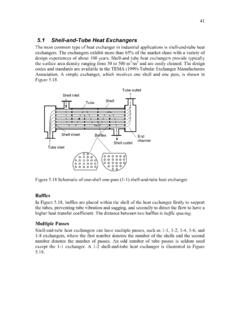
6 A fast heat exchange rate is desired for cost reasons. Various heat transfer methods are used, but essentially the systems can be divided into direct and indirect heat exchange methods. Table 1 summarizes the characteristics of the heat exchange systems used for ASEPTIC processing of liquids. TABLE 1. Characteristics of the heat Exchange Systems Used for ASEPTIC Processing of Liquids Equipment Product Aroma Energy Capital Space Pulp fouling Turn- Type Quality Reten- Saving Cost Capabi- Length down*. tion lity of Run Steam Excellent No Poor High Fair Fair- Excellent Fair Injection/ Good Infusion Plate heat Good Yes Excellent Low Excellent Limited Limited Good exchanger Tubular: Small Tubes Medium Yes Fair Medium Good Good Limited Good Large Tubes Poor Yes Fair Low Fair Good Good Good Swept Good Yes Very Very High Fair- Good Good Surface Poor High Good (* Turndown is the capability of the SYSTEM to process at different rates to accommodate different number of fillers or different package sizes.)
7 [Source : Dinnage (1983)]. 311. Some of the latest methods of sterilisation of products include: Microwaves Electrical resistance heating High voltage discharge Ultra high pressure Sterilisation of ASEPTIC PACKAGING Materials and Equipment Sterilisation Agents: heat , chemicals and radiation have been used, alone or in combination, for sterilization of ASEPTIC equipment and PACKAGING materials. Practical considerations and regulatory requirements have limited the number of sterilants, which are used for ASEPTIC systems. heat Initially, heat was used as the sterilant for ASEPTIC systems as a natural extension of thermal processing. Product supply lines and fillers are commonly sterilized by moist' heat in the form of hot water or saturated steam under pressure. Dry' heat , in the form of superheated steam or hot air, may also be used to sterilize equipment.
8 However, due to the relatively high dry heat resistance of bacterial endospores, the time-temperature requirements for dry heat sterilization are considerably higher than those for moist heat sterilization. Since, relatively large masses of metal are often present in ASEPTIC filling and PACKAGING systems, high temperatures and relatively long holding periods are necessary to assure that appropriate sterilization has occurred. Systems employing moist heat are frequently sterilized at temperatures ranging from 121 C to 129 C, while 176 C to 232 C is used for sterilization by dry heat . In addition, sterilization of air by incineration usually is conducted at temperatures ranging from 260 C to 315 C. Chemicals Hydrogen peroxide is the overwhelming choice for use as a chemical sterilant.
9 Other chemicals which have been used as sterilants, primarily for use in systems for acid food, include various acids, ethanol, ethylene oxide and peracetic acid. Hydrogen peroxide is not an efficient sporicide when used at room temperature. However, the sporicidal activity increases substantially with increasing temperatures. Therefore, most ASEPTIC PACKAGING systems use hydrogen peroxide (at concentrations of 30 to 35%). as a sterilant for PACKAGING materials followed by hot air (60 C to 125 C) to dissipate residual hydrogen peroxide. Radiation Gamma-radiation has been used for decades to decontaminate PACKAGING materials for use in ASEPTIC systems for packing acid and acidified food. Due to the penetrating powers of gamma-radiation, packages are treated in bulk at commercial irradiators.
10 A. dose of approximately Megaradians (Mrad) is commonly used to decontaminate containers for acid and acidified food. Recently, processes for low acid food ASEPTIC filling and PACKAGING systems are also being accepted. Doses required to sterilize containers for use with low acid food are considerably higher than those required for acid and acidified food. Other types of radiation are not widely used in ASEPTIC systems. Ultraviolet (UV-C) light has been used to decontaminate food contact surfaces. The low penetration and problems 312. associated with shadowing', limit the use of UV-C for ASEPTIC systems PACKAGING of low acid food. While equipment size, speed and costs have precluded use of electron beam irradiators until now; it is only a matter of time before such a SYSTEM is developed.