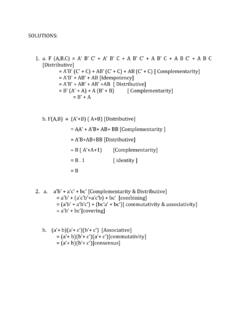
Transcription of Assignment 4 Solutions Pipelining and Hazards
1 Assignment 4 SolutionsPipelining and HazardsAlice LiangMay 3, 20131 Processor PerformanceThe critical path latencies for the 7 major blocks in a simple processor are given each part, answer the following is the critical path for a MIPS ADD instruction? Explain your the above schematic, some paths of note are the following:11. PC increment = Add + Add + Mux2. Control Unit = I-Mem + Control + ALUC ontrol + ALU + Mux3. Write Regs = I-Mem + Regs + Mux + ALU + MuxAfter comparing latencies, 3 should be the longest for both as Regs takes longer 400 + 200 + 30 + 140 + 30 = 800psb.
2 500 + 320 + 100 + 180 + 100 = the number of registers is doubled, this increases Regs by 100ps and Control by 20ps. This results in 10%fewer instructions due to fewer load/stores. What is the new critical path for a MIPS ADD instruction?10\% fewer instructions doesn t affect the critical path at all. Regs still takes longerthan Control and so does not change the critical path from 800 + 100 = 900psb. 1200 + 100 = 1300ps2 PipeliningThe 5 stages of the processor have the following that when Pipelining , each pipeline stage costs 20ps extra for the registers between processor: what is the cycle time?
3 What is the latency of an instruction? What is thethroughput?Because there is no Pipelining , the cycle time must allow an instruction to go through allstages in one cycle. The latency is the same as cycle time since it takes the instructionone cycle to go from the beginning of fetch to the end of writeback. The throughput isdefined as 1/CT CT = 300 + 400 + 350 + 550 + 100 = 1700psLatency = 1700psThroughput = 1/1700 inst/psb. CT = 200 + 150 + 100 + 190 + 140 = 780psLatency = 780psThroughput = 1/780 processor: What is the cycle time? What is the latency of an instruction?
4 What is the throughput? Pipelining reduces the cycle time to the length of the longest stage plus the registerdelay. Latency becomes CT*N where N is the number of stages as one instruction will needto go through each of the stages and each stage takes one cycle. The throughput formularemains the CT = 550 + 20 = 570 psLatency = 5 * 570 = 2850psThroughput = 1/570 inst/psb. CT = 200 + 20 = 220 psLatency = 5 * 220 = 1100psThroughput = 1/220 you could split one of the pipeline stages into 2 equal halves, which one would you choose? What is thenew cycle time? What is the new latency?
5 What is the new throughput?We would want to choose the longest stage to split in half. The new cycle time becomes theoriginally 2nd longest stage length. Calculate latency and throughput correspondingly, butremember there are now 6 stages instead of CT = 400 + 20 = 420 psLatency = 6 * 420 = 2520 psThroughput = 1/420 inst/psb. CT = 190 + 20 = 210 psLatency = 6 * 210 = 1260 psThroughput = 1/210 the distribution of instructions that run on the processor is:50%: ALU25%: BEQ15%: LW10%: SWAssuming there are no stalls or Hazards , what is the utilization of the data memory?
6 What is the utilizationof the register block s write port? (Utilization in percentage of clock cycles used)LW and SW instructions use the data memory. As a result, the utilization of the data memoryis 15% + 10% = 25%.Similarly, ALU and LW instructions use the register block s write port. As a result, theutilization of the register block s write port is 50% + 15% = 65%.33 Data More PipelinesYou are given a non-pipelined processor design which has a cycle time of 10ns and average CPI of the latency speedup in the following : The Solutions given assume the base CPI = throughput.
7 Since the question isambiguous, you could assume Pipelining changes the CPI to 1. The method for computing theanswers still is the best speedup you can get by Pipelining it into 5 stages?5x new latency would be 10ns/5 = the 5 stages are 1ns, , 4ns, 3ns, and , what is the best speedup you can get compared to theoriginal processor?The cycle time is limited by the slowest stage, so CT = = old CT / new CT = 10ns/4ns = each pipeline stage added also adds 20ps due to register setup delay, what is the best speedup you can getcompared to the original processor?
8 Adding the register delay, the new CT = = 10 = pipeline from stalls 20% of the time for 1 cycle and 5% of the time for 2 cycles (these occurencesare disjoint). What is the new CPI? What is the speedup compared to the original processor?New CPI = ( ) + ( ) + ( ) = performance = old CT * old CPI = 10 * = 14 New performance = new CT * new CPI = * = = 14 =