Example: bankruptcy
Balance problems after stroke - Stroke Association
Balance is very complex and involves many different parts of the body such as your ears, eyes, and sensory nerves in your muscles and joints. Balance problems and dizziness can also be caused by a number of health problems other than stroke. Treating an underlying condition can help improve your balance, and
Tags:
Information
Domain:
Source:
Link to this page:
Documents from same domain
Stroke elline Wesite
www.stroke.org.ukStroke elline Wesite stroke.org.uk Stroke Association April 1 Dementia after stroke Dementia is a life-changing condition that affects your ability to do
Occupational therapy after stroke - Stroke …
www.stroke.org.ukOccupational therapy after stroke For more information visit stroke.org.uk 3 success. The therapist can help you measure your success, for example by breaking down
Smoking and the risk of stroke - Stroke Association
www.stroke.org.uk4 Stroke Association – April 2012 Smoking and the risk of stroke ‘Quit Widgets’ for your computer and smart phone. Medication There are different types of medicines that can help you stop smoking such as nicotine
Speech and language therapy after stroke
www.stroke.org.ukStroke Association April 2012 3 Speech and language therapy after stroke This should be followed by a formal assessment. This may pick up problems
Emotional hanes ate stoe
www.stroke.org.ukStoe elline Website stroke.org.uk Emotional hanes ate stoe Stroke Association – April 1 Why have my emotions been affected? If your emotions or behaviour have changed
Communication problems ater stroke
www.stroke.org.uk2 Stroke Association April 2012 Communication problems ater stroke There are different types of aphasia: • If your problems are mainly with understanding what is …
Physical eects of stroke
www.stroke.org.ukPhysical eects of stroke Stroke Association – June 2013 1 ... Drop foot This is a condition where your toes catch on the ground when you step forward because ... Treatments for drop-foot Ankle-foot orthosis There are devices available to give you more support and stability.
Books and resources about stroke
www.stroke.org.ukspecific topics such as aphasia, personal experiences of stroke and ... management and recovery in nine clear and illustrated chapters. Books written from personal experience Also see some of the titles listed under ... Books and resources about stroke. Stroke useful.
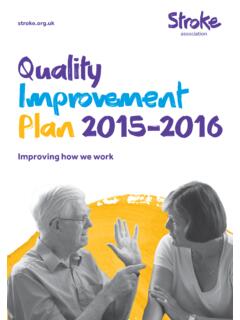
stroke.org.uk Quality Improvement Plan 2015-2016
www.stroke.org.ukstroke.org.uk Quality Improvement Plan 2015-2016 Improving how we work. 2 Quality Improvement Plan 2014 - 2015 Contents Introducing the Stroke Association 3 Stroke facts and figures 4 Our quality 5 Our commitment to you 6 ... 4. improvement. Quality Improvement Plan 2014 - 2015.
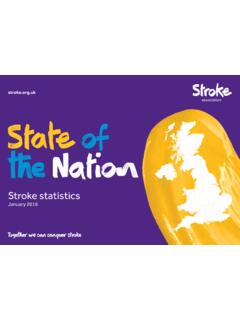
stroke.org.uk State of the Nation - Stroke Association
www.stroke.org.uk4 State of the Nation Stroke statistics - January 2016 • Stroke kills twice as many women as breast cancer and more men than prostate and testicular cancer combined a year. • Black people are twice as likely to have a stroke compared to white people. • Black and South Asian people have strokes at a younger age compared to white people.
Related documents

Dizziness & balance problems - Brain and Spine
www.brainandspine.org.ukDizziness and balance problems can affect people of all ages. You are more likely to experience dizziness as you get older, and some studies suggest that it is more common in females than males. Most people who experience dizziness or balance problems make a good recovery, although some people might experience frequent or constant
ACTIVITIES-SPECIFIC BALANCE CONFIDENCE (ABC) SCALE
www.exercisepd.comPts in a balance and vestibular clinic 71 Correlation between dizziness handicap inventory (DHI) and ABC (age 26 -88) was -.64. 15 Mild balance impairment 177 184 ABC correlated with tandem stance time, unipedal stance time, tandem walking, TUG, 6MWT, Tinneti’s Performance Oriented Mobility Assessment (.52-.63).16

Persistent Postural- DISORDERS Perceptual Dizziness
vestibular.orgdizziness, or disruption of balance such as: ο A peripheral or central vestibular disorder (e.g., BPPV, vestibular neuritis, Meniere’s disease, stroke) ο Vestibular migraine ο Panic attacks with dizziness ο Mild traumatic brain injury (concussion or whiplash) ο Dysautonomia (disease of the autonomic nervous system)

ASSESSMENT AND TREATMENT - Medical College of …
www.mcw.eduA PRACTICAL GUIDE TO DIZZINESS AND DISEQUILIBRIUM Evaluation/Treatment of BPPV 1) Perform Dix-Hallpike test on any patient reporting vertigo/dizziness with getting in/out of bed, tipping head back or bending over AND on any patient >65 with reports of imbalance or dizziness. 2) If Dix-Hallpike is negative, perform Roll Test.

Persistent postural-perceptual dizziness (PPPD): a common ...
pn.bmj.comunsteadiness, dizziness, or problems with balance, including acute, episodic or chronic vestibular syndromes, other neurological or medical illnesses, and psychological distress. 1. When triggered by an acute or episodic precipi-tant, symptoms settle into the pattern of crite-rion A as the precipitant resolves, but may occur
—An Effective, Evidence-Based Treatment - VeDA
vestibular.orgDizziness itself is not a disease—it is a symptom that can result from a vestibular disorder or from difficulties unrelated to the inner ear, such as cardiovascular, neurological, metabolic, vision, or psychological disorders. However, as many as 45% of people with dizziness symptoms have problems in the vestibular system (balance organs of the

Positional Dizziness (BPPV) - Pat
www.pat.nhs.ukPositional dizziness Positional dizziness, known as Benign Paroxysmal Positional Vertigo (or BPPV) is a disorder that usually causes spinning dizziness with certain head movements. About 20% of all dizziness is due to BPPV, and approximately 50% of dizziness in older people is due to BPPV. It occurs when loose crystals collect
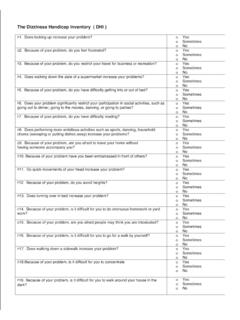
The Dizziness Handicap Inventory ( DHI )
geriatrictoolkit.missouri.eduThe patient is asked to answer each question as it pertains to dizziness or unsteadiness problems, specifically considering their condition during the last month. Questions are designed to incorporate functional (F), physical (P), and emotional (E) impacts on disability. To each item, the following scores can be assigned: No=0 Sometimes=2 Yes=4
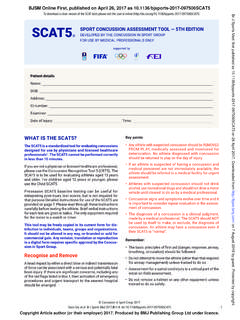
Sport concussion assessment tool - 5th edition
bjsm.bmj.comBalance / gait difficulties / motor incoordination: stumbling, slow / laboured movements Y N Disorientation or confusion, or an inability to respond appropriately to questions Y N Blank or vacant look Y N Facial injury after head trauma Y N STEP 3: MEMORY ASSESSMENT MADDOCKS QUESTIONS2 “I am going to ask you a few questions, please listen ...