Example: barber
BIOMOLECULESSSS
1. Glycogen is a branched chain polymer of α-D-glucose units in which chain is formed by C1—C4 glycosidic linkage whereas branching occurs by the formation of C1-C6 glycosidic linkage. Structure of glycogen is similar to _____. (i) Amylose (ii) Amylopectin (iii) Cellulose (iv) Glucose 2. Which of the following polymer is stored in the liver ...
Tags:
Information
Domain:
Source:
Link to this page:
Documents from same domain
Objectives Polymers - National Council of …
ncert.nic.in427 Polymers C:\Chemistry-12\Unit-15.pmd 28.02.07 Polymers can also be classified on the basis of mode of polymerisation into two sub groups.
ENVIRONMENTAL CHEMISTRY - National Council …
ncert.nic.in400 CHEMISTRY (c) Hydrocarbons: Hydrocarbons are composed of hydrogen and carbon only and are formed by incomplete combustion of fuel …
SEMICONDUCTOR AND SIMPLE CIRCUITSnot to be …
ncert.nic.in469 Semiconductor Electronics: Materials, Devices and Simple Circuits semiconductors. However , after 1990, a few semiconductor devices using organic semiconductors and semiconducting polymers have been
ntse exam notification - National Council Of …
ncert.nic.inExamination: The tentative pattern of written examination will be as follows: Stage-I & Il : examination at the State/UT level will comprise of three papers i.e.
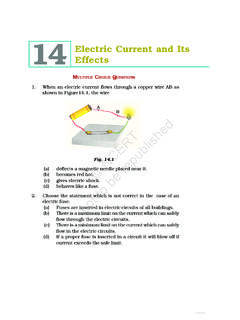
14 Effects Electric Current and Its - National …
ncert.nic.in76 EXEMPLAR PROBLEMS 3. Three bulbs A, B, C are connected in a circuit as shown in Figure 14.2. When the switch is ‘ON’ (a) bulb C will glow first. (b) bulb B and C will glow simulaneously and bulb A will
LAWS OF MOTION
ncert.nic.inLAWS OF MOTION 91 In practice, the ball does come to a stop after moving a finite distance on the horizontal plane, because of the opposing force of friction which
DESIGN OF THE QUESTION PAPER Mathematics …
ncert.nic.inDESIGN OF THE QUESTION PAPER, SET-I 207 (A) 18 5 (B) 17 5 (C) 17 8 (D) 1 7. In the adjoining figure, PA and PB are tangents from a point P to a circle with centre O.
CHAPTER 10
ncert.nic.in(A) Main Concepts and Results Circle, radius, diameter , chord, segment, cyclic quadrilateral. • Equal chords of a circle (or of congruent circles) subtend equal angles at the
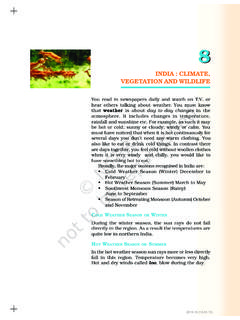
INDIA : CLIMATE, VEGETATION AND WILDLIFE
ncert.nic.inINDIA : CLIMATE, VEGETATION AND WILDLIFE 59 year. Therefore, they always appear gr een and are called evergreen forest as you may notice in Figure
TEXTBOOK IN GEOGRAPHY FOR CLASS IX
ncert.nic.inFOREWORD The National Curriculum Framework, (NCF) 2005, recommends that children’s life at school must be linked to their life outside the school. This principle
Related documents
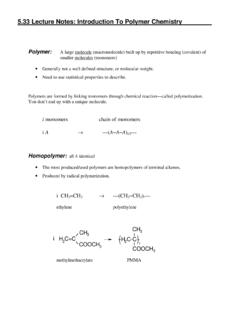
5.33 Lecture Notes: Introduction To Polymer Chemistry
web.mit.edu5.33, Introduction to Polymer Chemistry Page 4 Classification of polymers: Polymers (synthetic) 1) Thermoplastics (plastics) — linear, some cross -linking can be melted and reformed on heating a) Amorphous — no ordered structure b) Semi -crystalline — compo sed of microscopic crystallites — domains of crystalline structure.

CHAPTERS 14/15: POLYMER STRUCTURES, APPLICATIONS, & …
www3.nd.eduThe Polymers Chemistry: Ethylene Polyethylene • Polymerization: the reaction of the monomers to form the polymer macromolecule (a) The initial monomer (R); (b) Under certain conditions (T, P) in the presence of catalyst the double bonds break: forming a highly reactive radical with an unpaired electron, ready for the linking
Principles of Polymer Chemistry - ndl.ethernet.edu.et
ndl.ethernet.edu.etof polymer chemistry on the elementary level is not required, some exposure to the subject on the undergraduate level would probably be helpful. Each topic, however, is presented with the assump-tion that the reader has no prior knowledge of the subject. This book consists of ten chapters. A separate chapter on physical properties and physical
Pearson Edexcel International GCSE Chemistry
qualifications.pearson.comcan be used to make a polymer. (i) Give the name of the compound C 3 H 6 (1)..... (ii) Complete the table of information about this compound. (3) Type of formula Formula molecular C 3 H 6 C n H 2n CH 2 displayed (iii) Complete this structure to show the part of the polymer formed from two molecules of C 3 H 6 (2) –– C–– C–– C ...
Molecular Biology Fundamentals
www.esp.orgunderstand the structure and chemistry of proteins themselves, and (2) efforts to discover, catalog, and understand enzymatically ... polymer consisting of four subunits could not encode information, it was widely held that DNA provided only a structural role in chromosomes and

An Introduction to Gas Chromatography Mass Spectrometry
www.ucl.ac.ukThe international Union of Pure and Applied Chemistry (IUPAC) has drafted a ... often polymer, is coated or bonded on the wall of the capillary tube. Special high temperature polyimide coating Fused silica Stationary phase with Engineered Self Cross-linking (ESC) technology .

BD Vacutainer - Stanford University
iti.stanford.eduBD Vacutainer SST™ Tubes contain spray-coated silica and a polymer gel for serum separation. They are used for serum determinations in chemistry. BD Vacutainer® SST™ Tubes provide an efficient means of serum sample preparation and help to improve laboratory workflow. Closure Reference # Tube Size Draw Volume Type Colour Label type (mm) (mL)

Syllabus of LEADER ONLINE TEST SERIES TARGET JEE (Main ...
s3-ap-southeast-1.amazonaws.comTest Name Test Date Physics Chemistry Maths Test Pattern Basic Mathematics used in Physics, Vectors, Units, Dimensions and Measurement, Electrostatics Kinematics, Current electricity Laws of Motion and Friction, Capacitors GOC (Complete) Mole Concept, Atomic structure, Organic nomenclature, Basic principles of practical organic chemistry.