Transcription of BRE RdSAP Manual 5 - Identifying basic …
1 Building Research Establishment Ltd 2012 32 Identifying basic constructions Covered in this section: Traditional construction Non-traditional construction Modern Methods of construction (MMC) BRE Building Research Establishment Ltd 2012 33 Traditional construction The majority of houses/bungalows and many low-rise flats in Britain are of brick or brick and block wall construction , with pitched/sloping timber roofs. Solid wall construction was common from the 1800s to 1950. Cavity wall construction was introduced as early as 1900 in some areas but predominates from 1935 to the present day. Solid walls: Pre 1850 to 1950. Cavity walls: 1935 to present. Be aware of different mixes of header and stretcher bonds that require closer inspection to determine if a cavity is present and if the cavity has been insulated retrospectively.
2 Both the above walls are of cavity construction and both show drill holes where the cavity has been filled with injected insulation. RdSAP Convention Where a cavity wall has been identified, enter as such irrespective of the width of the cavity. Additional information on construction types in the Ageing properties and elements and Dwelling details sections. BRE Building Research Establishment Ltd 2012 34 Non-standard construction Definitions and further sources of information Included here are all constructions other than solid or cavity brick and/or block wall construction . Essentially they include: 1. Non-traditional Houses systems built between 1918 - 1980: Metal framed Pre-cast concrete In-situ concrete Timber framed Note: Both timber frame and system built are often described as non-traditional construction but they have different energy performances and are therefore identified separately in RdSAP .
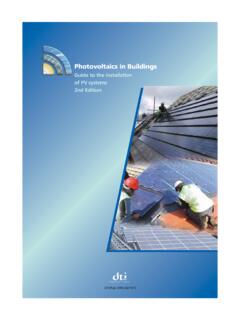
3 2. Modern Methods of construction (MMC) Dwellings constructed from the mid 1990 s, whose structural parts are wholly or in part manufactured off-site or on-site by contemporary methods. It includes complete housing systems built in factories through to new, site-based technologies. Identifying non-traditional and modern methods of construction Identifying specific construction types, whether non-traditional or modern methods of construction , can prove difficult. As such if you encounter a construction type that is unfamiliar to you then you should seek further advice. BRE have published several key publications to assist surveyors in Identifying construction systems: BRE Report 469 Non-traditional houses: Identifying non-traditional houses in the UK 1918-75 (below left).
4 BRE Report BR282 Timber frame housing 1920 -1975: Inspection and Assessment. BRE Report BR113 steel framed and steel clad houses: Inspection and Assessment. BRE CD ROM AP149 Non-traditional housing. A collection of 82 previously published reports and leaflets on specific types of non-traditional houses. BRE Trust FB11 Modern methods of house construction by Keith Ross (below right). REMEMBER know your limitations, if this is not your area of expertise then do not accept instructions for these types of dwellings without further specialist training. Refer to the BRE website for training courses or contact the team via email BRE Building Research Establishment Ltd 2012 35 Designated Defective A number of specific non-traditional dwelling types have been designated defective under the 1984 Housing Defects legislation (now part XVI of the Housing Act 1985) these are listed below.
5 Non-traditional dwellings - Designated Defective List Airey Ayrshire County Council Blackburn Orlit Boot Beaucrete Boot Pier and Panel Boswell Cornish Unit Type I Cornish Unit Type lI Dorran Dyke Gregory Mac-Girling Myton Newland Orlit Type I Orlit Type II Parkinson Reema Hollow Panel Schindler Smith Stent Stonecrete Tarran Temporary Bungalow Tee Beam Ulster Cottage Underdown Unitroy Unity Type I Unity Type II Waller Wates Wessex Whitson-Fairhurst Winget Woolaway Expect these types of dwellings to be over-clad and show other signs of remedial works. Cornish Unit Type 2: semi-detached left half over-clad. BRE Building Research Establishment Ltd 2012 36 Types of non-traditional construction Metal framed Principally these comprise steel framed (or steel and cast iron based) system built dwellings.
6 About 140,000 such dwellings have at some time or other been authorised for construction in the UK, and many different kinds of system have been used. In addition to the steel systems there were a small number of aluminium framed dwellings constructed. The majority of metal framed dwellings would have been constructed for local authorities, with many subsequently passing into private hands. Few records remain with local authorities as to their location however BRE Report BR113 steel framed and steel clad houses: Inspection and Assessment includes a useful list of locations. Some dwellings date from the interwar period but the majority date from the post Second World War period. This reflects the need for rapid re-building after the war and to a certain extent the availability of materials and manufacturing plant no longer directed to wartime production.
7 A common feature of many systems is that the finished dwelling was made to look as close as possible to conventionally built dwellings, with the preferred finishes either brick, imitation brick or render. Some of these disguises are nearly perfect and it takes more than a superficial examination to discover that some dwellings are indeed metal framed. On the other hand, some are immediately obvious as being of un-conventional design BISF Houses. If it is not obvious that the house is metal frame then the roof space is often the easiest place to confirm the construction type. The gable or flank wall normally comprises unlined sheathed metal framing, with the separating wall of metal stud framing, lined with plasterboard. It may also be possible to see the top of external wall panels at the eaves from within the roof where loft insulation does not preclude access.
8 Sometimes it is possible to identify construction within service cupboards where linings have not been installed. Type 3 first floor BISF Type 3 first floor Riley It is important to note that the cavities of metal clad houses should not be filled; external insulation should be used instead. Where cavities are filled there is an increased likelihood of corrosion caused by condensation. BRE Building Research Establishment Ltd 2012 37 Pre-cast concrete It is reported that around 284,000 dwellings in England have concrete panels as their predominant wall structure. The earliest being constructed during the 1920s but the majority being constructed during the 1950s and 1960s There are essentially two types of pre-cast concrete dwelling system: Panel systems Pre-cast concrete on concrete framing Panel systems These essentially involve producing flat reinforced concrete panel units in a factory and transporting them to site for assembly.
9 The structural panels are then stacked on pre-prepared foundations to typically form room or flat sized boxes. Panels being supplied for use as walls, intermediate floors and roofs. Panels used as external walls may have the concrete textured or have an external finish such as brick, tile, paint or sheet material applied to provide an aesthetic finish. Widely used in high rise developments they were also used for low rise housing. With low rise developments it was common to use the concrete panels to create a toast rack of separating walls and to use alternative materials for the external walls to the front and rear of the property. Internally concrete panels were usually wet plastered but some will have been dry-lined. Note that there are 23 different large panel systems used in the UK to construct buildings with 4 or more storeys.
10 Pre-cast concrete on concrete framing In a large number of cases the external appearance of the dwelling will immediately indicate that it is a pre-cast concrete system built house as the frame and panels are left exposed. However a small number of systems were rendered externally during construction . Typically the systems comprise a concrete frame with storey height infill panels. The infill panels comprise pre-cast concrete panels which span either vertically or horizontally between the concrete frame. In most cases the infill panels are slotted so that they engage with the frame. Most systems were two storey and featured pitched roofs, but there are some three storey Cornish Unit blocks and most Orlit houses had flat roofs. Cornish Unit Type 1 Cornish Unit Type 2 Be aware that different types can look almost identical note the similarities between the Cornish Unit Type 1 and Gregory houses.