Transcription of Buffer calculation: Tris buffer - Tris(hydroxymethyl ...
1 181 Buffer calculation: Tris Buffer - Tris(hydroxymethyl )-aminomethaneCalculat e the pH of a Buffer made from 50 mL of tris and 50 mL of tris-HCl. Assume volumes basetris-HCl (conjugate acid of tris base)182 Take 100. mL of the previous Buffer ( M tris / M tris-HCl), and add mL of M is the pH of the mixture?The HCL should react with the basic component of the Buffer - changing it to its conjugate acid:We need to find out the NEW concentrations of all the species in the Buffer volume of solution is now 105 mL (100 mL Buffer , 5 mL acid)the original bufferpH was , so wesaw a decrease of pH this unit pH change with adding mL of M HCl to 100.
2 ML of pure acid completely ionizes, so hydronium concentration is set by the acid:.. which is a change of pH unirs compared to water's initial pH of !184 INDICATORS-Instead of using a pH meter to monitor acidity, we may choose to use an Acid-base indicators are weak acids or weak bases which are highly The color of the undissociated indicator MUST BE DIFFERENT than the color of thedissociated form!The indicator must be present in very low concentrations - so that the indicator's equilibrium DOES NOT CONTROL the pH of the solution!
3 REDBLUE185 Look at the Henderson-Hasselbalch equation - we want to know how much of the red formand how much of the blue form are present!When does the color of the indicator change? IF the pH is << pKa, then the log term above must be both large AND negative!- What color is the solution?If the pH is >> pKa, then the log term above must be both large AND positive!- What color is the solution?- So, the color changes when the pH of the solution is near the pKa of the indicator, BUTwe can only DETECT the change when enough of the other form is and the solution is and the solution is BLUE186 Titration- also called volumetric analysis.
4 See the end of Ebbing chapter 4 for more frequently used to determine concentration of unknown acids or typically react a basic sample with a STRONG ACID, or an acidic sample with a STRONG BASEE xample:Titrate 20 mL of vinegar (acetic acid) with M NaOH. Let's study this happens to the pH of the solution during the titration? How does an indicator work?187 Vinegar is typically about acetic acid. What would the EQUIVALENCEPOINT (the point where we react away all of the acetic acid) be?Let's look at the pH of the solution during the titration- that may show us what's going on!
5 In the lab, we have used phenolphthalein indicator for vinegar titrations. Phenolphthalein changes from colorless to pink over the range of about pH 9 to pH 10. How does this indicator show where the endpoint is?But how do we tell the titration is over if we don't already know the concentration of the acid?188 Titration curve for the titration of 20 mL of M acetic acid with M sodium hydroxidebuffer region: With a moderate amount of NaOH added, we have a solutionthat contains significant amounts of both acetic acid and its conjugatebase (acetate ion).
6 We have a point: We're reacting away more and more of the original acetic acid and converting it to acetate ion. At the equivalence point, all of the aceticacid has been converted, and we have only a solution of acetate equivalence point:190 Let's calculate the pH at the equivalence the equivalence point, we have mmol of ACETATE ION (20+ ) mL of you figure out the concentration of acetateion, this is simply the calculation of the pH ofa salt solution!191bufferregionEQUIVALENCEPOINT What about that phenolpthalein indicator?
7 Phenolphthaleincolor changeCLEARPINKNear the equivalence point, a very small volume of base added (a drop!) will change the pH from slightly over 6 to near 12. Since phenolphthalein changes colors at about pH 9-10, we can stop the titration within a drop ofthe equivalence changeAnother interesting point: The halfway pointWhat's special about it? It's the point where we have added half the required acid to reach the equivalence millimoles is also the amount of acid left, and the added base gets converted to acetate ion!
8 193bufferregionEQUIVALENCEPOINT phenolphthaleincolor changeThe total volume is mL, and both the acid and conuugate base (acetate)are present at the same concentration. We have a the halfway point, the pH = pKa of the acid!Find the pH of this Buffer using the Henderson-Hasselbalch for finding acidionization constants!194 Solubility as an equilibrium processSOLUTION: Homogeneous mixture of substances Solutions contain:SOLUTE: Component(s) of a solution present in small amountSOLVENT: Component of a solution present in greatest amountSOLUBILITY: The amount of a solute that will dissolve in a given volume of solventSATURATED SOLUTION: Contains the maximum amount of solute that it ispossible to dissolve in a given volume of solvent!
9 A SATURATED SOLUTION is a solution where dissolved solute exists in anEQUILIBRIUM with undissolved solute!We usually call water the solvent in aqueous mixtures, evenif the water is present in smaller amount than another component195 Example: Consider a saturated solution of silver chloride:At equilibrium, the rate of dissolving equals the rate of crystallization!.. what does this equilibrium constant tell us? That silver chloride isn't very soluble!196 This equilibrium constant is given a special name - the SOLUBILITY PRODUCT CONSTANT - because the equilibriumexpression for the dissolving of a salt always appears asa PRODUCT of the concentrations of the ions in the compound!
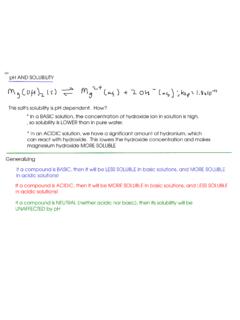
10 Remember, Ksp is an equilibrium constant, so everything that applies to equilibrium constants applies to the solubility constant - including what to do with coefficients:What is the solubility product constant expression for calcium phosphate?197 Solubility calculations and KspYou can calculate the solubility of a compound if you know Ksp!Calculate the solubility (in g/L) of lead(II) iodide at need to solve this equation, since thesewill give us equilibrium the dissolved lead concentration equals the dissolved lead(II) iodide : ppm (parts per million) is equivalent to mg/L for dilute aqueous solutions, and is a common unit for reporting amounts of impurities in water.