Transcription of BUSINESS CONTINUITY MANAGEMENT SYSTEM (BCMS)
1 MCMC MTSFB TC G014:2018. TECHNICAL CODE. BUSINESS CONTINUITY MANAGEMENT (BCM) - REQUIREMENTS. Developed by Registered by Registered date: 15 October 2018. Copyright 2018. MCMC MTSFB TC G014:2018. Development of technical codes The Communications and Multimedia Act 1998 ( the Act') provides for Technical Standards Forum designated under section 184 of the Act or the Malaysian Communications and Multimedia Commission ( the Commission') to prepare a technical code. The technical code prepared pursuant to section 185. of the Act shall consist of, at least, the requirement for network interoperability and the promotion of safety of network facilities. Section 96 of the Act also provides for the Commission to determine a technical code in accordance with section 55 of the Act if the technical code is not developed under an applicable provision of the Act and it is unlikely to be developed by the Technical Standards Forum within a reasonable time.
2 In exercise of the power conferred by section 184 of the Act, the Commission has designated the Malaysian Technical Standards Forum Bhd ( MTSFB') as a Technical Standards Forum which is obligated, among others, to prepare the technical code under section 185 of the Act. A technical code prepared in accordance with section 185 shall not be effective until it is registered by the Commission pursuant to section 95 of the Act. For further information on the technical code, please contact: Malaysian Communications and Multimedia Commission (MCMC). MCMC Tower 1. Jalan Impact Cyber 6. 63000 Cyberjaya Selangor Darul Ehsan MALAYSIA. Tel: +60 3 8688 8000. Fax: +60 3 8688 1000. OR. Malaysian Technical Standards Forum Bhd (MTSFB). Malaysian Communications & Multimedia Commission (MCMC).
3 Off Persiaran Multimedia Jalan Impact Cyber 6. Cyberjaya Selangor Darul Ehsan MALAYSIA. Tel: +60 3 8320 0300. Fax: +60 3 8322 0115. MCMC MTSFB TC G014:2018. Contents Page Committee representation .. iii Foreword .. iv 0. Introduction .. 1. 1. Scope .. 2. 2. Normative references .. 2. 3. Terms and definitions .. 2. BUSINESS CONTINUITY MANAGEMENT .. 2. BUSINESS CONTINUITY Plan (BCP) .. 2. BUSINESS Impact Analysis (BIA) .. 2. BUSINESS recovery .. 2. Critical BUSINESS functions .. 2. Interested party .. 2. Maximum Tolerable Period of Disruption (MTPD) .. 3. Minimum BUSINESS CONTINUITY Objective (MBCO) .. 3. Recovery Point Objective (RPO) .. 3. Recovery strategies .. 3. Recovery Time Objective (RTO) .. 3. Risk appetite .. 3. Risk assessment.
4 3. Top MANAGEMENT .. 3. 4. Abbreviations .. 4. 5. Context of organisation .. 4. Purpose of BUSINESS CONTINUITY MANAGEMENT SYSTEM (BCMS).. 4. Scope of BUSINESS CONTINUITY MANAGEMENT SYSTEM (BCMS) .. 5. 6. Leadership .. 5. MANAGEMENT 6. Policy .. 6. Responsibilities .. 7. 7. Planning .. 7. Addressing risks .. 7. BUSINESS CONTINUITY objectives .. 8. 8. Support .. 8. BUSINESS CONTINUITY MANAGEMENT SYSTEM (BCMS) 9. Incident response personnel .. 9. i MCMC MTSFB TC G014:2018. Competence .. 9. Communication ..10. Document control and change MANAGEMENT ..10. 9. Operations ..11. Operational planning and control ..11. Risk assessment (RA) and BUSINESS Impact Analysis (BIA) ..12. BUSINESS CONTINUITY strategies ..13. Establish and implement BUSINESS CONTINUITY procedures.
5 14. Exercising and testing ..17. 10. Performance evaluation ..18. Monitoring, measurement, analysis and evaluation ..18. Internal audit ..19. MANAGEMENT review ..19. 11. Non-conformity and corrective action ..20. Continual improvement ..21. Annex A Sample of qualitative Bibliography ..23. ii MCMC MTSFB TC G014:2018. Committee representation This technical code was developed by Trust and Privacy Sub Working Group which supervised by Security, Trust and Privacy Working Group under the Malaysian Technical Standards Forum Bhd (MTSFB) consists of representatives from the following organisations: Celcom Axiata Berhad Kementerian Sains, Teknologi dan Inovasi Pejabat Ketua Pegawai Keselamatan Kerajaan Malaysia Provintell Technologies Sdn Bhd Telekom Applied BUSINESS Sdn Bhd Telekom Malaysia Berhad TIME dotCom Berhad Universiti Kuala Lumpur webe digital sdn bhd iii MCMC MTSFB TC G014:2018.
6 Foreword This technical code for BUSINESS CONTINUITY MANAGEMENT (BCM) - Requirements ( this Technical Code'). was developed pursuant to section 185 of the Act 588 by the Malaysian Technical Standards Forum Bhd (MTSFB) via its Trust and Privacy Sub Working Group. It defines the general requirements to establish, maintain and implement effective BUSINESS CONTINUITY plan as an extension to the document MCMC MTSFB TC G009:2016'. Many BCM documents related to the requirements and guidelines available for reference. These documents are international standards, professional best practice, federal guidelines and federal regulations or directive. This technical code standardises the terms used in other organisations in order to achieve the common understanding while implementing the BUSINESS CONTINUITY MANAGEMENT SYSTEM .
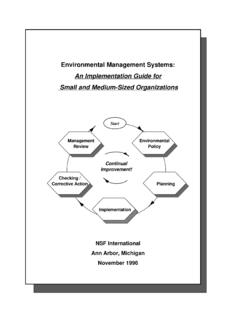
7 This Technical Code shall continue to be valid and effective until reviewed or cancelled. iv MCMC MTSFB TC G014:2018. BUSINESS CONTINUITY MANAGEMENT (BCM) - REQUIREMENTS. 0. Introduction Any major incident that escalates to disaster could have a significant BUSINESS impact over time on the organisation. The BUSINESS CONTINUITY MANAGEMENT (BCM) implementation (see Figure 1) is expected to provide the following benefits: a) provide a structured approach of managing risk within the organisation's environment;. b) provide strategic plan to respond and recover from risks that cannot be controlled or mitigated;. c) provide BUSINESS CONTINUITY and minimise damages and losses under adverse or abnormal conditions;. d) reduce negative impact to BUSINESS objectives .
8 E) encourage improved collaboration between its interested parties;. f) provides assurance to top MANAGEMENT and interested parties that it can depend upon predetermined levels of services in the event of a disruption;. g) enhance the organisation's reputation for prudence and efficiency; and h) potentially gains competitive advantage through the demonstrated ability to deliver BUSINESS CONTINUITY and maintain product and service delivery in the event of disruption. Figure 1. BCM implementation cycle 1. MCMC MTSFB TC G014:2018. 1. Scope This Technical Code defines the requirements that support the implementation of the BCM in an organisation. The requirement set out in this Technical Code are generic and intended to be applicable to any size of organisation.
9 2. Normative references The following normative references are indispensable for the application of this Technical Code. For dated references, only the edition cited applies. For updated references, the latest edition of the normative references (including any amendments) applies. ISO 31000, Risk MANAGEMENT - Principles and guidelines 3. Terms and definitions For the purposes of this Technical Code, the following terms and definitions apply. BUSINESS CONTINUITY MANAGEMENT Holistic MANAGEMENT process that identifies potential threats to an organisation and the impacts to BUSINESS operations those threats, if realised, might cause, and which provides a framework for building organisational resilience with the capability of an effective response that safeguards the interests of its key interested party, reputation, brand and value creating activities.
10 BUSINESS CONTINUITY Plan (BCP). Documented procedures that guide organisations to respond, recover, resume and restore to pre- defined level of operation following a disruption. This covers resources, services and activities required to ensure the CONTINUITY of critical BUSINESS functions . BUSINESS Impact Analysis (BIA). Process of analysing activities and the effect that a BUSINESS disruption might have upon them. BUSINESS recovery The courses of action for rebuilding functions to the condition where they are ready to maintain product and service delivery. This condition should be at a level sufficient to meet minimum BUSINESS CONTINUITY objective. Critical BUSINESS functions Vital functions without which an organisation will either not survive or will lose the capability to effectively achieve its critical objectives , such as delivery of key products and services, operational support functions etc.