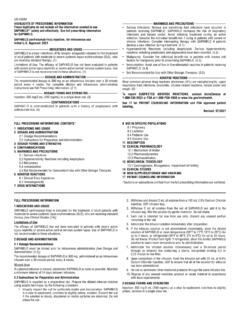
Transcription of CALQUENCE PRESCRIBING INFORMATION
1 US-33441 HIGHLIGHTS OF < strong >PRESCRIBINGstrong > < strong >INFORMATIONstrong > These highlights do not include all the < strong >INFORMATIONstrong > needed to use < strong >CALQUENCEstrong > safely and effectively. See full < strong >PRESCRIBINGstrong > < strong >INFORMATIONstrong > for (acalabrutinib) capsules, for oral use Initial Approval: 2017-------------------------------- RECENT MAJOR CHANGES ---------------------------------Indicat ions and Usage ( ) 11/2019 Dosage and Administration ( ) 11/2019--------------------------------- INDICATIONS AND USAGE ---------------------------------CALQUEN CE is a kinase inhibitor indicated for the treatment of adult patients with: Mantle cell lymphoma (MCL) who have received at least one prior therapy. ( ) This indication is approved under accelerated approval based on overall response rate. Continued approval for this indication may be contingent upon verification and description of clinical benefit in confirmatory trials. ( , ) Chronic lymphocytic leukemia (CLL) or small lymphocytic lymphoma (SLL).
2 ( )----------------------------- DOSAGE AND ADMINISTRATION ------------------------------ Recommended dose is 100 mg orally approximately every 12 hours; swallow whole with water and with or without food. ( ) Advise patients not to break, open, or chew capsules. ( ) Manage toxicities using treatment interruption, dose reduction, or discontinuation. ( ) Avoid < strong >CALQUENCEstrong > in patients with severe hepatic impairment ( , )---------------------------- DOSAGE FORMS AND STRENGTHS ----------------------------Capsules: 100 mg. (3)------------------------------------ CONTRAINDICATIONS -----------------------------------None. (4)----------------------------- WARNINGS AND PRECAUTIONS ------------------------------ Serious and Opportunistic Infections: Monitor for signs and symptoms of infection and treat promptly. ( ) Hemorrhage: Monitor for bleeding and manage appropriately.
3 ( ) Cytopenias: Monitor complete blood counts regularly. ( ) Second Primary Malignancies: Other malignancies have occurred, including skin cancers and other solid tumors. Advise patients to use sun protection. ( ) Atrial Fibrillation and Flutter: Monitor for symptoms of arrhythmias and manage. ( )------------------------------------ ADVERSE REACTIONS -----------------------------------Most common adverse reactions (incidence 30%) were: anemia, neutropenia, upper respiratory tract infection, thrombocytopenia, headache, diarrhea, and musculoskeletal pain. ( )To report SUSPECTED ADVERSE REACTIONS, contact AstraZeneca at 1-800-236-9933 or FDA at 1-800-FDA-1088 or DRUG INTERACTIONS ----------------------------------- CYP3A Inhibitors: Avoid co-administration with strong CYP3A inhibitors. Dose adjustments may be recommended. ( , 7, ) CYP3A Inducers: Avoid co-administration with strong CYP3A inducers.
4 Dose adjustments may be recommended. ( , 7, ) Gastric Acid < strong >reducingstrong > Agents: Avoid co-administration with proton pump inhibitors (PPIs). Stagger dosing with H2-receptor antagonists and antacids. ( , 7, )----------------------------- USE IN SPECIFIC POPULATIONS ------------------------------ Pregnancy: May cause fetal harm and dystocia ( ) Lactation: Advise not to breastfeed. ( )See 17 for PATIENT COUNSELING < strong >INFORMATIONstrong > and FDA-approved patient labeling. Revised: 11/2019 FULL < strong >PRESCRIBINGstrong > < strong >INFORMATIONstrong > : CONTENTS*1 INDICATIONS AND USAGE Mantle Cell Lymphoma Chronic Lymphocytic Leukemia or Small Lymphocytic Lymphoma2 DOSAGE AND ADMINISTRATION Recommended Dosage Recommended Dosage for Hepatic Impairment Recommended Dosage for Drug Interactions Concomitant Use with Gastric Acid < strong >reducingstrong > Agents Dose Modifications for Adverse Reactions3 DOSAGE FORMS AND STRENGTHS4 CONTRAINDICATIONS5 WARNINGS AND PRECAUTIONS Serious and Opportunistic Infections Hemorrhage Cytopenias Second Primary Malignancies Atrial Fibrillation and Flutter6 ADVERSE REACTIONS Clinical Trials Experience7 DRUG INTERACTIONS8 USE IN SPECIFIC POPULATIONS Pregnancy Lactation Females and Males of Reproductive Potential Pediatric Use Geriatric Use Hepatic Impairment11 DESCRIPTION12 CLINICAL PHARMACOLOGY Mechanism of Action Pharmacodynamics Pharmacokinetics13 NONCLINICAL TOXICOLOGY Carcinogenesis.
5 Mutagenesis, Impairment of Fertility14 CLINICAL STUDIES Mantle Cell Lymphoma Chronic Lymphocytic Leukemia16 HOW SUPPLIED/STORAGE AND HANDLING17 PATIENT COUNSELING < strong >INFORMATIONstrong > *Sections or subsections omitted from the full < strong >PRESCRIBINGstrong > < strong >INFORMATIONstrong > are not < strong >PRESCRIBINGstrong > < strong >INFORMATIONstrong > 1 INDICATIONS AND USAGE Mantle Cell LymphomaCALQUENCE is indicated for the treatment of adult patients with mantle cell lymphoma (MCL) who have received at least one prior indication is approved under accelerated approval based on overall response rate [see Clinical Studies ( )]. Continued approval for this indication may be contingent upon verification and description of clinical benefit in confirmatory Chronic Lymphocytic Leukemia or Small Lymphocytic LymphomaCALQUENCE is indicated for the treatment of adult patients with chronic lymphocytic leukemia (CLL) or small lymphocytic lymphoma (SLL).
6 2 DOSAGE AND ADMINISTRATION Recommended DosageCALQUENCE as MonotherapyFor patients with MCL, CLL, or SLL, the recommended dose of < strong >CALQUENCEstrong > is 100 mg taken orally approximately every 12 hours until disease progression or unacceptable in Combination with ObinutuzumabFor patients with previously untreated CLL or SLL, the recommended dose of < strong >CALQUENCEstrong > is 100 mg taken orally approximately every 12 hours until disease progression or unacceptable toxicity. Start < strong >CALQUENCEstrong > at Cycle 1 (each cycle is 28 days). Start obinutuzumab at Cycle 2 for a total of 6 cycles and refer to the obinutuzumab < strong >PRESCRIBINGstrong > < strong >INFORMATIONstrong > for recommended dosing. Administer < strong >CALQUENCEstrong > prior to obinutuzumab when given on the same (acalabrutinib) capsules, for oral use2 Advise patients to swallow capsule whole with water. Advise patients not to open, break or chew the capsules.
7 < strong >CALQUENCEstrong > may be taken with or without food. If a dose of < strong >CALQUENCEstrong > is missed by more than 3 hours, it should be skipped and the next dose should be taken at its regularly scheduled capsules of < strong >CALQUENCEstrong > should not be taken to make up for a missed Recommended Dosage for Hepatic ImpairmentAvoid administration of < strong >CALQUENCEstrong > in patients with severe hepatic modifications are not required for patients with mild or moderate hepatic impairment [see Use in Specific Populations ( ) and Clinical Pharmacology ( )]. Recommended Dosage for Drug InteractionsDose Modifications for Use with CYP3A Inhibitors or Inducers These are described in Table 1 [see Drug Interactions (7)]. Table 1: Recommended Dose Modifications for Use with CYP3A Inhibitors or InducersCYP3 ACo-administered DrugRecommended < strong >CALQUENCEstrong > useInhibitionStrong CYP3A inhibitorAvoid concomitant these inhibitors will be used short-term (such as anti-infectives for up to seven days), interrupt CYP3A inhibitor100 mg once CYP3A inducerAvoid concomitant these inducers cannot be avoided, increase < strong >CALQUENCEstrong > dose to 200 mg approximately every 12 Use with Gastric Acid < strong >reducingstrong > AgentsProton Pump Inhibitors: Avoid concomitant use [see Drug Interactions (7)].
8 H2-Receptor Antagonists: Take < strong >CALQUENCEstrong > 2 hours before taking a H2-receptor antagonist [see Drug Interactions (7)].Antacids: Separate dosing by at least 2 hours [see Drug Interactions (7)]. Dose Modifications for Adverse ReactionsRecommended dose modifications of < strong >CALQUENCEstrong > for Grade 3 or greater adverse reactions are provided in Table 2. Table 2: Recommended Dose Modifications for Adverse ReactionsEventAdverse Reaction OccurrenceDose Modification(Starting dose = 100 mg approximately every 12 hours)Grade 3 or greater non-hematologic toxicities, Grade 3 thrombocytopenia with bleeding, Grade 4 thrombocytopeniaorGrade 4 neutropenia lasting longer than 7 days First and Second Interrupt < strong >CALQUENCEstrong > . Once toxicity has resolved to Grade 1 or baseline level, < strong >CALQUENCEstrong > may be resumed at 100 mg approximately every 12 < strong >CALQUENCEstrong > . Once toxicity has resolved to Grade 1 or baseline level, < strong >CALQUENCEstrong > may be resumed at a reduced frequency of 100 mg once reactions graded by the National Cancer Institute Common Terminology Criteria for Adverse Events (NCI CTCAE).
9 Refer to the obinutuzumab < strong >PRESCRIBINGstrong > < strong >INFORMATIONstrong > for management of obinutuzumab DOSAGE FORMS AND STRENGTHS 100 mg CONTRAINDICATIONS WARNINGS AND PRECAUTIONS Serious and Opportunistic InfectionsFatal and serious infections, including opportunistic infections, have occurred in patients with hematologic malignancies treated with or Grade 3 or higher infections (bacterial, viral, or fungal) occurred in 19% of 1029 patients exposed to < strong >CALQUENCEstrong > in clinical trials, most often due to respiratory tract infections (11% of all patients, including pneumonia in 6%). These infections predominantly occurred in the absence of Grade 3 or 4 neutropenia, with neutropenic infection reported in of all patients. Opportunistic infections in recipients of < strong >CALQUENCEstrong > have included, but are not limited to, hepatitis B virus reactivation, fungal pneumonia, Pneumocystis jiroveci pneumonia, Epstein-Barr virus reactivation, cytomegalovirus, and progressive multifocal leukoencephalopathy (PML).
10 Consider prophylaxis in patients who are at increased risk for opportunistic infections. Monitor patients for signs and symptoms of infection and treat Hemorrhage Fatal and serious hemorrhagic events have occurred in patients with hematologic malignancies treated with < strong >CALQUENCEstrong > . Major hemorrhage (serious or Grade 3 or higher bleeding or any central nervous system bleeding) occurred in of patients, with fatal hemorrhage occurring in of 1029 patients exposed to < strong >CALQUENCEstrong > in clinical trials. Bleeding events of any grade, excluding bruising and petechiae, occurred in 22% of of antithrombotic agents concomitantly with < strong >CALQUENCEstrong > may further increase the risk of hemorrhage. In clinical trials, major hemorrhage occurred in of patients taking < strong >CALQUENCEstrong > without antithrombotic agents and of patients taking < strong >CALQUENCEstrong > with antithrombotic agents.