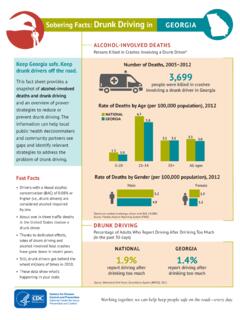
Transcription of CDC HIV Factsheet False Positive Test Results
1 May 2018 False - Positive HIV Test Results False - Positive Results and SpecificityWhen a person is not infected with HIV but receives a Positive test result, that result is considered a False Positive . Generally, HIV tests have high specificity, meaning that there are few False - Positive Results and most uninfected individuals are classified as uninfected by the test. If 1,000 uninfected people are tested with an HIV test and 4 have False - Positive Results , the HIV test s specificity is (996 true negative test Results /1,000 HIV uninfected persons tested). Causes of False - Positive HIV Test Results False - Positive test Results can occur due to technical issues associated with the test or biological causes. Technical issues include specimen mix-up, mislabeling, improper handling, and misinterpretation of a visually read rapid test result. Biological causes include participation in an HIV vaccine study, autoimmune disorders and other medical Additional testing to Distinguish True Positive from False Positive When a screening test is Positive , additional testing is needed to determine if the Positive result was accurate or whether the screening test result was falsely Positive .
2 If the screening test was a laboratory test, additional testing will generally occur using the original ,6 If it was a rapid test, additional testing may occur in one of three ways: by submitting a specimen to the laboratory, by conducting a rapid test algorithm ( , rapid tests from different test manufacturers in sequence), or by referring the individual to a healthcare provider who can conduct additional , 8 If a rapid test algorithm is conducted and the initial test is reactive, but the subsequent test is not, additional testing in a laboratory is needed to rule out an early Impact of HIV Prevalence HIV prevalence is the proportion of a population living with HIV infection. HIV prevalence within a population tested influences how many False - Positive Results there are relative to true- Positive Results . High prevalence: If you test 10,000 specimens and HIV prevalence is high (2%), 200 specimens will be from persons who are infected with HIV (true- Positive ) and 9,800 will be from persons who are not infected with HIV.
3 If test specificity is , Results for approximately 20 specimens will be False - Positive . In this case, of the 220 with Positive Results (200 true-positives plus 20 False -positives), 91% are actually infected with HIV. The number of true positives far exceeds the number of False positives. Low prevalence: If HIV prevalence is much lower ( ), only 10 of 10,000 specimens will be from persons who are infected with HIV (true- Positive ) and 9,990 will be from persons who are not infected with HIV. If test specificity is , Results for 20 specimens will be False - Positive . In this case, of the 30 with Positive Results (10 true-positives plus 20 False -positives), only 33% will be actually infected and the number of False -positives will exceed the number of true-positives. A testing program in a low prevalence population that implements routine testing of everyone in the population may be testing more low-risk people, and may expect to see more False - Positive than true- Positive Center for HIV/AIDS, Viral Hepatitis, STD, and TB PreventionDivision of HIV/AIDS PreventionHigh HIVprevalenceof 2%10,000 tested; test specificity is ~2091% True Positive (200/220)Low HIVprevalenceof ,000 tested; test specificity is ~2033% True Positive (10/30)Our testing program s HIV screening test has too many False - Positive Results .
4 What can we do?If you are testing a low-prevalence population, you can expect a higher proportion of all Positive tests to be False - Positive . If your testing program observes a number of False positives in excess of expectation for that screening test and specimen type ( , > 2 False positives per 100 negatives), contact the test manufacturer and your health Centers for Disease Control and Prevention and Association of Public Health Laboratories. Laboratory Testingfor the Diagnosis of HIV Infection: Updated Recommendations. 2014. June 27, Gill MJ, Rachlis A, Anand C. Five cases of erroneously diagnosed HIV infection. CMAJ : Canadian MedicalAssociation Journal. 1991;145(12) Wood RW, Dunphy C, Okita K, Swenson P. Two HIV-infected persons not really infected. Archives of InternalMedicine. 2003;163(15) Esteva MH, Blasini AM, Ogly D, Rodriguez MA.
5 False Positive Results for antibody to HIV in two men withsystemic lupus erythematosus. Annals of the Rheumatic Diseases. 1992;51(9) Shida S, Takahashi N, Fujishima N, et al. False - Positive human immunodeficiency virus antibody testand autoimmune hemolytic anemia in a patient with angioimmunoblastic T-cell lymphoma. Intern ;50(20) Association of Public Health Laboratories. Suggested Reporting Language for the HIV Laboratory DiagnosticTesting Algorithm. 2017; Accessed 11/03 Centers for Disease Control and Prevention. Planning and Implementing HIV testing Programs and LinkagePrograms in Nonclinical Settings: A Guide for Program Managers. 2014; 11/03 Centers for Disease Control and Prevention. Implementing HIV testing in Nonclinical Settings: A Guide forHIV testing Providers. 2016; Accessed 11/03 1-800-CDC-INFO (232-4636)Visit More InformationAll content is based on the most recent data available in May 2 of 2