Transcription of CDC Policy Analytical Framework
1 CDC s Policy Analytical FrameworkCenters for Disease Control and PreventionOffice of the Associate Director for PolicyCS247166-ASuggested Citation: Centers for Disease Control and Prevention. CDC s Policy Analytical Framework . Atlanta, GA: Centers for Disease Control and Prevention, US Department of Health and Human Services; more information, please contactCenters for Disease Control and Prevention1600 Clifton Road, Mailstop D-28 Atlanta, GA 30329-4027, USA Phone: 800-CDC-INFOE mail: site addresses of nonfederal organizations are provided solely as a service to readers. Provision of an address does not constitute an endorsement of this organization by CDC or the federal government, and none should be inferred.
2 CDC is not responsible for the content of other organizations Web S Policy Analytical FRAMEWORK3 This document provides a guide for identifying, analyzing, and prioritizing policies that can improve health. The Policy Analytical Framework (Figure 1) expands on domains I, II and III of CDC s Policy Process (Problem Identification, Policy analysis , and Strategy and Policy Development). The goals of this document are to: Improve the analytic basis for identifying and prioritizing policies that can improve health Improve the strategic approach to identify and further the adoption of Policy key steps include1. Identify the problem or issue 2.
3 Identify an appropriate Policy solution 3. Identify and describe Policy optionsa. Assess Policy optionsb. Prioritize Policy options4. Develop a strategy for furthering adoption of a Policy solutionCDC plays an important role in identifying and describing Policy options to address public health problems, analyzing policies to understand their potential health, economic and budgetary impacts, and identifying evidence-based Policy solutions and gaps in the evidence base. Note that federal law prohibits lobbying related activities by CDC at the federal, state and local level. CDC S Policy Analytical FRAMEWORK4 FIGURE 1: THE Policy Analytical Framework (DOMAINS I, II, III OF CDC S Policy PROCESS)CDC S Policy Analytical FRAMEWORK5 Domain 1: Problem IdentificationSTEP 1: IDENTIFY THE PROBLEM OR ISSUEThe first step is to clearly identify the problem or issue you are trying to address.
4 Synthesize data on the characteristics of the problem or issue, including the burden (how many people it affects), frequency (how often it occurs), severity (how serious of a problem is it), and scope (the range of outcomes it affects). It helps to define the problem or issue as specifically as possible for example lack of access to fresh fruits and vegetables (instead of obesity ) or barriers to sustaining HIV treatment (instead of HIV/AIDS ). A way to look for these is as contributing factors or risk factors in the literature on the public health problem. This level of specificity can help you understand how best to address the problem.
5 In addition, it is also useful to frame the problem in a way that helps illuminate possible Policy solutions. For example, providing safe places for people to be physically active in their communities (which has clear Policy solutions) instead of increasing physical activity (where the Policy options are not as clear). Domain 2: Policy AnalysisSTEP 2A. IDENTIFY AND DESCRIBE Policy OPTIONSIDENTIFYR esearch possible Policy options relevant to the problem or issue you have identified and described. Potential strategies for gathering evidence include reviewing literature on the topic, surveying best practices (including best practices in other problem/issue areas), and conducting an environmental scan to understand what other jurisdictions are doing.
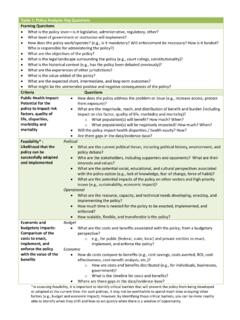
6 Be sure to collect evidence that addresses alternative and opposing points of view on the problem or issue and include the option of maintaining the status quo. DESCRIBE (TABLE 1)The first step is to describe each of the Policy options you have identified. Answer the overarching questions to describe the process and structure as well as the questions for each of the three interrelated criteria: health impact, feasibility, and economic and budgetary impacts (Table 1). To focus attention on the key components of each criterion, we developed a list of sample questions for each. Not all questions are appropriate for all problems or issues; furthermore, questions beyond those noted here should sometimes be considered.
7 Addressing these questions will enable you to assess Policy options in Step 2b. In answering the questions, it is possible to pull from different sources and types of evidence. Keep in mind that some sources and study design are of higher quality (see link table showing varying strength of different types of evidence). If you find that data are lacking on the specific Policy , consider data from similar policies used to address a different problem or S Policy Analytical FRAMEWORK6 TABLE 1: Policy analysis : KEY QUESTIONSFRAMING QUESTIONS What is the Policy lever is it legislative, administrative, regulatory, other? What level of government or institution will implement?
8 How does the Policy work/operate? ( , is it mandatory? Will enforcement be necessary? How is it funded? Who is responsible for administering the Policy ?) What are the objectives of the Policy ? What is the legal landscape surrounding the Policy ( , court rulings, constitutionality)? What is the historical context ( , has the Policy been debated previously)? What are the experiences of other jurisdictions? What is the value-added of the Policy ? What are the expected short, intermediate, and long-term outcomes? What might be the unintended positive and negative consequences of the Policy ? CRITERIAQUESTIONSP ublic health impact: Potential for the Policy to impact risk factors, quality of life, disparities, morbidity, and mortality How does the Policy address the problem or issue ( , increase access, protect from exposure)?
9 What are the magnitude, reach, and distribution of benefit and burden (including impact on risk factor, quality of life, morbidity and mortality)? What population will benefit? How much? When? What population will be negatively impacted? How much? When? Will the Policy impact health disparities / health equity? How? Are there gaps in the data/evidence-base?Feasibility*: Likelihood that the Policy can be successfully adopted and implementedPolitical What are the current political forces, including political history, environment, and Policy debate? Who are the stakeholders, including supporters and opponents? What are their interests and values?
10 What are the potential social, educational, and cultural perspectives associated with the Policy option ( , lack of knowledge, fear of change, force of habit)? What are the potential impacts of the Policy on other sectors and high priority issues ( , sustainability, economic impact)?Operational What are the resource, capacity, and technical needs developing, enacting, and implementing the Policy ? How much time is needed for the Policy to be enacted, implemented, and enforced? How scalable, flexible, and transferable is the Policy ?Economic and budgetary impacts: Comparison of the costs to enact, implement, and enforce the Policy with the value of the benefitsBudget What are the costs and benefits associated with the Policy , from a budgetary perspective?