Example: marketing
Chapter 10 Bernoulli Theorems and Applications
Bernoulli Theorems and Applications 10.1 The energy equation and the Bernoulli theorem There is a second class of conservation theorems, closely related to the conservation of energy discussed in Chapter 6. These conservation theorems are collectively called Bernoulli Theorems since the scientist who first contributed in a fundamental way to the
Tags:
Information
Domain:
Source:
Link to this page:
Documents from same domain

Gary McGrath Al Suchy - Woods Hole …
www.whoi.eduMANAGEMENT SYSTEM MANUAL ARM-03 BALLAST WATER MANAGEMENT PLAN Originator: Approved By: Gary McGrath Al Suchy Page 1 of 47 Number: ARM-03 Revision 22 Effective Date: 10/8/2015

Methods to account for spatial autocorrelation in …
www.whoi.eduMethods to account for spatial autocorrelation in the analysis of species distributional data: a review Carsten F. Dormann, Jana M. McPherson, Miguel B. Arau´jo, Roger Bivand, Janine Bolliger,

Stable Carbon Isotope Geochemistry
www.whoi.edu5 Isotope Fractionation during Photosynthesis, ε P In photosynthesis 12CO 2 is preferentially taken up relative to 13CO 2.There are two stages when kinetic isotope effects can occur:

Lecture 2: Constitutive Relations
www.whoi.eduLecture 2: Constitutive Relations E. J. Hinch 1 Introduction This lecture discusses equations of motion for non-Newtonian uids. Any uid must satisfy

Lecture 1: Introduction to ocean tides
www.whoi.eduLecture 1: Introduction to ocean tides Myrl Hendershott 1 Introduction The phenomenon of oceanic tides has been observed and studied by humanity for centuries.

SEDIMENT BACTERIA: Who’s There, What Are They …
www.whoi.eduP1: HCS/plb P2: MBL/vks/mkv QC: MBL/abe T1: MBL March 28, 1997 14:5 Annual Reviews NEALTEXT.txt AR29-12 BACTERIA IN SEDIMENTS 405 …
Uses of Derivative Spectroscopy
www.whoi.eduUses of Derivative Spectroscopy Application Note UV-Visible Spectroscopy Anthony J. Owen Derivative spectroscopy uses first or higher derivatives of absorbance

Organic Paleothermometers: Long-chain ketones …
www.whoi.edu1 Organic "Paleothermometers": Long-chain ketones (alkenones) and glycerol dialkyl glycerol tetraethers (GDGTs) as SST indicators General Reading:

Terrestrial Organic Carbon Inputs to Marine Sediments
www.whoi.edu1 Terrestrial Organic Carbon Inputs to Marine Sediments Reading List Hedges J.I. and Oades J.M. (1997) Comparative organic geochemistries of soils and

Terrestrial Organic Carbon Inputs to Marine Sediments
www.whoi.edu8 Molecular markers of terrestrial vegetation Two primary groups of compounds have been used to trace present and past terrestrial (vascular plant) vegetation inputs in aquatic sediments:
Related documents

NOTES ON SYLOW’S THEOREMS
math.berkeley.eduNotes on Sylow’s theorems, some consequences, and examples of how to use the theorems. Here are some notes on Sylow’s theorems, which we covered in class on October 10th and 12th. Textbook reference: Section 4.5. 1.1. Sylow’s theorems and their proofs. De nitions. Let Gbe a group, and let pbe a prime number.
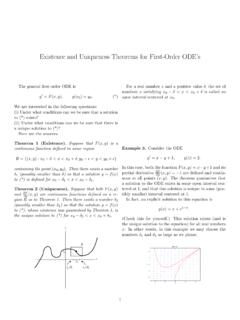
Existence and Uniqueness Theorems for First-Order ODE’s
faculty.math.illinois.eduExistence and Uniqueness Theorems for First-Order ODE’s The general rst-order ODE is y0 = F(x;y); y(x0) = y0: (*) We are interested in the following questions: (i) Under what conditions can we be sure that a solution

Thevenin’s and Norton's Theorems - Zubair Khalid
www.zubairkhalid.orgEE240 Circuits I Problem 5: Find the Thevenin equivalent circuit for the following circuit with respect to the terminals AB (Irwin –Example 5.8) Thevenin’sand Norton's Theorems 6 Problems –In class 1 2 1 1 2

Thevenin’s and Norton’s Theorems
web.iit.eduneed to find out V. Since it's open circuit and there is no current going through R 1.Treat R 1 as wire. ciucuit become simple three series resistor and a voltage source. Secondly, find the current. Thirdly, find the sum voltage across R 3 and R 2. That's the answer we're looking for. Using Ohm’s law, we find: I = V/R, where V = 15V R = R4+R3 ...

SOME FUNDAMENTAL THEOREMS IN MATHEMATICS
people.math.harvard.edusuch list of theorems is a matter of personal preferences, taste and limitations. The num-ber of theorems is arbitrary, the initial obvious goal was 42 but that number got eventually surpassed as it is hard to stop, once started. As a compensation, there are 42 “tweetable" theorems with included proofs.

VECTOR IDENTITIES AND THEOREMS
personal.utdallas.eduB VECTOR IDENTITIES AND THEOREMS A = X Ax + Y Ay + Z Az A + B = X (Ax + Bx) + Y (Ay + By) + Z (Az + Bz) A . B = AxBx + AyBy + AzBz A A A X Y z A x B = det IAx Ay Az Bx By Bz = X (AyBz - AzBy) + y (A~Bx - AxBz) + Z (AxBy - AyBx) A. (B x C) = B .(C x A) = C.(A x B)