Transcription of CHAPTER 2: PHONOLOGICAL AWARENESS
1 CHAPTER 2: PHONOLOGICAL AWARENESSA student s level of PHONOLOGICAL AWARENESS at the end of kindergarten is one of the strongest predictors of future reading success, in grade one and beyond.**Adams et al. on PHONOLOGICAL AwarenessIn recent years, many researchers have explored the relationship between PHONOLOGICAL AWARENESS and success with reading and spelling. PHONOLOGICAL AWARENESS is the area of oral language that relates to the ability to think about the sounds in a word (the word s PHONOLOGICAL structure) rather than just the meaning of the word.
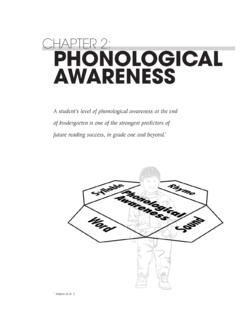
2 It is an understanding of the structure of spoken language that it is made up of words, and words consist of syllables, rhymes, and sounds. Fitzpatrick summarizes it best by saying that PHONOLOGICAL AWARENESS is the ability to listen inside a word (5).Children who have well-developed PHONOLOGICAL AWARENESS when they come to school have a head start making sense of how sounds and letters operate in print. This ability is important for using sound-letter knowledge effectively in reading and writing. In fact, a student s level of PHONOLOGICAL AWARENESS at the end of kindergarten is one of the strongest predictors of future reading success, in grade one and beyond.
3 Many children begin kindergarten with well-developed PHONOLOGICAL AWARENESS . Some seem to develop these skills fairly easily within a stimulating classroom environment, while others need more instruction that consciously and deliberately focuses on PHONOLOGICAL AWARENESS . More than 20 percent of students struggle with some aspects of PHONOLOGICAL AWARENESS , while 8 10 percent exhibit significant delays. Early intervention is crucial and can make a real difference to students with limited levels of PHONOLOGICAL AWARENESS .(See CHAPTER 5: Early Intervention for Students At Risk.)
4 The Development ofPhonological AwarenessWe know that many children first demonstrate PHONOLOGICAL AWARENESS as preschoolers. They begin to recognize words as separate entities ( , What does the mean?). They also become aware of how groups of sounds (syllables or rhymes) operate in words in spoken language ( , Matt and pat rhyme). They develop an AWARENESS of individual sounds and can attend to and manipulate them in a word ( , Dad and dear they start the same). These individual sounds of a language are known as Out More About PHONOLOGICAL AwarenessAdams, M.
5 J., B. R. Foorman, I. Lundberg, and T. Beeler. Phonemic AWARENESS in Young Children: A Classroom Curriculum. Paul Brookes Publishing Co., , Donald, Marcia Invernizzi, Shane Templeton, and Francine Johnston. Words Their Way. 3d ed. Prentice Hall, 2003. Cunningham, James W, Patricia M. Cunningham, James V. Hoffman, and Hallie K. Yopp. Phonemic AWARENESS and the Teaching of Reading: A Position Statement from the Board of Directors of the International Reading Association. International Reading Association, 1998. , J. Phonemic AWARENESS : Playing With Sounds to Strengthen Beginning Reading Teaching Press, , U.
6 , and P. Bryant. PHONOLOGICAL Skills and Learning to Press, th, Priscilla L., and Mary W. Olson. Phonemic AWARENESS Helps Beginning Readers Break the Code. The Reading Teacher (1992): 516 , Thomas. Word Building: A Strategic Approach to the Teaching of Phonics. The Reading Teacher (1995): 484 , Moira F., and Lita Ericson. The PHONOLOGICAL AWARENESS Handbook for Kindergarten and Primary Teachers. International Reading Association, , G., and I. Fountas. Word , , Catherine E., M. Susan Burns, and Peg Griffi n, eds. Preventing Reading Diffi culties in Young Children.
7 National Academy Press, , Hallie K. Developing Phonemic AWARENESS in Young Children. The Reading (1992): 696 703.. A Test for Assessing Phonemic AWARENESS in Young Children. The Reading (1995): 20 29. 117 PHONOLOGICAL AWARENESSCOMPREHENSIVE LITERACY RESOURCE FOR KINDERGARTEN TEACHERS118 Expected PHONOLOGICAL AWARENESS Skills in KindergartenBy the end of kindergarten, given sufficient instruction, practice, and exposure to many literacy activities, students should be able to Word level: recognize how many words are in a sentenceSyllable level: segment and blend words of at least three syllablesRhyme level: understand the concept of rhyming recognize and generate rhyming wordsSound level.
8 Isolate the beginning or ending sounds in words segment and blend sounds in a word with three sounds change a sound in a word to make a new word in familiar games and songs An important link in developing PHONOLOGICAL AWARENESS is to encourage students to use invented or temporary spelling. When students attempt to write a word, they must first listen to their own language, segment the sounds in the word, and fi nally, try to match the sounds with known letters. Students need some PHONOLOGICAL AWARENESS to use invented spelling, but their exploration of sounds through writing helps them to discover more about how sounds and letters work in English, and then how to use this knowledge as they Role of PHONOLOGICAL AwarenessThere are different levels of PHONOLOGICAL AWARENESS within words: syllables, onsets and rimes, and sounds.
9 Recognizing this has important implications for supporting students development of PHONOLOGICAL AWARENESS . Good readers look for familiar letter patterns as one strategy when attempting to decode or spell unfamiliar words they use familiar sound chunks from known words, not just individual sounds. Thomas Gunning says that students look for pronounceable word parts (484). This chunking of sounds makes the reading and spelling process much more effective and efficient. These letter patterns are based on familiar syllable or rhyme patterns as well as sound clusters and individual ability to look inside words for syllables, rhymes, and individual sounds when reading and spelling is based on the PHONOLOGICAL Awarenessrefers to an understanding of the sound structure of language that is, that language is made up of words, syllables, rhymes, and sounds (phonemes).
10 This knowledge occurs initially in oral language; students do not have to know how to name letters or their corresponding sounds in order to demonstrate PHONOLOGICAL AWARENESS . Phonemic AWARENESS is one component of PHONOLOGICAL AWARENESS . It refers to knowledge of words at the level ofindividual sounds how to segment, blend, or manipulate individual soundsin words. Phonics refers to an understanding of the sound and letter relationships in a language. PHONOLOGICAL AWARENESS is necessary in order to usethis phonics knowledge effectively in reading and writing.