Transcription of Chapter 21: Hydrocarbons
1 HydrocarbonsBIGIdea organic compounds called Hydrocarbons differ by their types of Introduction to HydrocarbonsMAINIdeaHydrocarbons are carbon-containing organic compounds that provide a source of energy and raw AlkanesMAINIdea Alkanes are Hydrocarbons that contain only single Alkenes and AlkynesMAINIdeaAlkenes are Hydrocarbons that contain at least one double bond, and alkynes are Hydrocarbons that contain at least one triple hydrocarbon IsomersMAINIdeaSome Hydrocarbons have the same molecular formula but have different molecular Aromatic HydrocarbonsMAINIdeaAromatic Hydrocarbons are unusually stable compounds with ring structures in which electrons are shared by many The primary source of Hydrocarbons is petroleum.
2 About 75 million barrels of petroleum are pumped out of the Earth each day. Hydrocarbons are used as fuels and are the raw materials for products such as plastics, synthetic fibers, solvents, and industrial Steve Starr/CORBISH ydrocarbonCompoundsChapter 21 Hydrocarbons 743 Start-Up ActivitiesStart-Up ActivitiesHydrocarbon Compounds Make the following Foldable to help you organize information about hydrocarbon to: study the entire Chapter online explore take Self-Check Quizzes use the Personal Tutor to work Example Problems step-by-step access Web Links for more information, projects, and activities find the Try at Home Lab, Comparing Water and a HydrocarbonLLAAUUNCH NCH LabLabHow can you model simple Hydrocarbons ?
3 Hydrocarbons are made of hydrogen and carbon atoms. Recall that carbon has four valence electrons and it can form four covalent bonds. Procedure1. Read and complete the lab safety form. 2. Use a molecular model kit to build a structure with two carbon atoms connected by a single bond. 3. Place hydrogen atoms in all of the unoccupied posi-tions on your model so that each carbon atom has a total of four Repeat Steps 2 3 for models based on three, four, and five carbon atoms each. Be sure that each carbon atom is attached to a maximum of two other carbon atoms. Analysis1. Make a table listing the number of carbon and hydro-gen atoms in each Describe the composition of each structure with a molecular Analyze the pattern of the carbon-to-hydrogen ratio to develop a generic formula for Hydrocarbons with single How do you think the molecular formula would be affected if the carbon atoms were attached by double and triple bonds?
4 STEP 1 Fold three sheets of notebook paper in half horizontally. Holding two sheets of paper together, make a 3-cm cut at the fold line on each side of the paper. STEP 2 On the third sheet,cut along the fold line leaving a3 cm portion uncut on each side of the paper. STEP 3 Slip the first two sheets through the cut in the third sheet to make a 12-page book. Label your book hydrocarbon ,$!",%3 Use this Foldable with Sections , , , and As you read these sections, use your book to record features of each type of hydrocarbon , distinguishing characteristics, and real-world examples. ANDREW LAMBERT PHOTOGRAPHY/SCIENCE PHOTO LIBRARY/Photo Researchers Chapter 21 HydrocarbonsSection to HydrocarbonsMAINIdeaHydrocarbons are carbon-containing organic compounds that provide a source of energy and raw Reading Link If you have ridden in a car or a bus, you have used Hydrocarbons .
5 The gasoline and diesel fuel that are used in cars, trucks, and buses are CompoundsChemists in the early nineteenth century knew that living things, such as the plants and panda shown in Figure , produce an immense variety of carbon compounds. Chemists referred to these compounds as organic compounds because they were produced by living Dalton s atomic theory was accepted in the early nineteenth century, chemists began to understand that compounds, including those made by living organisms, consisted of arrangements of atoms bonded together in certain combinations. They were able to synthesize many new and useful substances. However, scientists were not able to synthe-size organic compounds.
6 Many scientists incorrectly concluded that they were unable to synthesize organic compounds because of vitalism. According to vitalism, organisms possessed a mysterious vital force, enabling them to assemble carbon compounds. Disproving vitalism Friedrich W hler (1800-1882), a German chemist, was the first scientist to realize that he had produced an organic compound by synthesis in a laboratory. W hler s experiment did not immediately disprove vitalism, but it prompted a chain of similar exper-iments by other European chemists. Eventually, the idea that the synthesis of organic compounds required a vital force was discredited and scien-tists realized they could synthesize organic compounds.
7 Figure Living things contain, are made up of, and produce a variety of organic two organic compounds that you have studied in a previous science Explain the terms organic compound and organic chemistry. Identify Hydrocarbons and the models used to represent them. Distinguish between saturated and unsaturated Hydrocarbons . Describe where Hydrocarbons are obtained and how they are Vocabularymicroorganism: a tiny organism, such as a bacterium or a protozoan, that cannot be seen without a microscopeNew Vocabularyorganic compoundhydrocarbonsaturated hydrocarbonunsaturated hydrocarbonfractional distillationcracking Panorama Media (Beijing) Introduction to Hydrocarbons 745 Figure Methane a hydrocar-bon found in natural gas is the simplest In addition to hydrogen, what other elements readily bond with carbon?
8 organic chemistry Today, the term organic compound is applied to all carbon-containing compounds with the primary exceptions of carbon oxides, carbides, and carbonates, which are considered inorganic. Because there are so many organic compounds, an entire branch of chemistry, called organic chemistry, is devoted to their study. Recall that carbon is an element in group 14 of the periodic table, as shown in Figure With the electron configuration of 1 s 2 2 s 2 2 p 2 , carbon nearly always shares its electrons and forms four covalent bonds. In organic compounds, carbon atoms are bonded to hydrogen atoms or atoms of other elements that are near carbon in the periodic table especially nitrogen, oxygen, sulfur, phosphorus, and the importantly, carbon atoms also bond to other carbon atoms and form chains from two to thousands of carbon atoms in length.
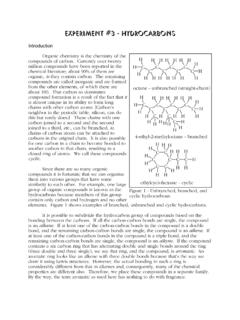
9 Also, because carbon forms four bonds, it forms complex, branched-chain structures, ring structures, and even cagelike structures. With all of these bonding possibilities, chemists have identified millions of different organic compounds and are synthesizing more every Check Explain why carbon forms many simplest organic compounds are Hydrocarbons , which contain only the elements carbon and hydrogen. How many different com-pounds do you think two elements can form? You might guess that only a few compounds are possible. However, thousands of Hydrocarbons are known, each containing only the elements carbon and hydrogen. The simplest hydrocarbon molecule, C H 4 , consists of a carbon atom bonded to four hydrogen atoms.
10 This substance, called methane, is an excellent fuel and is the main component of natural gas, as shown in Figure Check Name two uses of methane or natural gas in your home or Figure Carbon is found in group 14 of the periodic table. It can bond to four other elements and form thousands of different compounds. A. T. Willett/Alamy746 Chapter 21 HydrocarbonsModels and Hydrocarbons Chemists represent organic molecules in a variety of ways. Figure shows four different ways to represent a methane molecule. Covalent bonds are represented by a single straight line, which denotes two shared electrons. Most often, chemists use the type of model that best shows the information they want to highlight.