Example: air traffic controller
Chapter 3 Stoichiometry - Chemistry
Stoichiometry Example C 6H 6 + Br 2-----> C 6H 5Br + HBr Benzene (C 6H 6) reacts with Bromine to produce bromobenzene (C 6H 6Br) and hydrobromic acid. If 30. g of benzene reacts with 65 g of bromine and produces 56.7 g of bromobenzene, …
Tags:
Information
Domain:
Source:
Link to this page:
Documents from same domain

Chapter 1 Structure and Bonding - Chemistry
www2.chemistry.msu.eduThe atomic mass (atomic weight) of an element is weighted average mass in atomic mass units (amu) of an element’s naturally occurring isotopes. Carbon: Atomic Number and Atomic Mass 12C 6 AC Z 13C 6 (98.9 12.000) (1.1 13.000) 12.011 100 × +× =

Standard Operating Procedure: Pumps
www2.chemistry.msu.eduStandard Operating Procedure: Pumps Last Updated: ... operation of ports and evacuation procedures are covered in the glove box SOP document. As a general
Radiation Detection & Measurement Dept. of …
www2.chemistry.msu.eduRadiation Detection & Measurement Dept. of Chemistry --- Michigan State Univ. National Superconducting Cyclotron Lab DJMorrissey Spring/2oo9

Chemistry 151 - Michigan State University
www2.chemistry.msu.eduChemistry 151 • Professor James H. Geiger • Office: Chemistry Building, Room 9 ... Chemistry, the Central Science, 10th edition, Prentice-Hall, 2005. ISBN: 0-13-109686-9. ... Registering for Mastering Chemistry, What You Need: A valid email address

Bond Dissociation Energies of Organic Molecules
www2.chemistry.msu.eduBond Dissociation Energies of Organic Molecules STEPHEN J. BLANKSBY*,† AND G. BARNEY ELLISON*,‡ Department of Chemistry, University of Wollongong, NSW, 2522, Australia, and Department of Chemistry &

Chapter 9: Atomic Absorption Spectrometry
www2.chemistry.msu.eduChapter 9: Atomic Absorption Spectrometry. Read: pp. 230 – 249 Problems: 9-1,3,5,6,8. Figure 9-13a. A(λ)= ε(λ)bC = log P. o /P

Chapter 24 Chemistry of Coordination Compounds
www2.chemistry.msu.edu6 3+ • Co3+ electron configuration: • 4s23d4----" 4s03d6 • Need six orbitals for six ligands so: !Hybridize 1 4s, 3 4p and 2 3d to give: !Sp3d2 orbitals. The 6 …
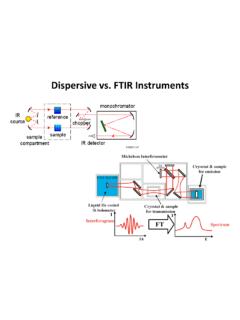
Dispersive vs. FTIR Instruments - Chemistry
www2.chemistry.msu.eduA spectroscopic technique used to observe vibrational, rotational, and other low-frequency [modes in a system. 1] It relies on inelastic scattering, or Raman scattering, of monochromatic light, usually from a laser in the visible, near infrared, or near ultraviolet range.

Principles of FTIR Spectroscopy - Chemistry
www2.chemistry.msu.eduPrinciples of Diffuse Reflectance Method K is the absorption coefficient, and S is the scattering coefficient. In practice, the comparative reflectance r∞ with respect to a standard powder such as KBr or KCl, of which K is near zero (0) in the actual measurement range Spectrum of solid caffeine Measurement of chemicals adhering to a surface ...

Chapter 5 Signals and Noise - Michigan State University
www2.chemistry.msu.eduNoise pick-up and possible amplification by the instrument circuit can be minimized. Difference Amplifiers →Analyte signal and reference signals are fed into the inputs of an operational amplifier is a scaler-type configuration. Common mode noise rejection. V o = R. k. R. i (V. 2 - V. 1)
Related documents
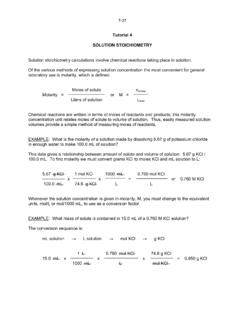
Tutorial 4 SOLUTION STOICHIOMETRY - EIU
www.eiu.eduChemical reactions are written in terms of moles of reactants and products; this molarity concentration unit relates moles of solute to volume of solution. Thus, easily measured solution volumes provide a simple method of measuring moles of reactants. EXAMPLE: What is the molarity of a solution made by dissolving 5.67 g of potassium chloride

Stoichiometry: Baking Soda and Vinegar Reactions
labsci.stanford.eduStoichiometry: Baking Soda and Vinegar Reactions Teacher Version ... A mole is a unit of measurement just like a “dozen” eggs is 12 eggs. A mole, which was ... it is the number of atoms in 12 grams of carbon, is known as Avogadro’s . Created by LABScI at Stanford 2 Number: 6.02 x 10²³. The number of grams in a mole differs from substance ...

Chapter 4 Stoichiometry of Chemical Reactions
web.ung.eduChapter 4 Stoichiometry of Chemical Reactions Figure 4.1 Many modern rocket fuels are solid mixtures of substances combined in carefully measured amounts and ignited to yield a thrust-generating chemical reaction. (credit: modification of work by NASA)

4.3Reaction Stoichiometry
web.ung.edu4.3Reaction Stoichiometry By the end of this section, you will be able to: • Explain the concept of stoichiometry as it pertains to chemical reactions • Use balanced chemical equations to derive stoichiometric factors relating amounts of reactants and products • Perform stoichiometric calculations involving mass, moles, and solution molarity
Chapter 10 ChemiCal alCulations and equations
preparatorychemistry.com10.1 Equation Stoichiometry 369 The ratio of moles of P 4O 10 to moles of P (which came from the subscripts in the chemical formula, P 4O 10) provided the key conversion factor that allowed us to convert from units of phosphorus to units of tetraphosphorus decoxide. Now let’s assume that you have been transferred to the division responsible for the

STOICHIOMETRY OF COMBUSTION
fluid.wme.pwr.wroc.plFUNDAMENTALS: moles and kilomoles Atomic unit mass : 1/12 12 6C ~ 1.66 10-27 kg Atoms and molecules mass is defined in atomic unit mass: which is defined in relation to the 1/12 of carbon 12 6C . Mole: (Avogadro number) 6.022•10 23 atoms Volume of 1 mole (perfect gas) 22.414 l (T= 0 oC, p = 1 atm) Kmole: 10 3 moles Mass of one mole (kmole) is a number of …
TOPIC 10. CHEMICAL CALCULATIONS IV - solution …
scilearn.sydney.edu.auStep 6: From the volume of NaOH solution used, its concentration can now be deduced. As 4.170 × 10⁻³ mole of NaOH are in 25.00 mL, then concentration of NaOH = moles = 4.170 × 10–3 = 0.167 M litres 0.02500 Example 5. Sodium carbonate (10.0 g) is reacted completely with hydrochloric acid (0.115 M).