Transcription of CHAPTER 9 PHASE DIAGRAMS PROBLEM SOLUTIONS
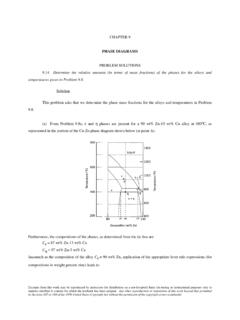
1 CHAPTER 9. PHASE DIAGRAMS . PROBLEM SOLUTIONS . A 90 wt% Ag-10 wt% Cu alloy is heated to a temperature within the + liquid PHASE region. If the composition of the liquid PHASE is 85 wt% Ag, determine: (a) The temperature of the alloy (b) The composition of the PHASE (c) The mass fractions of both phases Solution (a) In order to determine the temperature of a 90 wt% Ag-10 wt% Cu alloy for which and liquid phases are present with the liquid PHASE of composition 85 wt% Ag, we need to construct a tie line across the + L PHASE region of Figure that intersects the liquidus line at 85 wt% Ag; this is possible at about 850 C. (b) The composition of the PHASE at this temperature is determined from the intersection of this same tie line with solidus line, which corresponds to about 95 wt% Ag. (c) The mass fractions of the two phases are determined using the lever rule, Equations and with C0.
2 = 90 wt% Ag, CL = 85 wt% Ag, and C = 95 wt% Ag, as C0 CL 90 85. W = = = C C L 95 85. C C 0 95 90. WL = = = C C L 95 85. Excerpts from this work may be reproduced by instructors for distribution on a not-for-profit basis for testing or instructional purposes only to students enrolled in courses for which the textbook has been adopted. Any other reproduction or translation of this work beyond that permitted by Sections 107 or 108 of the 1976 United States Copyright Act without the permission of the copyright owner is unlawful. For a copper-silver alloy of composition 25 wt% Ag-75 wt% Cu and at 775 C (1425 F) do the following: (a) Determine the mass fractions of and phases . (b) Determine the mass fractions of primary and eutectic microconstituents. (c) Determine the mass fraction of eutectic.
3 Solution (a) This portion of the PROBLEM asks that we determine the mass fractions of and phases for an 25 wt%. Ag-75 wt% Cu alloy (at 775 C). In order to do this it is necessary to employ the lever rule using a tie line that extends entirely across the + PHASE field. From Figure and at 775 C, C = wt% Ag, C = wt% Ag, and Ceutectic = wt% Sn. Therefore, the two lever-rule expressions are as follows: C C 0 25. W = = = C C C 0 C 25 W = = = C C (b) Now it is necessary to determine the mass fractions of primary and eutectic microconstituents for this same alloy. This requires us to utilize the lever rule and a tie line that extends from the maximum solubility of Ag in the PHASE at 775 C ( , wt% Ag) to the eutectic composition ( wt% Ag). Thus C eutectic C 0 25. W ' = = = C eutectic C C 0 C 25 We = = = C eutectic C (c) And, finally, we are asked to compute the mass fraction of eutectic , We.
4 This quantity is simply the difference between the mass fractions of total and primary as We = W W ' = = Excerpts from this work may be reproduced by instructors for distribution on a not-for-profit basis for testing or instructional purposes only to students enrolled in courses for which the textbook has been adopted. Any other reproduction or translation of this work beyond that permitted by Sections 107 or 108 of the 1976 United States Copyright Act without the permission of the copyright owner is unlawful. Consider the hypothetical eutectic PHASE diagram for metals A and B, which is similar to that for the lead-tin system, Figure Assume that (1) and phases exist at the A and B extremities of the PHASE diagram, respectively; (2) the eutectic composition is 47 wt% B-53 wt% A; and (3) the composition of the PHASE at the eutectic temperature is wt% wt% A.
5 Determine the composition of an alloy that will yield primary . and total mass fractions of and , respectively. Solution We are given a hypothetical eutectic PHASE diagram for which Ceutectic = 47 wt% B, C = wt% B at the eutectic temperature, and also that W ' = and W = ; from this we are asked to determine the composition of the alloy. Let us write lever rule expressions for W ' and W . C C 0 C 0. W = = = C C C . C eutectic C 0 47 C 0. W ' = = = C eutectic C 47 C . Thus, we have two simultaneous equations with C0 and C as unknowns. Solving them for C0 gives C0 = wt%. B. For a 68 wt% Zn-32 wt% Cu alloy, make schematic sketches of the microstructure that would be observed for conditions of very slow cooling at the following temperatures: 1000 C (1830 F), 760 C (1400 F), 600 C (1110 F), and 400 C (750 F).
6 Label all phases and indicate their approximate compositions. Solution The illustration below is the Cu-Zn PHASE diagram (Figure ). A vertical line at a composition of 68. wt% Zn-32 wt% Cu has been drawn, and, in addition, horizontal arrows at the four temperatures called for in the PROBLEM statement ( , 1000 C, 760 C, 600 C, and 400 C). Excerpts from this work may be reproduced by instructors for distribution on a not-for-profit basis for testing or instructional purposes only to students enrolled in courses for which the textbook has been adopted. Any other reproduction or translation of this work beyond that permitted by Sections 107 or 108 of the 1976 United States Copyright Act without the permission of the copyright owner is unlawful. On the basis of the locations of the four temperature-composition points, schematic sketches of the four respective microstructures along with PHASE compositions are represented as follows: Excerpts from this work may be reproduced by instructors for distribution on a not-for-profit basis for testing or instructional purposes only to students enrolled in courses for which the textbook has been adopted.
7 Any other reproduction or translation of this work beyond that permitted by Sections 107 or 108 of the 1976 United States Copyright Act without the permission of the copyright owner is unlawful. Consider kg of austenite containing wt% C, cooled to below 727 C (1341 F). (a) What is the proeutectoid PHASE ? (b) How many kilograms each of total ferrite and cementite form? (c) How many kilograms each of pearlite and the proeutectoid PHASE form? (d) Schematically sketch and label the resulting microstructure. Solution (a) The proeutectoid PHASE will be Fe3C since wt% C is greater than the eutectoid composition ( wt% C). (b) For this portion of the PROBLEM , we are asked to determine how much total ferrite and cementite form. Application of the appropriate lever rule expression yields CFe 3C C 0 W = = = CFe 3C C Excerpts from this work may be reproduced by instructors for distribution on a not-for-profit basis for testing or instructional purposes only to students enrolled in courses for which the textbook has been adopted.
8 Any other reproduction or translation of this work beyond that permitted by Sections 107 or 108 of the 1976 United States Copyright Act without the permission of the copyright owner is unlawful. which, when multiplied by the total mass of the alloy ( kg), gives kg of total ferrite. Similarly, for total cementite, C 0 C WFe 3C = = = CFe 3C C And the mass of total cementite that forms is ( )( kg) = kg. (c) Now we are asked to calculate how much pearlite and the proeutectoid PHASE (cementite) form. Applying Equation , in which C1' = wt% C. C 1' Wp = = = which corresponds to a mass of kg. Likewise, from Equation C1' WFe 3C' = = = which is equivalent to kg of the total kg mass. (d) Schematically, the microstructure would appear as: Excerpts from this work may be reproduced by instructors for distribution on a not-for-profit basis for testing or instructional purposes only to students enrolled in courses for which the textbook has been adopted.
9 Any other reproduction or translation of this work beyond that permitted by Sections 107 or 108 of the 1976 United States Copyright Act without the permission of the copyright owner is unlawful. The microstructure of an iron carbon alloy consists of proeutectoid ferrite and pearlite; the mass fractions of these two microconstituents are and , respectively. Determine the concentration of carbon in this alloy. Solution This PROBLEM asks that we determine the carbon concentration in an iron-carbon alloy, given the mass fractions of proeutectoid ferrite and pearlite. From Equation C 0' W p = =. which yields C0' = wt% C. The mass fractions of total ferrite and total cementite in an iron-carbon alloy are and , respectively. Is this a hypoeutectoid or hypereutectoid alloy? Why? Solution In this PROBLEM we are given values of W and WFe C for an iron-carbon alloy ( and , 3.)
10 Respectively), and then are asked to specify whether the alloy is hypoeutectoid or hypereutectoid. Employment of the lever rule for total leads to CFe 3C C0 C0. W = = =. CFe 3C C Now, solving for C0, the alloy composition, leads to C0 = wt% C. Therefore, the alloy is hypereutectoid since C0 is greater than wt% C. Excerpts from this work may be reproduced by instructors for distribution on a not-for-profit basis for testing or instructional purposes only to students enrolled in courses for which the textbook has been adopted. Any other reproduction or translation of this work beyond that permitted by Sections 107 or 108 of the 1976 United States Copyright Act without the permission of the copyright owner is unlawful.