Transcription of Chapter 9 - Stoichiometry
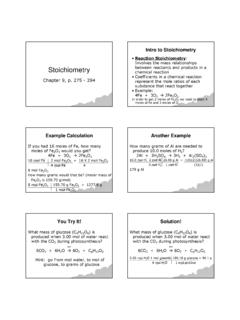
1 Chapter 9 - Stoichiometry 9-1 Introduction to Stoichiometry Composition Stoichiometry - deals with mass relationships of elements in compounds Reaction Stoichiometry - Involves mass relationships between reactants and products in a chemical reaction I. Reaction Stoichiometry Problems A. Four problem Types, One Common Solution given mass given moles unknown moles unknown mass 1. Given and unknown quantities are in moles 2. Given is an amount in moles and the unknown is a mass (usually in grams) 3. Given is a mass in grams and the unknown is an amount in moles 4. Given is a mass in grams and the unknown is a mass in grams B. Mole Ratio 1.
2 A conversion factor that relates the amounts in moles of any two substances involved in a chemical reaction 2. Mole ratio is used to convert: given moles unknown moles C. Molar Mass 1. Molar mass of compounds and elements is used to convert: given mass given moles and unknown moles unknown mass 9-2 Ideal Stoichiometric Calculations Ideal Stoichiometry - All reactants are converted into products I. A Common Method for Solving All Stoichiometry Problems A. Mass-Mass Problems 1. Start with a known mass of reactant or product, find an unknown mass of another reactant or product 2. All other Stoichiometry problems are derivations (shortened versions) of this larger solution: Find moles Use mole ratios Find grams of of given using to find moles of unknown using molar mass unknown molar mass gramsunknownofmolegramsinmassmolarsunkno wnxequationbalancedingivenofmolesequatio nbalancedinunknownofmolesxgramsinmassmol arsgivengivenofmolexgramsingiven= 1''1)( 1 B.
3 Steps to Solving Problems 1. Start with a correctly balanced chemical equation a. Use key words in the problem statement to identify substances as either reactants or products. 2. Determine what units you've been given and what you are being asked to find 3. Label each step with the correct units! a. the units from the numerator of the first step become the units in the denominator of the next step, and so forth 4. Stop when you have an answer with the units that you are searching for There are four types of Stoichiometry problems, but you do not have to "learn" four different equations for solving techniques are the same for any conversion problems!
4 9-3 Limiting Reactants and Percent Yield I. Limiting Reactant A. Definition of Limiting Reactant 1. The reactant that limits the amounts of the other reactants that can combine and the amount of product that can form in a chemical reaction " I want to make chocolate chip cookies. I look around my kitchen (I have a BIG kitchen!) and find 40 lbs. of butter, two lbs. of salt, 1 gallon of vanilla extract, 80 lbs. of chocolate chips, 200 lbs. of flour, 150 lbs. of sugar, 150 lbs. of brown sugar, ten lbs. of baking soda and TWO eggs. It should be clear that it is the number of eggs that will determine the number of cookies that I can make.
5 " B. Excess Reactant 1. The substance that is not used up completely in a reaction C. Identifying the Limiting Reactant 1. Convert grams of each reactant to moles if the problem has not already done so for you 2. Use molar ratios from the balance chemical equation to determine which reactant is limiting, and which reactant is in excess D. Stoichiometry with Limiting Reactants 1. All calculations should start with the amount of the limiting reactant, not the excess reactant II. Percent Yield A. Theoretical Yield 1. The maximum amount of product that can be produced from a given amount of reactant B. Actual Yield 1. The measured amount of a product obtained from a reaction C.
6 Calculating Percent Yield 1. The ratio of the actual yield to the theoretical yield, multiplied by 100 100xyieldltheoreticayieldactualyieldperc ent= 2