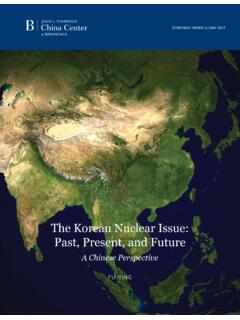
Transcription of China and nuclear weapons
1 SEPTEMBER 2019 China AND nuclear WEAPONSCAITLIN TALMADGEDOMAINS OF STRATEGIC COMPETITION1 EXECUTIVE SUMMARYFor decades, nuclear weapons have been largely peripheral to relations, but the nuclear relationship is now growing more competitive as both countries pursue major programs to modernize their forces. China s efforts to strengthen its relatively small nuclear arsenal seem largely oriented toward improving survivability and do not appear to constitute a shift away from the country s long-standing No First Use (NFU) policy. Nevertheless, the improvements are provoking anxiety in Washington, which has long resisted acknowledging a state of mutual nuclear vulnerability with core concern is likely that improvements in China s nuclear arsenal, even if intended only to improve survivability, will reduce the ability to limit damage in the worst-case scenario of an all-out nuclear war with China .
2 The preference for damage limitation, largely through missile defense and counterforce capabilities, should not be taken to mean that the United States intends to start a nuclear war or that it believes it could emerge from a nuclear war unscathed. Rather, the likely objective is to make China to worry that if China starts a crisis or conflict that raises risks of nuclear escalation, the United States will have a higher tolerance for bearing these risks than China will, because of the United States relatively greater ability to limit the damage the United States would suffer in a nuclear exchange. Advocates of damage limitation believe that such a capability could deter China from initiating conflict in the first place even conflict well below the nuclear threshold and could endow the United States with bargaining advantages in any effort to coerce China if a crisis or war did break or wrongly, this is likely why the United States perceives China s ongoing improvements to survivability as threatening, especially when set against the backdrop of growing bipartisan concern about China s broader strategic intentions, and a conventional balance that is also becoming less favorable to the United States and its allies.
3 Understandably, however, China is also very unlikely to stop seeking a more survivable nuclear arsenal, even if its strategic aims are limited and its nuclear doctrine remains static. As a result, nuclear competition between the United States and China is almost certain to intensify. This paper explores the causes and implications of this emerging deteriorating bilateral relationship has heightened concern about the consequences of intensified military competition between the two Although some analysts have emphasized that conflict is far from inevitable, others have warned of the growing possibility of clashes or even war in the East or South China Seas, or over Much of this work has rightly emphasized the conventional dimensions of such Yet the United States and China both possess nuclear weapons , and their potential role in a more rivalrous relationship merits close attention as the United States, China is undergoing a significant, decades-long modernization of its nuclear forces.
4 Currently, this effort does not appear to constitute a shift away from China s long-standing No First Use (NFU) policy. Rather, the improvements in China s small and relatively vulnerable nuclear forces GLOBAL CHINACHINA AND nuclear WEAPONSDOMAINS OF STRATEGIC COMPETITION2appear largely oriented toward improving survivability. In other words, China is seeking a more secure second-strike capability a force that can guarantee an unacceptable level of nuclear retaliation against any state that launches a first strike against China , and thereby deter such an attack from being launched. That a country with China s resources would seek a more robust nuclear force is unsurprising, especially given the much larger and Russian nuclear arsenals. Despite the fact that Chinese nuclear modernization does not appear to presage a new, more ambitious nuclear doctrine, the effort is provoking anxiety in despite the fact that Chinese nuclear modernization does not appear to presage a new, more ambitious nuclear doctrine, the effort is provoking anxiety in Washington.
5 This is because the United States is highly resistant to the idea of acknowledging a state of mutual nuclear vulnerability with China . Even during the Obama administration, the United States avoided describing the nuclear relationship as one of mutually assured destruction (MAD).5 In MAD, there is no meaningful way for either side to avoid suffering unacceptable damage in a nuclear war, no matter who strikes of accepting MAD with China a country that possesses intercontinental ballistic missiles (ICBMs) that can reach the continental United States the United States has sought capabilities that could be used for damage limitation. The most recent nuclear Posture Review in fact explicitly highlights the long-standing pursuit of damage limitation, which is a nuclear mission distinct from Deterrence tries to convince an adversary not to launch a nuclear attack by threatening him with nuclear retaliation if he does so.
6 Damage limitation, by contrast, is not about imposing costs on the adversary; it is about meaningfully reducing the costs to oneself in an all-out nuclear The United States pursues damage limitation through counterforce capabilities, which can enable the United States to find, destroy, or disable adversary nuclear forces; missile defenses, which can intercept adversary nuclear launches; and civil defense is important to note that the pursuit of damage limitation does not mean that the United States intends to start a nuclear war or that it believes it could emerge from a nuclear war unscathed. Rather, the likely objective is to make China to worry that if China starts a crisis or conflict that raises risks of nuclear escalation, the United States will have a higher tolerance for bearing these risks than China will, because of the United States relatively greater ability to limit the damage the United States would suffer in a nuclear Were this effort successful, nuclear capabilities could theoretically deter China from initiating any conflict in the first place, or could endow the United States with bargaining advantages in any effort to coerce China if a crisis or war did break out.
7 Again, the idea is not that the United States would relish fighting a nuclear war. It is that when nuclear weapons began to cast their inevitable shadow over any tense interaction even well below the nuclear threshold the United States probably would be less likely to back down over escalation fears than China . China s awareness of this fact could thus give the United States an important advantage in what strategist Thomas Schelling famously characterized as a competition in risk-taking. 9 Rightly or wrongly, this is likely why the United States perceives China s ongoing improvements to survivability as threatening, even though these improvements do not appear to constitute a shift away from NFU. The concern is that improvements in China s nuclear arsenal, even if intended only to improve survivability, will reduce the ability to limit damage or at least reduce China s perception of the ability to limit damage, which is what counts.
8 In the worst-case scenario, the shift could even embolden a revisionist, highly resolved China to behave aggressively, especially toward allies and partners. Amidst growing bipartisan concern about China s broader strategic intentions, and a conventional balance that is also becoming less favorable, the United States therefore tends to view any erosion of its perceived position of nuclear advantage as cause for alarm. Understandably, however, China is also very unlikely to stop seeking a more survivable arsenal, even if its strategic aims are limited and its nuclear doctrine remains static. As a result, nuclear competition between the United States and China is almost certain to CHINACHINA AND nuclear WEAPONSDOMAINS OF STRATEGIC COMPETITION3 This paper explores the causes and implications of this emerging competition in five steps. First, it briefly reviews the history and background of the nuclear relationship as relevant to understanding the present state of affairs.
9 Second, the paper discusses recent developments in China s nuclear forces. Third, it explains why the nuclear relationship is likely headed in a more competitive direction even though China s modernization effort does not appear to signal a fundamental change in China s nuclear strategy. Fourth, the paper analyzes what this potential competition could mean for deterrence and escalation in both the conventional and nuclear domains. Finally, the paper briefly considers ways that policymakers might manage a more competitive nuclear relationship with POSITION: THE nuclear RELATIONSHIPFor decades, nuclear weapons were largely peripheral to relations. China tested its first nuclear weapon in 1964, but it never developed a large and sophisticated arsenal as the United States and Soviet Union This choice probably stemmed at least partly from the Chinese Communist Party s early focus on economic development and regime consolidation.
10 But Mao also explicitly eschewed the nuclear arms race on strategic grounds, emphasizing that nuclear weapons had only two purposes: deterring nuclear aggression and countering nuclear coercion (that is, preventing a nuclear state from using nuclear threats to exert pressure on a non- nuclear state).11 Following this logic, China adopted a posture of assured retaliation, building barely enough weapons to credibly threaten nuclear retaliation in the event that it was the target of nuclear As China experts Taylor Fravel and Evan Medeiros note, A decade after exploding its first nuclear device, China likely possessed only 75 nuclear warheads and tens of gravity bombs. Another decade later, in 1985, .. China may have possessed as many as 151 nuclear warheads. 13 Put another way, China s arsenal was roughly half the size of Britain s and France s at the time, and orders of magnitude smaller than the and Soviet s lean deterrent went hand in hand with its declared policy of No First Use of nuclear weapons .