Transcription of CHM 130 Conversion Practice Problems
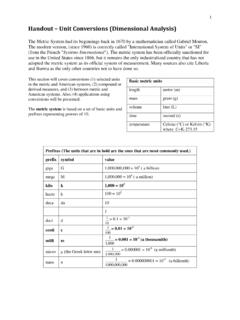
1 worksheet CHM 130 Conversion Practice Problems For conversions within the metric system, you must memorize the Conversion (for example: 1000 mL. = 1 L, or 1000 g = 1 kg should be memorized) Remember that metric conversions are exact ratios and thus will not limit your significant digits for the answer. First start with what you are given. Figure out what units you need. You will need to create a ratio ( Conversion factor) between the units given and the units needed. Ask yourself which unit is bigger. Put a "1" by that unit. Then ask how many of the smaller units are in the bigger unit. Put that number in front of the smaller unit. There is your Conversion factor. Make sure the units cancel and you get the units you need. Always write your units down. Practice as many of the following as you need - the answers are below.
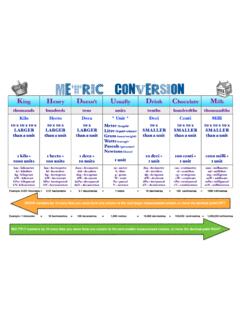
2 Given: Conversion factors in your book, do NOT Google any other conversation factors. You can use the ones given on the shapes table. 1. How many pounds does kg of cheese weigh? 2. How many mL are in quarts? 3. How many inches are in km? 4. How many feet are in km? 5. How many km are in miles? 6. How many yards are in miles? 7. How many cc's are in 979 mL? 8. How many Kelvins are in 9. How many degrees Celsius are in 315 K? 10. How many degrees Fahrenheit are in 11. How many kL are in 8383 L? 12. How many cm are in m? 13. How many meters are in 252 mm? 14. How many liters are in x 104 mL? 15. How many mm are in m? 16. If the mass of a lead ball is g and the volume is mL, what is the density of the lead ball? 17. If the density of carbon tetrachloride is g/mL, and a sample has a volume of mL, what is the mass?
3 18. If the density of propanol is g/mL and a sample has a mass of g what is the volume? 19. How many km are in m? 20. How many cL are in x 10-3 L? 21. A water sample of mass kg is how many liters? d (H2O) = g/mL. 22. If gold's density is g/mL, how much would a L sample weigh in grams? 23. Table salt has a density of g/mL. If you used mL on your food, how much in mg is that? 24. The density of ethanol is g/mL. How much in grams does x 10-2L mass? 25. How many cg are in g? 26. How many cg are in x 103 mg? 27. How many mL are in L? 28. What is the density in g/mL of a substance that masses kg and has a volume of x 102mL? 29. How much water in mL would mg of copper displace? d (Cu) = g/mL. Answers: 1. kg (1000g / 1 kg)(1 lb / 454 g) = pounds 2. quarts (946 mL / quart) = 470 mL.
4 3. km (1000 m / 1 km)( 100 cm / 1 m)(1 inch / cm) = x 104 or 39,400 inches 4. km (1000 m / 1 km)( 100 cm / 1 m)(1 inch / cm)(1 ft / 12 in) = 11,300 or x 104 feet 5. mile(1760 yds / 1 mile)(3 ft / 1 yd)(12 in / 1 ft)( cm / 1 in)(1 m / 100cm)(1 km / 1000m ) = km 6. miles (1760 yds / 1 mile ) = x 105 or 128,000 yards 7. 979 cc (cc = mL). 8. + 273 = 258K. 9. 315K - 273 = 42oC. 10. 86oF. 11. 8383 L ( 1 kL / 1000 L) = kL. 12. m (100 cm / 1 m) = cm 13. 252 mm (1 m / 1000 mm) = m 14. x 104 mL (1 L / 1000 mL) = L. 15. m ( 1000mm / 1 m) = 123 mm 16. g / mL = g/mL. 17. mL ( g/mL) = g 18. g ( mL / g) = mL. 19. m ( 1 km / 1000 m) = x 10-3 km 20. x 10-3 L ( 100 cL / 1 L) = x 10-1 or cL. 21. Since density of water = g/mL: kg ( 1000g / kg)(1 mL / 1 g)(L / 1000 mL) = L. 22. L ( 1000 mL / L )( g / mL) = 643 g 23.
5 ML ( g / mL)(1000 mg / g ) = 4320 mg 24. x 10-2L ( 1000mL / 1 L)( g / mL) = g 25. g (100 cg / 1 g) = cg 26. x 103 mg ( 1 g / 1000 mg)(100 cg / 1 g) = 249 cg or x 102 cg 27. L (1000 mL / 1 L) = x 102 or 258 mL. 28. kg (1000 g / 1 kg) = 987 g then divide by x 102mL = g/mL. 29. mg ( 1 g / 1000 mg)( 1 mL / g Cu) = x 10-4 mL.