Transcription of Chronic Obstructive Pulmonary Disease (COPD) - ATS
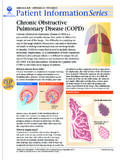
1 47 Chronic Obstructive Pulmonary Disease (COPD)5 Chronic Obstructive Pulmonary Disease (COPD) is an umbrella term for condi-tions, including Chronic bronchitis and emphysema , that impede the flow of air in the bronchi and trachea. COPD is the fourth-leading cause of death in the United States and is a major cause of sickness. It is currently the fifth-leading cause of death worldwide, but the World Health Organization projects it will become the third-leading cause by 2030 (1). COPD is both preventable and organizations have more specifically defined COPD as a Disease state characterized by airflow limitation that is not fully reversible. The airflow limitation is usually both progressive and associated with an abnormal inflammatory response of the lungs to noxious particles or gases. Whom does it affect?
2 Definition, epidemiology, prevalence, economic burden, and vulnerable populationsChronic Obstructive Pulmonary Disease is diagnosed using a medical device called a spirometer, which measures air volume and flow, the main components of common clinical breathing tests ( Pulmonary function tests). The measurement 476/25/10 12:47:46 PMChronic Obstructive Pulmonary Disease Chapter 548of the forced expired volume of air in one second (FEV1) as a percentage of the total amount of air that can be forcefully exhaled (forced vital capacity or FVC) is the main functional way of defining COPD. An FEV1/FVC ratio less than after a patient is given a bronchodilator usually indicates that he or she has COPD. A progressive Disease , COPD is widely recognized as having four stages of severity. At its most severe stage, the FEV1 is less than 30 percent of normal (2).
3 COPD is a common Chronic Disease . Most estimates of COPD put its prev-alence in the adult population in the 5 to 10 percent range, although these esti-mates vary by the specific criteria used. The Third National Health and Nutrition Examination Survey (NHANES III) data the most recent survey that included spirometry showed a prevalence of COPD in adults of percent (1). Over 50 percent of people with evidence of COPD, though, have never been > > > from COPD vary by state, which may reflect differences in smoking, diagnosis, or treatment. Centers for Disease Control and Prevention. National Vital Statistics System. Atlanta: of COPD deaths by state, per 100,000 486/26/10 12:10:13 AMChapter 5 Chronic Obstructive Pulmonary Disease49diagnosed with Disease . This proportion is even higher among people with mild Disease , which is most amenable to intervention (3).
4 COPD is responsible for about 700,000 hospitalizations annually in the United States. In recent years, the hospitalization rate among women has increased and is now similar to the rate among men. In 2005, more than 126,000 adults in the United States died from COPD (4). Age-adjusted mortality rates varied dramatically by state, from a low of per 100,000 in Hawaii to a high of per 100,000 in has an enormous financial burden, with estimated direct medical costs in 1993 of $ billion. The estimated indirect cost related to morbidity (loss of work time and productivity) and premature mortality is an additional $ billion, for a total of $ billion annually. By 2002, this cost was estimated at $ billion annually (1).COPD hospitalizations increased until about 2000 and then leveled off.
5 COPD rates shadow smoking rates with a delay of several years. DeFrances CJ, Hall MJ, for the Division of Health Care Statistics. 2005 National Hospital Discharge Survey. Hyattsville, MD: number of men and women hospitalized for COPD0510152025300100,000200,000300,00040 0,000500,000600,000700,000800,0001990199 2199419961998200420022000 Rate per 10,000 populationEstimated number of annual hospitalizations for COPDMen Women Estimated number of hospitalizations Estimated number of hospitalizations Rate per 10,000 Rate per 10, 496/25/10 12:47:50 PMChronic Obstructive Pulmonary Disease Chapter 550 What we are learning about the diseasePathophysiology, causes: genetic, environment, microbesCOPD comprises a collection of different processes, including Chronic or recur-rent bronchitis, emphysema , and airway responsiveness that contribute to the Disease .
6 The most important risk factor for COPD in the United States is ciga-rette smoking. Other factors, including occupational or environmental exposures to dusts, gases, vapors, biomass smoke, malnutrition, early life infections, recur-rent respiratory infections, genetic predisposition, increased airways respon-siveness, and asthma may be important in many individuals (3). Chronic or recurrent bronchitis is a major component of COPD. It consists of bouts of increased cough and sputum production that can occur frequently. The attacks may be related to an acute bacterial or viral infection or a Chronic CasE stuDyA 52-year-old woman sought medical attention for increasing shortness of breath on exertion for over two years. She used to walk 9 holes of golf with her women s group every Wednesday, but over the last year she has had to use a golf cart.
7 She has attributed this change to getting old. She was told three years earlier that she had a touch of asthma and was given an inhaler to use when she was symptomatic. In the last six months, she had three trips to the emergency department for acute bronchitis. She had smoked for about 15 years, but stopped 20 years ago. Spirometry showed an FEV1 of 62 percent of that predicted and an FEV1 / FVC of case highlights several typical features of COPD. First, it is becoming increasingly common among women, and women are more likely to be misdiagnosed (5). Second, people with COPD are told they have asthma or another respiratory Disease . Third, the symptoms can occur long after a person has stopped smoking, and, in some cases, in the absence of a smoking history altogether. People often attribute their breathing problems to other causes, and they may feel that once they have stopped smoking they will no longer suffer its 506/25/10 12:47:50 PMChapter 5 Chronic Obstructive Pulmonary Disease51process that has permanently damaged the airways, known as bronchiectasis.
8 While most people have had an episode of bronchitis at some point in their life, recurrent episodes (typically two to three per year) are frequently observed in , another component of COPD, entails the destruction of alveoli (air sacs) in the lungs, impairing their ability to bring oxygen into the body and eliminate carbon dioxide. The best known genetic risk factor for COPD is alpha-1 antitrypsin defi-ciency. Alpha-1 antitrypsin is a special protein that protects the lungs from enzymes known as proteases. The body s white blood cells seek out and destroy bacteria and viruses trying to invade the lungs. They kill the microbes by releasing enzymes and other toxic products that, in addition to killing the organ-isms, can damage the lungs. Alpha-1 antitrypsin quickly inactivates the enzymes produced by these white cells, protecting the lung from damage.
9 In individuals [R][L]100mmThis computed tomography (CT) scan shows emphysema on the right (R), where most of the lung tissue is replaced by large spaces of air. The left side (L) has bronchitis and bronchiectasis dilated bronchi with thickened walls. This image would be characteristic of alpha-1 antitrypsin deficiency, although this patient did not have E. 516/25/10 12:47:51 PMChronic Obstructive Pulmonary Disease Chapter 552with alpha-1 antitrypsin deficiency, the low level of antitrypsin fails to protect the lungs from enzymatic tissue damage. This is a major cause of COPD in patients with alpha-1 antitrypsin deficiency. There are approximately 100,000 people in the United States who are deficient in alpha-1 antitrypsin because of a genetic defect. These patients can develop lung Disease even in the absence of ciga-rette smoking, although smoking increases their chances of developing is also increasingly associated with other diseases, such as pneu-monia, hypertension, heart failure, forms of heart Disease , lung vascular dis-ease, cancer, osteoporosis, and the role of environmental factors like cigarette smoke in the cau-sation of COPD is well established, the mechanisms linking the exposure to the Disease at the cellular level are still poorly understood.
10 For instance, it is known that a characteristic form of inflammation involving a type of white blood cell (neutrophilic leukocytes) is associated with the structural changes of the lung that are found in Chronic bronchitis and emphysema . However, the critical bio-logical pathways remain elusive. This gap in knowledge has been an obstacle to new drug development. The susceptibility to environmental irritants is likely to be determined by genetic factors. Knowing the genes associated with COPD susceptibility and development would be a significant step forward in better understanding the biology of COPD and identifying new drug targets. One such COPD-associated gene mutation has already been discovered; it is responsible for the COPD seen in patients with alpha-1 antitrypsin deficiency.