Example: confidence
Cleaning Techniques in Dry Environment
Clean to a microbiological level Visually or functionally clean Organic-labeling requirements Kosher or halal requirements ... while minimizing food safety risks • General rule, dry cleaning is less risky from a food safety perspective than wet cleaning. • If wet cleaning is chosen, water ...
Tags:
Information
Domain:
Source:
Link to this page:
Documents from same domain

Food Transportation Safety: Characterizing Risks and ...
www.foodprotection.org212 FOOD PROTECTION TRENDS | APRIL 2010 Food Transportation Safety: Characterizing Risks and Controls by Use of Expert Opinion NYSSA ACKERLEY,1* AYLIN SERTKAYA1 and RACHEL LANGE2 1Eastern Research Group, Inc., 110 Hartwell Ave., Lexington, MA 02421, USA; 2Food and Drug Administration, Center for Food Safety and Applied Nutrition, 5100 Paint Branch Parkway, College …
Food Transportation Safety: Characterizing Risks and ...
www.foodprotection.org212 FOOD PROTECTION TRENDS | APRIL 2010 Food Transportation Safety: Characterizing Risks and Controls by Use of Expert Opinion NYSSA ACKERLEY,1* AYLIN SERTKAYA1 and RACHEL LANGE2 1Eastern Research Group, Inc., 110 Hartwell Ave., Lexington, MA 02421, USA; 2Food and Drug Administration, Center for Food Safety and Applied Nutrition, 5100 Paint …

Peracetic Acid and Hydrogen Peroxide Post-dip …
www.foodprotection.org98. Food Protection Trends March/April. Pak bags were pre-filled with 205 g of de-ionized water to facilitate sufficient coating of the sample piece during the
(Canadian Food Inspection Agency), 2018. Safe Food for ...
www.foodprotection.orgThe Canadian Food Inspection Agency (CFIA) is strongly committed to its mission to safeguard food, animals and plants to enhance the health and well-being of Canada’s people, environment and economy. Learn how the CFIA is responding to today and building for the

Survival of Salmonella on Lemon and Lime Slices and ...
www.foodprotection.org156 Food Protection Trends March/April (Difco, Becton Dickinson). The cocktail was prepared by adding equal volumes of each serovar. Serial dilutions in 0.1% peptone water of …
Characteristics of Food Contact surface materials ...
www.foodprotection.org576 FOOD PROTECTION TRENDS | OCTOBER 2012 Non-magnetic stainless steel The non-magnetic stainless steels, primarily austenitic alloys, are generally Fe-C alloys with Cr (ranging to 26%) and Ni (usually less than 35%).

CLEANING, SANITIZING AND THE SEVEN STEPS OF …
www.foodprotection.orgDec 07, 2017 · The seven steps of wet sanitation . About your presenter As the Director of Food Safety and Quality in Ecolab’s Global Food and Beverage Division, Scott bridges Ecolab Innovation and Service Excellence with today’s needs and future Food Safety trends.
CLEANING, SANITIZING AND THE SEVEN STEPS OF …
www.foodprotection.orgDec 07, 2017 · The seven steps of wet sanitation . About your presenter As the Director of Food Safety and Quality in Ecolab’s Global Food and Beverage Division, Scott bridges Ecolab Innovation and Service Excellence with today’s needs and future Food Safety trends.
Related documents

Microbiological Aspects of Cleaning Validation
www.pharmig.org.ukthe microbiological aspect. •Divided into: •The microorganisms themselves (a direct hazard) •The presence of residues that potentially provide a microbial growth source (an indirect hazard). •To evaluate these microbiological risks a sound microbiological sampling plan is required.

Microbiological specifications - Nestlé
www.nestle.commicrobiological risks Purpose of this booklet: To help you understand • Why we use microbiological criteria/ specifications for raw materials (RM), food ingredients, finished-products (FP) at various stages of the food chain. • What are the main components of microbiological specifications. • How Nestlé establishes micro-
Microbiological Risk Assessment (MRA) in Food Processing
safefood360.comMicrobiological risk assessment (MRA) is one of the most important tools in food safety management. It provides a structured way of identifying and assessing microbiological risks in food but can be a challenge for those responsible for food safety in a processing environment. This whitepaper provides an overview of the main steps in MRA and ...
Annex 2 WHO good practices for pharmaceutical …
www.who.intcleaning, disinfection and minimize the risks of contamination. 2.1.4 There should be separate air supply to laboratories and production areas. Separate air-handling units and other provisions, including temperature and humidity controls where required, should be in place for microbiological laborator ies.
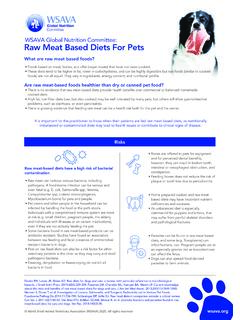
WSAVA Global Nutrition Committee: Raw Meat Based Diets …
wsava.orgDavies RH, Lawes JR, Wales AD. Raw diets for dogs and cats: a review, with particular reference to microbiological hazards. J Small Anim Pract. 2019;60(6):329-339; Freeman LM, Chandler ML, Hamper BA, Weeth LP. Current knowledge about the risks and benefits of raw meat-based diets for dogs and cats. J Am Vet Med Assoc. 2013;243(11):1549-1558;
Biosafety in Microbiological and Biomedical Laboratories ...
www.cdc.govcombinations of risks and mitigations feasible in biomedical and clinical labora-tories. The BMBL should be used as a tool in the assessment and proposed mitigation steps in biomedical and clinical laboratories. This edition of BMBL includes revised sections, agent summary statements, and appendices.
Biosafety in Microbiological and Biomedical Laboratories ...
www.cdc.govcombinations of risks and mitigations feasible in biomedical and clinical labora-tories. The BMBL should be used as a tool in the assessment and proposed mitigation steps in biomedical and clinical laboratories. This edition of BMBL includes revised sections, agent summary statements, and appendices.