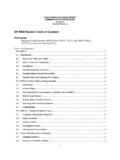
Transcription of Code of Academic Integrity
1 Policy V. Responsible Official: Vice Provost for Student Affairs Effective Date: May 10, 2017 code of Academic Integrity Policy Statement The University strives to provide an environment that encourages all students (undergraduate, medical, graduate, and continuing education) to learn, create, and share knowledge responsibly. As society entrusts our students and faculty to pursue knowledge and report their discoveries truthfully, any deliberate falsehood or misrepresentation undermines the stature of the University. The following standards of Academic Integrity are deemed necessary for fulfilling the University s mission, as well as its motto: Studiis et Rebus Honestis ( For honorable studies and pursuits ).
2 These standards are also necessary for evaluating the quality of student work in a fair manner. Reason for the Policy Some actions cannot be tolerated because they seriously interfere with the basic purposes and processes of an Academic community or with the rights afforded other members of the community. By formulating a code of Academic Integrity , the University reaffirms the principle of student Academic achievement coupled with personal responsibility and accountability for individual action and the consequences of that action. Applicability of the Policy The standards for Academic honesty and Integrity established in this policy apply to all students enrolled at the University of Vermont in any work performed in furtherance of a particular course or course of study.
3 Students enrolled in the College of Medicine are expected to meet the standards of Academic honesty established in this policy. The procedure for hearing and resolving allegations that a student in the College of Medicine has violated the standards of this policy are set forth in Rules and Regulations of the College of Medicine of the University of Vermont. Individuals enrolled in precollege coursework through Continuing and Distance Education ( , Summer Academy) are expected to comply with the behavioral requirements of this code and with any other requirements that may be established by Continuing and Distance Education.
4 code of Academic Integrity Page 2 of 14 violations of conduct requirements by individuals enrolled in precollege coursework will be addressed through processes established by Continuing and Distance Education. Faculty have responsibilities under this code . All suspected deliberate violations of Academic Integrity (plagiarism, fabrication, collusion, or cheating) must be reported to the Center for Student Conduct within two weeks of discovery. Reports may be submitted using a web referral form: Policy Elaboration General Provision Attempts to violate or to assist others in violating this code , including unsuccessful attempts, are prohibited and are subject to the same response under this code as are actual violations .
5 Standards All Academic work ( , homework assignments, written and oral reports, use of library materials, creative projects, performances, in-class and take-home exams, extra-credit projects, research, theses and dissertations) must satisfy the following four standards of Academic Integrity . Multiple students submitting a single assignment for Academic credit are responsible for their individual contributions to the final product and for fairly contributing to the whole. Academic work submitted for credit must include original work as outlined by the instructor and course work expectations.
6 1. Students may not plagiarize. All ideas, arguments, and phrases, submitted without attribution to other sources must be the creative product of the student. Thus, all text passages taken from the works of other authors (published or unpublished) must be properly cited. The same applies to paraphrased text, opinions, data, examples, illustrations, and all other creative work. violations of this standard constitute plagiarism. 2. Students may not fabricate. All experimental data, observations, interviews, statistical surveys, and other information collected and reported as part of Academic work must be authentic.
7 Any alteration, , the removal of statistical outliers, must be clearly documented. Data must not be falsified in any way. violations of this standard constitute fabrication. 3. Students may work cooperatively, but not collude. Students are encouraged to collaborate on Academic work within any limits that may be prescribed by their instructors. Students may only provide, seek or accept information about any Academic work that will be submitted for a grade, to or from another student, with the authorization of the instructor. violations of this standard constitute collusion.
8 4. Students may not cheat. Students must adhere to the guidelines provided by their instructors for completing Academic work. Students may not claim as their own work any portion of Academic work that was completed by another person. Students may only use materials approved by their instructor code of Academic Integrity Page 3 of 14 when completing an assignment or exam. Students may not present the same (or substantially the same) work for more than one course or within the same course without obtaining approval from the instructor of each course. Students must adhere to all course reserves regulations.
9 Students may not act dishonestly or convey information that the student knows or should know to be false, by actions such as lying, forging or altering any document or record in order to gain an unfair Academic advantage. violations of this standard constitute cheating. Please note: Course expectations may vary from instructor to instructor. All students have an obligation to convey a clear understanding of the expectations associated with each particular assignment and each particular course in which the student is enrolled. Communicating the Standards of Academic Integrity The University should continuously communicate the importance of Academic Integrity to its students and faculty.
10 Examples include: 1. During Orientation sessions, each student receives information about the code of Academic Integrity . 2. Each semester the Registrar includes the code of Academic Integrity on the Look-Up Classes page of myUVM. The definition of the grade of XF will appear in the University Catalogue and on each official transcript. 3. The University provides an informative web page on Academic Integrity , for public access, that clearly describes the standards of Academic Integrity , with examples of different violations . 4. Throughout the year, students are periodically sent a notice of the importance of Academic Integrity .