Example: tourism industry
Common Equations Used in Chemistry
Relationships of rate constants at two different temperatures: ln k1 k2 = Ea R ( T1 - T2 T1T2) Law of Mass Action - General expression of equilibrium constant: K = [C]c[D]d [A]a[B]b Relationship between Kp and Kc: Kp = Kc(0.0821*T)∆ n The equilibrium constant for the overall reaction is given by the product of
Tags:
Information
Domain:
Source:
Link to this page:
Documents from same domain

Introduction to Citations
www.sctcc.edu1 Plagiarize: “To use the words or ideas of another person as if they were your own words or ideas” (Merriam-Webster). Mary Stangler Center for Academic Success Rev. 20150630 Introduction to Citations Citations are used to show your reader(s) where the information in your paper was originally published.
PHYS 2310 Engineering Physics I Formula Sheets
www.sctcc.eduJul 20, 2017 · Chapters 1-18 Chapter 1/Important Numbers Chapter 2 Units for SI Base Quantities Quantity Unit Name Unit Symbol Length Meter M Time Second s Mass (not weight) Kilogram kg Common Conversions 1 kg or 1 1m 1000 g or m 1 m ∆×106 1 m 100 cm 1 inch 2.54 cm 1 m 1000 mm 1 day 86400 seconds

Asymptotes, Holes, and Graphing Rational Functions
www.sctcc.eduwhere x is a factor in the numerator and denominator. Setting this factor equal to zero we get x=0. We n ow cross out the common factor, and substitute 0 in for x we get y=0. There is a hole at (0,0) Our equation in lowest terms is 4 4 ( ) 2 2 x x x f x 2) To find vertical asymptotes, we set the denominator equal to zero and solve. When we do

Stats Review Chapter 9
www.sctcc.eduChapter 9 Revised 8/16 Mary Stangler Center for Academic Success. Note: This review is meant to highlight basic concepts from the course. It does not cover all concepts presented by your instructor. Refer back to your notes, unit objectives, handouts, etc. to further prepare for your
Related documents

Chapter 11: Stoichiometry
www.mcvts.netMole ratios You have read that the coefficients in a chemical equa-tion indicate the relationships between moles of reactants and products. You can use the relationships between coefficients to derive conversion factors called mole ratios. A mole ratio is a ratio between the numbers

Effective Communication in Relationships
www.scott.af.milRelationships The way couples communicate can enhance their relationship or lead to escalating disagreements ... If you can respectfully discuss frustrations early you can conquer them as mole-hills instead of mountains. I B H C Effective Communication in Relationships 2

Solutions Manual for Materials Science and Engineering An ...
downloadusb.com(b) Mole, in the context of this book, is taken in units of gram-mole. On this basis, how many atoms are there in a pound-mole of a substance? Solution (a) In order to determine the number of grams in one amu of material, appropriate manipulation of the amu/atom, g/mol, and atom/mol relationships is all that is necessary, as #g/ a m u = 1§ m ol

Biology Scoring Guidelines 2015 - College Board
secure-media.collegeboard.org1 mole of glucose in the organism. Describe. what happens to the excess energy that is released from the metabolism of glucose. ... evolutionary relationships of the organisms. Provide reasoning. for the placement on the tree of the species that is least related to the others.
Appendix A. Units of Measure, Scientific Abbreviations ...
www.adfg.alaska.govmole mol newton N normal N or n ohm ... show mathematical relationships. If you, the author, cannot quickly see the key re-lationships in an equation, then the equation is surely too complex for someone un-familiar with the topic, and the equation should be restated using a …
Principle of Maximum Entropy
mtlsites.mit.eduone mole of material (an amount with mass in grams equal to the atomic weight of the element) then there would be Avogadro’s number N ... conclusions and general relationships we will be able to establish. 10.2 Probabilities Although the problem has been set up, we do not know which actual state the system is in. To express
4. MATERIALAND ENERGY BALANCE
beeindia.gov.inMole fraction of salt = 0.34 / (5.56 + 0.34) = 0.058 d) The molar concentration (M) is 220.5/58.5 = 3.77 moles in m3 Note that the mole fraction can be approximated by the (moles of salt/moles of water) as the number of moles of water are dominant, that is the mole fraction is close to 0.34 / 5.56 = 0.061.
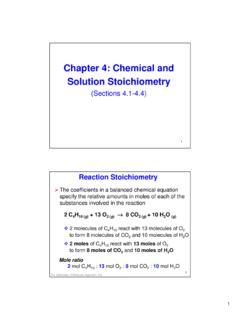
Chapter 4: Chemical and Solution Stoichiometry
webhost.bridgew.eduUse mole theoretical mole ratio (fr. the balanced eq.) and compare it with the actual ratio (given) to find the limiting reactant. 19 2Al + 3 I2 -----> 2 AlI 3 Obviously, 489 g is less than 652, so Al is the limiting reagent (lower yield from Al), making I 2 the excess reagent 20

First Law, Heat Capacity, Latent Heat and Enthalpy
faculty.uca.eduIn this section we will explore the relationships between heat capacities and specific heats and internal. Heat Capacity The heat capacity of an object is the energy transfer by heating per unit temperature change. That is, C = Q 4T. In this expression, we will frequently put subscripts on …
Chapter 10 ChemiCal alCulations and equations
preparatorychemistry.comChapter 10 ChemiCal CalCulations and ChemiCal equations 367 10.1 Equation . Stoichiometry 10.2 Real-World . Applications of . Equation Stoichiometry 10.3 Molarity and . Equation . Stoichiometry lthough Chapter 9 was full of questions that began with, “