Example: bachelor of science
Commonly Abused Drugs Chart
drug abuse. To be effective, treatment must address the individual’s drug abuse and any associated medical, psychological, social, vocational, and legal problems. 5. Remaining in treatment for an adequate period of time is critical. The appropriate duration for an individual depends on the type and degree of his or her problems and needs.
Tags:
Information
Domain:
Source:
Link to this page:
Documents from same domain
principles of drug addiction treatment
www.drugabuse.govthird edition. II National Institute on Drug Abuse National Institutes of Health U.S. Department of Health and Human Services principles of drug addiction treatment A research-based guide third edition. iiii iiiiii Martin W. Adler, Ph.D. Temple University School of Medicine
from the director: Comorbidity
www.drugabuse.govThe terms “dual diagnosis,” “mentally ill chemical abuser,” and “co-occurrence” are also used to refer to drug use disorders that are comorbid with other mental illnesses.
Opioid Risk Tool - National Institute on Drug Abuse
www.drugabuse.govhp://ww.drgabse.go/nidamed-medical-healh-professionals Opioid Risk Tool Introduction he Opioid Risk Tool (ORT) is a brief, self-report screening tool designed
Cough and Cold Medicine Abuse
www.drugabuse.govPromethazine-codeine cough syrup, a medication that contains codeine, an opioid that acts as a cough suppressant and can also produce relaxation and euphoria when consumed at a higher-than- ... Cough and Cold Medicine Abuse •May 2014 Page 2 guaifenesin commonly found in DXM -
Spice ( Synthetic Marijuana
www.drugabuse.govSpice (“Synthetic Marijuana”) "Spice" refers to a wide variety of herbal mixtures that produce experiences similar to marijuana (cannabis) and that are marketed as "safe," legal alternatives to that drug. Sold under many names, including K2, fake weed, Yucatan Fire, Skunk, Moon
Drugs, Brains, and Behavior The Science of Addiction
www.drugabuse.govDrugs, Brains, and Behavior The Science of Addiction Image: White Matter Fibers, Parietal Areas • www.humanconnectomeproject.org
Spice&(SyntheticMarijuana)&
www.drugabuse.govSpice (Synthetic Marijuana) • December 2012 • Page 1 !! Spice&(SyntheticMarijuana)&! “Spice”referstoawidevariety!ofherbal! mixtures!thatproduce!experiencessimi
Sample Patient Agreement Forms
www.drugabuse.govhttpwwrgabsegoniamemeialealtprofessionals. Sample Patient Agreement Forms. Introduction. This resource includes two sample patient agreement forms that can

Clinical Opiate Withdrawl Scale - National Institute on ...
www.drugabuse.govClinical Opiate Withdrawal Scale Introduction The Clinical Opiate Withdrawal Scale (COWS) is an 11-item scale designed ... score for the complete scale can be used to help clinicians determine the stage or severity of opiate withdrawal and assess the level of physical dependence on opioids. Practitioners sometimes express concern about
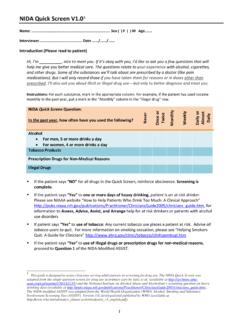
NIDA Quick Screen V1.0 1
www.drugabuse.gov2 Questions 1-8 of the NIDA-Modified ASSIST V2.0 Instructions: Patients may fill in the following form themselves but screening personnel should offer to read the questions aloud in a private setting and complete the form for the patient. To preserve confidentiality, a
Related documents

THE CONFIDENTIALITY OF ALCOHOL AND DRUG ABUSE
www.samhsa.govabuse treatment programs. 6. A substance abuse treatment program is defined as an individual or entity that provides alcohol or drug abuse diagnosis, treatment or referral. For the purposes of this document, the term “program” includes both individual substance abuse providers and substance abuse provider organizations. 7

Theories on Drug Abuse - Selected Contemporary ...
archives.drugabuse.govDRUG ABUSE Selected Contemporary Perspectives Editors: DAN J. LETTIERI, Ph.D. MOLLIE SAYERS HELEN WALLENSTEIN PEARSON NIDA Research Monograph 30 March 1980 DEPARTMENT OF HEALTH AND HUMAN SERVICES Public Health Service Alcohol, Drug Abuse, and Mental Health Administration National Institute on Drug Abuse Division of …

Long-Term Consequences of Child Abuse and Neglect
www.childwelfare.govAlcohol and other drug use. Adults who had been maltreated as children are at a significantly higher risk of substance use disorders than adults who have not been maltreated (LeTendre & Reed, 2017; (Choi, DiNitto, Marti, & Choi, 2017). Future perpetration of maltreatment. Although most children who have experienced abuse and neglect do not

THE SOCIAL IMPACT OF DRUG ABUSE
www.unodc.orgfrom a broad international perspective. Secondly, based on that analysis, to suggest how problems of drug abuse prevention and control can be addressed in a constructive, coordinated manner. The paper concerns primarily narcotic drugs and psychotropic substances but also includes, where appropriate, information on problems related to the abuse ...

Alcohol (Canadian Drug Summary)
ccsa.caAlcohol Key Points Alcohol is by far the most common drug used by Canadians and use has increased significantly among females since 2013. Approximately 15% of Canadians who drink alcohol consume above Canada’s Low-risk Alcohol Drinking Guidelines. The risky use of alcohol is still the most prevalent among young adults (age 18–24).

Drug Enforcement in the United States: History, Policy ...
sgp.fas.orgDrug cases represent the second highest category of criminal cases filed by U.S. Attorneys; however, federal drug cases have steadily declined over the last decade. This report focuses on domestic drug enforcement. It outlines historic development and major changes in U.S. drug enforcement to help provide an understanding of how and why certain ...