Transcription of Concrete Technology in Focus - BASF
1 United States 23700 Chagrin Boulevard Cleveland, Ohio 44122-5544 Tel: 800 628-9990 Fax: 216 839-8821 Canada 1800 Clark Boulevard Brampton, Ontario L6T 4M7 Tel: 800 387-5862 Fax: 905 Registered trademark of the BASF-Group in many countries BASF Corporation 2019 12/19 CTF-0118 LIT #: AD3000123 ContactLIMITED WARRANTY NOTICEWe warrant our products to be of good quality and will replace or, at our discretion, refund the purchase price of any products proved defective. Satisfactory results depend not only upon quality products, but also upon many factors beyond our control. Therefore, except for such replacement or refund, BASF MAKES NO WARRANTY OR GUARANTEE, EXPRESS OR IMPLIED, INCLUDING WARRANTIES OF FITNESS FOR A PARTICULAR PURPOSE OR MERCHANTABILITY, RESPECTING ITS PRODUCTS, and BASF shall have no other liability with respect thereto.
2 Any claims regarding product defect must be received in writing within one (1) year from the date of shipment. User shall determine the suitability of the products for the intended use and assume all risks and liability in connection therewith. Any authorized change in the printed recommendations concerning the use of our products must bear the signature of the BASF Technical information and all further technical advice are based on BASF s present knowledge and experience. However, BASF assumes no liability for providing such information and advice including the extent to which such information and advice may relate to existing third party intellectual property rights, especially patent rights.
3 BASF SHALL NOT BE RESPONSIBLE FOR CONSEQUENTIAL, INDIRECT OR INCIDENTAL DAMAGES (INCLUDING LOSS OF PROFITS) OF ANY KIND. BASF reserves the right to make any changes according to technological progress or further weather can lead to many problems in mixing, placing, and curing of Concrete that can have an adverse effect on its properties and service life. This guide has been developed by BASF to assist the entire construction team (owners, specifiers, contractors, and ready-mixed Concrete producers) in the design, production, delivery, placement and curing of quality Concrete in hot Hot Weather ConcretingACI Committee 305 defines hot weather as any combination of high ambient temperature, high Concrete temperature, low relative humidity, wind speed and solar radiation.
4 The effects of high temperature, solar radiation and low relative humidity on Concrete may be more pronounced with increases in wind velocity (see Figure 1), and can lead to rapid evaporation of moisture, which is the primary cause of plastic shrinkage cracks in temperature, FRate of evaporation, lb/sq ft/hkg/m 5 15 25 35 Concrete temperature 100 F (38 C)90 F (32 C)60 F (16 C)50 F (10 C)40 F (4 C)Wind velocity 25 mph (40 km/h)20 mph (32 km/h)15 mph (24 km/h)10 mph (16 km/h)5 mph (8 km/h)2 mph (3 km/h)080 F (27 C)70 F (21 C)Relative humidity100 percent90807060504030201040 50 60 70 80 90 100 C Figure 1.
5 Effect of Concrete and Air Temperatures, Relative Humidity and Wind Speed on the Rate of Surface Moisture Evaporation from Concrete (Source: ACI Specification for Hot Weather Concreting)If the rate of evaporation approaches lb/ft2/h (1 kg/m2/h), precautions against plastic shrinkage cracking are Technology in FocusMore InformationThe Master Builders Solutions brand brings all of BASF s expertise together to create chemical solutions for new construction, maintenance, repair and renovation of structures. Master Builders Solutions is built on the experience gained from more than a century in the construction industry. The know-how and experience of a global community of BASF construction experts form the core of Master Builders Solutions.
6 We combine the right elements from our portfolio to solve your specific construction challenges. We collaborate across areas of expertise and regions and draw on the experience gained from countless construction projects worldwide. We leverage global BASF technologies, as well as our in-depth knowledge of local building needs, to develop innovations that help make you more successful and drive sustainable construction. The comprehensive portfolio under the Master Builders Solutions brand encompasses Concrete admixtures, cement additives, chemical solutions for underground construction, waterproofing solutions, sealants, Concrete repair & protection solutions, performance grouts, performance flooring ProblemsThe potential problems of hot weather can occur at any time of the year in warm tropical or arid climates and generally occur during the summer season in other climates.
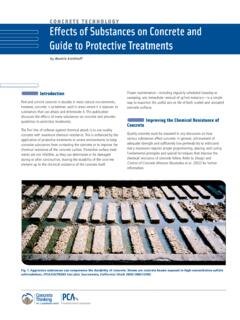
7 Problems associated with freshly mixed Concrete placed during hot weather conditions include increased: Water demand (see Figure 2) Rate of slump loss and tendency for retempering Rate of setting (see Table 1) Difficulty in handling, placing, consolidating and finishing Occurrence of plastic shrinkage cracking Amount of air-entraining admixture to entrain air Need for early curing Risk of cold joints30405060708090100110260 270 280 290 300 310 Water content, lb/yd (kg/m )(184) (178)(172)(166)(161)(154)(0) (4) (10) (16) (21) (27) (32) (38) (44)3 Concrete temperature, F ( C)Slump: 3 in.
8 (75 mm) Max. size agg.: 1-1/2 in. (38 mm)3 Figure 2. Effect of Concrete Mix Temperature on Water Requirement(Source: PCA, Design and Control of Concrete Mixtures)Admixture Systemsfrom Master Builders SolutionsTable 1. Setting Time of Concrete at Various Temperatures Approximate Temperature Setting Time100 F (38 C) 1-2/3 hours90 F (32 C) 2-2/3 hours80 F (27 C) 4 hours70 F (21 C) 6 hours60 F (16 C) 8 hours50 F (10 C) 11 hours40 F (4 C) 14 hoursIn hardened Concrete , hot weather can increase: Drying shrinkage and differential thermal cracking Permeabilityand decrease: Compressive and flexural strengths Durability Watertightness Uniformity of surface appearanceACI 305R guide to Hot Weather Concreting, states that Concrete can be produced in hot weather without maximum limits on placing temperature, and perform satisfactorily when proper precautions are observed in proportioning, production, delivery, placing, consolidating, finishing, and curing .
9 As part of these precautions, an effort should be made to keep the temperature of the fresh Concrete as low as practical. Concrete Temperature ControlConcrete temperature at the time of mixing is influenced by temperature, specific heat and quantity of its approximate temperature of freshly mixed Concrete can be calculated from the following equation:[ (TsMs + TaMa + TcMc) + TwMw + TsMws + TaMwa][ (Ms + Ma + Mc) + Mw + Mws + Mwa]T = where:T = final temperature of the Concrete mixtureTc , Ts , Ta and Tw = temperature of cement, fine aggregate, coarse aggregate and water, respectivelyMc , Ms , Ma , Mw , Mws and Mwa = mass of cement, saturated surface-dry fine aggregate, saturated surface-dry coarse aggregate, mixing water, free water on fine aggregate and free water on coarse aggregate, temperature of Concrete can be reduced by 1 F ( C) by reducing.
10 Cement temperature by 8 F (4 C) Water temperature by 4 F (2 C) (see Figure 3) Aggregate temperature by 2 F (1 C)Of all Concrete -making materials, water is the easiest to cool, and using ice as part of the mixing water will help reduce the Concrete temperature. The amount of ice used must be included as part of the mix water and should not be more than approximately 75% of the amount of water required to meet the specified water-cementitious materials ratio. ACI 305R has additional guidelines for the use of ice in Concrete . As coarse aggregate is the ingredient with greatest mass in Concrete , changes in its temperature have a considerable effect on Concrete temperature.












![6ITSVXIH F] %'- 'SQQMXXII - dl.mycivil.ir](/cache/preview/4/b/b/f/2/e/8/1/thumb-4bbf2e81b2b2df04c22714e49f0954ce.jpg)