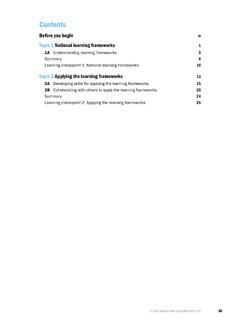
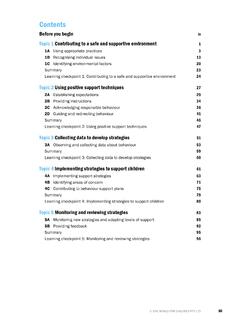
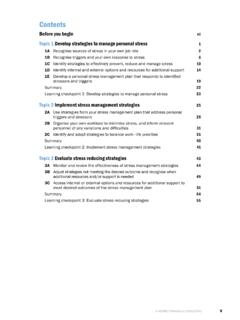
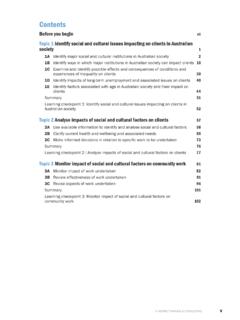
Transcription of Contents
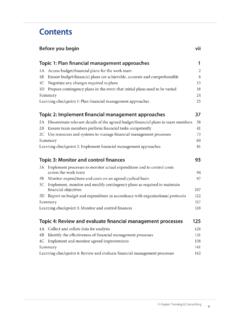
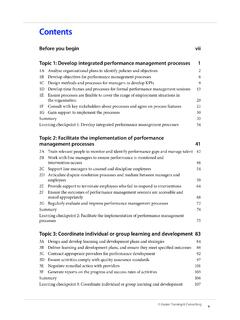
1 ASPIRE TRAINING & CONSULTING vContentsBefore you begin viiTopic 1 Communicate with co-workers and people who have support needs 11A Identify and use appropriate communication techniques 21B Demonstrate respect and uphold rights in communication 121C Represent the organisation appropriately 191D Provide information in accordance with policies and protocols 27 Summary 37 Learning checkpoint 1: Communicate with co-workers and people who have support needs 38 Topic 2 Address communication needs 432A Recognise and support communication needs 442B Access interpreter and translation services 502C Identify and address problems and communication barriers 562D Defuse conflict and refer if necessary 652E Seek and respond to feedback on effectiveness of communication 70 Summary 73 Learning checkpoint 2.
2 Address communication needs 74 Topic 3 Facilitate meetings 773A Develop an agenda and prepare to facilitate a meeting 783B Communicate details of meeting in accordance with protocol 813C Contribute to and follow meeting objectives 853D Provide opportunities to explore issues 893E Use strategies to encourage equal participation 943F Identify and address communication needs of meeting participants 1023G Facilitate conflict resolution 1053H Keep records in accordance with requirements 1083I Evaluate and improve meeting processes 112 Summary 115 Learning checkpoint 3: Facilitate meetings 1164 CHCCOM002 USE COMMUNICATION TO BUILD RELATIONSHIPSYour body language and whether you are nodding your head in agreement or pointing your fingerYou facial expressions, such as whether you are smiling or frowning Motivational interviewingMotivational interviewing is used to help the person you support to develop their own intrinsic motivation.
3 If motivation comes from within them, the person is more likely to reach a goal or change behaviour. Motivational interviewing is person-centred, which means it focuses on the individual needs of the person. It also directly involves the person in the process. Motivational interviewing was first developed by psychologists Professor William R Miller, and Professor Stephen Rollnick, (1991) to address people who struggled with alcohol addiction. Motivational interviewing asks open-ended questions, which help the individual identify why they want to change their own behaviour.
4 They are more likely to succeed in changing their behaviour if they identify reasons for changing it. Principles of motivational interviewing:XXThe interviewer asks open-ended questions to encourage the individual to think for themselves. XXThe interviewer provides positive interviewer uses reflective listening and provides summarising statements for the process promotes using empathy, warmth and acceptance. XXThe main goal is to engage the individual and encourage change talk , which helps the individual motivate set should be small, genuinely important, specific and realistic for the interviewing versus a coercive approachMotivational interviewing is preferred to using a coercive approach.
5 A coercive approach involves forcing a person to do something, such as change a behaviour. A coercive approach is less effective, because the motivation is external. They will find it hard to motivate themselves in the future, because they rely on external sources of motivation, such as being told what to do. For example, if a person has problems related to smoking, and a doctor tel ls them they need to stop smoking, they are less likely to change their behaviour than if they decide for themselves that smoking is a bad idea, and they would like to quit.
6 The motivational approach is also preferred to a coercive approach because it is more person-centred and empathetic. The individual is central to the process, and therefore more likely to succeed with behavioural change. ASPIRE TRAINING & CONSULTING ASPIRE TRAINING & CONSULTING 13 TopiC 1 COMMUNICATE WITH CO-WORkERS AND PEOPLE WHO HAVE SUPPORT NEEDS Commonwealth legislation that protects individualsXXRacial Discrimination Act 1975 XXSex Discrimination Act 1984 XXDisability Discrimination Act 1992 XXAge Discrimination Act 2004 XXPrivacy Act 1988 XXAustralian Human Rights Commission Act 1986 Commonwealth legislation that protects older peopleXXFor example.
7 Aged Care Act 1997 (Cth) Home and Community Care Act 1985 (Cth)State/territory legislation that protects individual s informationXXFor example: Health Records and Information Privacy Act 2002 (NSW) Information Privacy Act 2000 (Vic.)Human rightsThe Universal Declaration of Human Rights describes the rights that should be attributed to all humans. The Australian Human Rights Commission (initially called the Human Rights and Equal Opportunity Commission) was established in 1986 to deal with breaches of anti-discrimination laws and to promote human rights Act only covers actions or policies of the Act promotes human rights for all people, and covers most forms of discrimination not already covered in the other Acts, including discrimination on the basis of medical history and criminal records.
8 Here are some relevant rights set out in the Universal Declaration of Human Rights, which you should think about when interviewing people you support, and other rights in the universal Declaration of Human rightsXXAll people are one should have their privacy, family, home or mail interfered one should experience attacks on their honour or has the right to freedom of thought, conscience and has the right to freedom of opinion and expression. ASPIRE TRAINING & CONSULTING 17 TopiC 1 COMMUNICATE WITH CO-WORkERS AND PEOPLE WHO HAVE SUPPORT NEEDS People you support and colleagues have the right to.
9 XXreceive information in an accessible form such as plain English, via interpreters or aidsXXbe treated equallyXXbe free from discriminationXXrespond to any allegationsXXhave an independent third person or advocate with respectfullyHere are two examples of community services workers communicating with people receiving cultural sensitivityJessica is a caseworker who has been working with a particular family for several months. The parents were born in a home visit, Jessica says that she is interested in learning more about Islam.
10 The mother s face lights up. Ramadan had recently ended and her kitchen is full of treats made for the celebration that comes at the end of fasting. The woman makes tea and offers Jessica some sweets. She tells Jessica all about Ramadan. She also shares the story of her arranged feels honoured to hear this woman s story. She learnt so much more than if she had read a book or attended a workshop. The trust and rapport that underscored the professional relationship was enhanced by this exchange. identify differencesSusan is a team leader in community services.