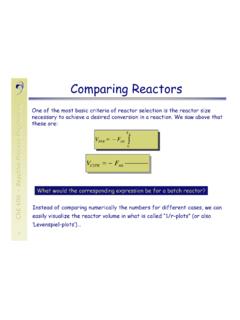
Transcription of CONVERSION AND REACTOR SIZING
1 1 Objectives: CONVERSION AND REACTOR SIZINGCONVERSION AND REACTOR SIZING Define CONVERSION and space time. Write the mole balances in terms of CONVERSION for a batch REACTOR , CSTR, PFR, and PBR. Size reactors either alone or in series once given the molar flow rate of A, and the rate of reaction, -rA, as a function of CONVERSION , X. CONVERSION :Choose one of the reactants as the basis of calculation and relate the other species involved in of calculation and relate the other species involved in the rxn to this basis. Space time:the time necessary to process one REACTOR volume of fluid based on entrance conditions (holding time or mean residence time)2 CONVERSION AND REACTOR SIZINGCONVERSION AND REACTOR SIZING1.
2 ConversionConsider the general equation dDCbBAdDcCbBaA+ +We will choose A as our basis of + +The basis of calculation is most always the limiting reactant. The CONVERSION of species A in a reaction is equal to the number of moles of A reacted per mole of A )()(AAAAFFXNNX = =BatchFlow00 AAFXNX==X = Moles of A reactedMoles of A fedFor irreversible reactions, the maximum value of CONVERSION , X, is that for complete CONVERSION , X = reversible reactions, the maximum value of CONVERSION , X, is the equilibrium CONVERSION , X = REACTOR Design Equations:Batch REACTOR Design Equations: Design EquationsDesign Equations = fedAofMolesreactedAofMolesfedAofMolescon sumedreacted)([]0AN=[]X [1]Now the # of moles of A that remain in the REACTOR after a time t, NAcan be expressed in terms of NA0and X;expressed in terms of NA0and X.
3 [][ ][ ])1(000 XNNXNNNAAAAA = =[2]VrdtdNmixingprefectVrdtdNAAAA = =)([3]For batch reactors, we are interested in determining how long to leave the reactants in the REACTOR to achieve a certain CONVERSION =00(Since NA0is constant) [4]VrdtdXNVrdtdXNAAAA = = 00 Batch REACTOR design eq n (in differential form)[5]4 For a constant volume batch REACTOR : (V = V0)== AAAdtdCdtVNddtdNV00)/(1 From [3] = ==XAAAAAVrdXNtVrdXNdtrdtdC00 From [5]Constant volume batch reactorBatch time, t, required to achieve a AVr0conversion t XFlow REACTOR Design Equations:Flow REACTOR Design Equations.
4 ReactedAofmolesfedAofmolesFor continuous-flow systems, time usually increases with increasing REACTOR = 000inlet molar flow rateMolar flow rate at which A is consumed within the systemOutlet flow rate0000)1(vCFXFFAAAA = =moles /volumevolume / time (volumetric flow rate, dm3/s)5 For liquid systems, CA0is usually given in terms of molarity (mol/dm3)For gas systems, CA0can be calculated using gas pressure000000 TRPyTRPCAAA = =Py Entering molar flow rate is yA0= entering mole fraction of APt i ttl(kP)0000000 TRPyvCvFAAA = =P0= entering total pressure (kPa)CA0= entering conc n (mol/dm3) R= kPa dm3/ mol KT= T(K)CSTR (Design Equation)CSTR (Design Equation)DadCacBabA+ +For a rxn:FFAAArFFV =0 Substitute for FAAAAAAAXFFFVXFFF)(00000 = =exitAAArXFVr)(0 = 6 PFR (Design Equation)PFR (Design Equation)rdVdFAA = dXFdFXFFFAAAAA = =000 Substitute back:AAArdVdXFdVdF = = 0 Seperate the variables V = 0 when X = 0 =XAArdXFV00 Applications of Design Equations for Applications of Design Equations for Continuous Flow ReactorsContinuous Flow REACTOR SizingReactor SizingGiven rAas a function of CONVERSION , -rA= f(X), one can size any type of REACTOR .
5 We do this by constructing a Levenspiel Plot. Here we plot either FA0/ -rAor 1 / -rAas a function of X. For FA0/ -rAvs. X, the volume of a CSTR and the volume of a PFR can be represented as the shaded areas in the Levelspiel Plots shown below: Levenspiel PlotsLevenspiel Plots7A particularly simple functional dependence is the first order dependence:)1(0 XCkCkrAAA = = Specific rxn rate (function of T)initial conc n()For this first order rxn, a plot of 1/-rAas a function of X yields : = XCkrAA11110-1/rAXExample:Example:Let s consider the isothermal gas-phase isomerization:A BX-rA(mol/m3s) [T = 500 K][P = 830 kPa = atm]initial charge was pure A8 Example:Example.
6 Let s consider the isothermal gas-phase isomerization:A BX-rA(mol/m3s)1 / [T = 500 K][P = 830 kPa = atm]initial charge was pure A-1/rADraw Draw --1/r1/rAAvs X:vs X:We can use this figure to size flow reactors for different entering molar flow in mind :1. if a rxn is carried out isothermally, the rate is Xy,usually greatest at the start of the rxn, when the conc n of reactant is greatest. (when x 0 -1/rAis small)2. As x 1, rA 0 thus 1/-rA & V An infinite REACTOR volume is needed to reach complete reversible reactions (A B), the max X is the equilibrium CONVERSION Xe.
7 At equilibrium, rA X Xe, rA 0 thus 1/-rA & V An infinite REACTOR volume is needed to obtain FA0= mol/s, we can calculate [FA/-rA](m3)Plot FA0/-rAvs X obtain Levenspiel Plot!Example: Calculate volume to achieve 80 % CONVERSION in = )(201mmmolrXFVsmolmrexitAAA= = = = m3 CSTRs are usually used for liquid-phase Numerical Evaluation of IntergralsNumerical Evaluation of IntergralsThe integral to calculate the PFR volume can be evaluated using a method such as Simpson s One-Third :NOTE:The intervals ( X) shown in the sketch are not drawn to scale. They should be s One-Third Rule is one of the most common numerical methods.
8 It uses three data points. One numerical methods for evaluating integrals are:1. Trapezoidal Rule (uses two data points)2. Simpson s Three-Eighth s Rule (uses four data points)3. Five-Point Quadrature Formula10 Trapezoidal RuleTrapezoidal Rulef(x1)f(x)2)]()([)()]()([1)(012011010 hxfxfAhxfAxfxfhdxxfxx = =+= A1A2x0x1xhf(x0))]()([22)(2)()(210010212x fxfhxfxfxfhAAA+ = + =+=Five Point Quadrature formula:Five Point Quadrature formula:..)233233(83)(4)424(3)(654321004 43210040fffffffhdxxfxxhwherefffffhdxxfNx xxx++++++ = =++++ = For N+1 points, where N is an :Example:Consider the liquid phase reaction; A Productswhich is to take place in a PFR.
9 The following data was obtained in a batch (mol/dm3s) the molar feed of A to the PFR is 2 mol/s, what PFR volume is necessary to achieve 80 % CONVERSION under identical conditions as those under which the batch data was obtained?11 Hint :FA0= 2 mol/s, fed to a plug flow reactordXrFVPFRXAA = 001 Thus one needs (1/-rA) as a function of :XFdXFVPFRAXA ++ == For Simpson s three point formula we have:[] )125( :)()()0(3:dmmolsdmsmolrdXFVPFRXrXrXrrVAA AAAAAA= + + = = = To reach 80 % CONVERSION your PFR must be 293 3 dm3To reach 80 % CONVERSION , your PFR must be in PFRS izing in PFRE xample: Determine the volume in PFR to achieve a 80 % = 80800:dXrFrdXFVarrangingAAAA = =.
10 ReLet s numerically evaluate the integral with trapezoidal )(00= ==XAArFXf )( == ) ( =+ =With five point quadrature V = m3 Comparing CSTR & PFR SizingComparing CSTR & PFR SizingVCSTR> VPFRfor the same CONVERSION and rxn reason is that CSTR always operates at lowest rxn rate. PFR starts at a high ypgrate, then gradually decreases to the exit in Series:The exit of one REACTOR is fed to the next rAas a function of CONVERSION , one can design any sequence of valid if there are no side =00 Example:Using Levenspiel plots to calculate CONVERSION from known REACTOR A is fed at a volumetric flow rate 1000 dm3/h and at a concentration of mol/dm3to an existing CSTR, which is connected in series to an existing tubular REACTOR If the volume of the CSTR is 1200 dm3and the tubular REACTOR volume isreactor.