Transcription of CONVOY LEADER TRAINING HANDBOOK - GlobalSecurity.org
1 0 CONVOY LEADER TRAINING HANDBOOK 32nd Transportation Group KUWAIT Revision I Dated 08 August 2003 1 TABLE OF CONTENTS Table of Contents Page 01 Preface Page 02 section I CONVOY Operations LEADER TRAINING POI Page 03 section II CONVOY Warning Order Format Page 06 section III PCC / PCI Checklist Page 08 section IV Time Schedule Page 12 section V CFLCC Rules of Engagement Page 13 section VI CONVOY Risk Management Page 14 section VII CONVOY Brief Format Page 16 section VIII CONVOY Execution Matrix Page 19 section IX CONVOY Manifest Page 20 section X CONVOY Formations Page 21 section XI Weapon Engagement Skills Page 22 section XII battle drills React to Contact (Moving) Page 24 CONVOY Forced to Stop Page 25 Rally Points (floating)
2 Page 26 Break Contact Page 27 Recovery / CASEVAC Operations Page 28 Consolidation & Reorganization Page 29 Reports Page 30 2 PREFACE The purpose of this HANDBOOK is to provide a field guide for CONVOY leaders conducting long haul operations in support of Operation Iraqi Freedom. The focus is on planning, preparing and executing operations to counter level I and II threat. This HANDBOOK is based on doctrine, tactics, techniques and procedures outlined in: CALL No. 03-6, Tactical CONVOY Operations, March 2003 JRTC CONVOY LEADER HANDBOOK , March 2002 ARTEP 55-506-10-MTP, Plans for Movement Control Team, June 2002 ARTEP 55-406-MTP, Plans for the Transportation Movement Control Bn, August 2002 ARTEP 55-406-30-MTP, Transportation Movement Control, March 2000 FM 55 30, Army Motor Transport Units and Operations, June 1997 The point of contact for this HANDBOOK is the MPRI Kuwait Observer Controller Team, Camp Doha, Kuwait, APO 09889.
3 Point of contact information is listed below. Mr. Randall Cook MPRI KOCT Academy Coordinator Camp Doha, Kuwait APO AE 09889 DSN: 468-2926 Commercial (Kuwait): (965) 938-3278 E-mail: Downloaded from: 3 CONVOY LEADER TRAINING POI Troop Leading Procedures TRAINING (CO PLT leadership 4 Hours) I. Initial Receipt of Mission (Higher WARNO / Tasker) a. Do you understand all aspects of your mission b. See yourself / show stoppers c. Issue WARNO 1 i. Lead time for subordinate preparation ii. Provide information from higher iii.
4 Task to subordinate leaders iv. Initial timeline v. Initial PCC guidance vi. Subordinate unit rehearsals II. Battalion OPORD Issued III. Receive the Mission a. Provide higher with current unit capabilities / Mission Show Stoppers (Feedback from initial PCCs / PCIs) b. Develop Time Line (1/3 2/3 Rule) i. Backward planning process ii. Tasks to be accomplished c. Delegate responsibilities to subordinates d. Issue Warning Order # 2 i. Provide refined information from higher ii.
5 Redefine tasks to subordinate leaders iii. Detailed timeline iv. Additional tasks / responsibilities to subordinates e. Coordinate for Support i. Internal Coordination 1. Recovery 2. Maintenance 3. Supply (replenish combat loads) 4. Medical ii. External Coordination 1. Gun Trucks / MPs 2. Other Units / Vehicles IV. Analyze the Mission a. See Yourself / Unit b. Map Reconnaissance c. METT-TC Analysis i. Mission ii. Enemy iii. Terrain (route) and Weather (effects) iv. Troops ( CONVOY / serial organization / Initial Risk Assessment) v.
6 Time vi. Civilians on the Battlefield / Rules of Engagement 4 Troop Leading Procedures TRAINING (CO PLT leadership 4 Hours) cont. V. Develop a Tentative Plan (wargame execution) i. Support Available ii. Task Organization iii. Formation / March Guidance iv. Review / Develop SOPs v. Rules of Engagement vi. Risk Management VI. Complete the Plan a. Prepare CONVOY Brief b. Develop / Refine strip maps for all Vehicles c. Develop Visual Aids d. Prepare Rehearsal Area e. Develop Execution Matrix (FRAGO for phases of CONVOY routes) f.
7 Develop Manifest g. Update Risk Management VII. Issue the CONVOY Brief / Conduct Brief-Backs VIII. Conduct Rehearsals (SOPs) IX. LEADER Inspections (PCIs) X. Supervision Standard Operating Procedures (SOP) Development (CO PLT leadership / Gun Truck 5 Hours) XI. SOP Development / Rehearsals a. CONVOY Formation Organization i. leaders ii. Communications iii. Recovery Assets iv. Combat Lifesavers / Medics v. Weapons Systems 1. Individual Weapons 2. Automatic Weapons 3. Crew-Served Weapons 4.
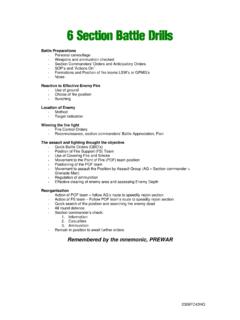
8 Gun Truck vi. Obstacle Reduction Assets b. Individual Weapon Engagement 1. Readiness / Alert 2. Scanning / Acquisition 3. Sector of Fire / Signaling 4. Point of Aim 5. Rate of Fire 5 Standard Operating Procedures (SOP) Development (CO PLT leadership / Gun Truck 5 Hours) cont. c. battle drills i. React to Attack (Moving) ii. CONVOY Forced to Stop iii. Rally Points (Floating) iv. Break Contact v. Recovery / CASEVAC Operations vi. Consolidation and Reorganization vii.
9 Reports XII. Company CDR / XO Develop / Rehearse CONVOY Brief (1 Hour) Tactical Exercise Without Troops CONVOY Live Fire Exercise (6 Hours) XIII. CONVOY CDR / XO Issues CONVOY Brief (CO CDR) (.5 Hour) XIV. CONVOY Rehearsals (CO CDR) (1 Hour) XV. CONVOY CDR PCIs / Final Inspections (CO CDR) (.5 Hour) XVI. CONVOY LFX Dry Run (MPRI) (1 Hour) XVII. CONVOY LFX Wet Runs (2) (2 Hours) LEADER After-Action Review (1 Hour) 6 CONVOY WARNING ORDER FORMAT 1.
10 SITUATION: A brief statement of the enemy and friendly situation. (Who, What, Where). 2. MISSION: (Who, What, When, Where, Why) 3. TASK ORGANIZATION: (Based on tasking from higher WARNO) 4. Initial Time Schedule: When Who What 5. Special Instructions: (PCC / PCI Guidance, Rehearsals, additional tasks to be accomplished) 7 6. Service & Support: Class I: (Rations & Water) Class III: (POL) Class V: (Ammunition / Pyrotechnics) Weapon System Rounds Type Pyrotechnic Device Number Location Class IV: (Medical) 7.