Transcription of Critical Thinking - ed
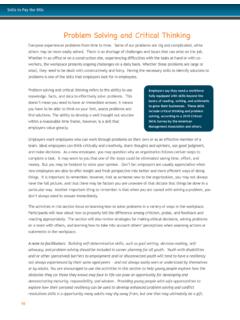
1 32 Journal of De Velopmental eD ucatIonCritical Thinking : Intellectual Standards Essential to Reasoning Well Within Every Domain of Human Thought, Part TwoBy Richard Paul and Linda ElderIn our last Critical Thinking column we introduced the idea of intellectual standards and pointed out that all natural languages are repositories for such standards, which, when appropriately applied, serve as guides for assessing human reasoning. We argued that intellectual standards are necessary for cultivating the intellect and living a rational life, are presupposed in many concepts in modern natural languages, and are presupposed in every subject and discipline.
2 In this column, the second in the series, we introduce and explicate some of the intellectual standards essential to reasoning well through the problems and issues implicit in everyday human Essential Intellectual StandardsWe postulate that there are at least nine intellectual standards important to skilled reasoning in everyday life. These are clarity, precision, accuracy, relevance, depth, breadth, logicalness, significance, and fairness. It is unin-telligible to claim that any instance of reasoning is both sound and yet in violation of these standards.
3 To see this, suppose someone were to claim that her or his reasoning is sound regarding x, though, at the same time, admittedly unclear, inaccurate, imprecise, irrelevant, narrow, superficial, illogical, trivial, and unfair with respect to x. Beginning with these nine intellectual standards will help set the stage for conceptualizing intellectual standards (more broadly) and for appreciating the essential role of intellectual standards in human Intellectual Standards: An ExplicationClarity: Understandable, the meaning can be grasped; to free from confusion or ambiguity, to remove obscurities.
4 Clarity is a gateway standard. If a statement is unclear, one cannot determine whether it is accurate or relevant. In fact, it is impossible to tell anything about a statement without knowing what it is saying. For example, here is an unclear question: What can be done about the education system in America? To adequately address the question, a clearer understanding of how the person asking the question is conceptualizing the problem Is needed. A clearer question might be What can educators do to ensure that students learn the skills and abilities which help them understand the world in which they live and function as ethical persons in that world?
5 Thinking is always more or less clear. It is helpful to assume that one does not fully understand a thought except to the extent that he or she can elaborate, illustrate, and exemplify it. Questions that focus on clarity in Thinking include: Could you elaborate on that point? or Do I need to elaborate on that point? Could you express that point in another way? Can I express that point differently? Could you give me an illustration? or Should I give an illustration? Could you give me an example? or Should I provide an example?
6 Let me state in my own words what I think you just said. Am I clear about your meaning? I hear you saying ___. Am I hearing you correctly, or have I misun-derstood you? Accuracy: free from errors, mistakes or distortions; true, correct. A statement can be clear but not accurate, as in Most dogs weigh more than 300 pounds. Thinking is always more or less accurate. It is useful to assume that a statement s accuracy has not been fully assessed except to the extent that one has checked to determine whether it represents things as they really are.
7 Questions that focus on accuracy in Thinking include: How could I check that to see if it is true? How could I verify these alleged facts? Can I trust the accuracy of these data given the source from which they come? Precision: exact to the necessary level of detail, specific. A statement can be both clear and accurate, but not precise, as in Jack is overweight. (One doesn t know how overweight Jack is, one pound or 500 pounds.) Thinking is always more or less precise. It is likely that one does not fully understand a statement except to the extent that he or she can specify it in detail.
8 Questions that focus on precision in Thinking include: Could you give me more details about that? Could you be more specific? Could you specify your allegations more fully? Relevance: bearing upon or relating to the matter at hand; implies a close logical relationship with, and importance to, the matter under consideration. A statement can be clear, accurate, and precise but not relevant to the question at issue. For example, students often think that the amount of effort they put into a course should be used in raising their grade in a course.
9 Often, however, effort does not measure the quality of student learning, and when this is so, effort is irrelevant to their appropriate grade. Thinking is always capable of straying from the task, question, problem, or issue under consideration. It is useful to assume individuals have not fully assessed Thinking except to the extent that they have considered all issues, concepts, and information relevant to it. Questions that focus on relevance in Thinking include: I don t see how what you said bears on the question. Could you show me how it is relevant?
10 Could you explain the connection between your question and the question we are addressing? How does this fact bear upon the issue? How does this idea relate to this other idea? How does your question relate to the issue at hand? Depth: containing complexities and multiple interrelationships, implies thoroughness in Thinking through the many variables in the situation, context, idea, or 37, Issue 1 Fall 2013 33continued on page 36 A statement can be clear, accurate, precise, and relevant, but superficial (.)