Example: air traffic controller
CSEC Chemistry Revision Guide Answers
with creating the first version of the periodic table. 2. The elements in the modern periodic table are arranged on the basis of increasing atomic number, the electronic configuration of their atoms and their chemical properties. 3. a) Elements in the same group all have the same number of valence electrons.
Tags:
Information
Domain:
Source:
Link to this page:
Documents from same domain
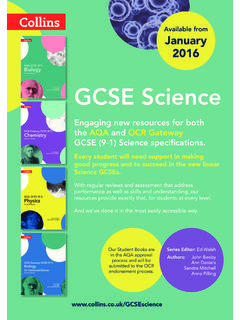
GCSE Science - Collins Education
resources.collins.co.ukOCR Gateway Single Science (Biology A (9-1) J247, Chemistry A (9-1) J248, ... GCSE (9-1) Science 3 GCSE Science Course Guide.indd 3 08/12/2015 20:15. Key changes to the new Science GCSEs ... Sample material is also available for you to look at online for free

1 Introduction to communication in health, social …
resources.collins.co.ukin health and social care work. It focuses on the reasons why people communicate in health or social care settings, the methods they use and the importance of ensuring that communication in care settings is

AQA GCSE English Language and English Literature
resources.collins.co.ukTeacher Guide AQA GCSE English Language and English Literature Series Editors: Sarah Darragh and Jo Heathcote Sarah Darragh, Phil …
1 Introduction to communication in health, social …
resources.collins.co.ukin health and social care work. It focuses on the reasons why people communicate in health or social care settings, the methods they use and the importance of ensuring that communication in care settings is
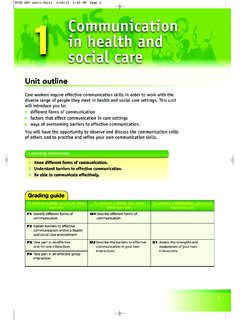
1 Communication in health and social care
resources.collins.co.uk1 1 1 Know different forms of communication. 2 Understand barriers to effective communication. 3 Be able to communicate effectively. Learning outcomes

AQA GCSE (9-1) Biology - Collins Education
resources.collins.co.ukAQA GCSE (9-1) Biology Teacher Pack Advance draft material for the 2016 specifications Louise Smiles Series editor: Ed Walsh DRAFT Collins GCSE Biology TP cover.indd 1 10/12/2015 14:16

Edexcel GCSE Maths - Collins Education
resources.collins.co.ukEdexcel GCSE Maths 209732 Edexcel Higher Teacher Pack title page.indd 1 3/27/15 2:38 PM Higher Student Book Answers

AQA GCSE Maths - Collins Education
resources.collins.co.ukHigher Student Book Answers Higher Student Book Answers. Browse the complete Collins catalogue at www.collins.co.uk William Collins’ dream of knowledge for all began with the publication of his first book in 1819. A self-educated mill ... AQA GCSE Maths Higher SB Answers…

GCSE AQA Foundation Combined Science - Collins Education
resources.collins.co.ukHuman Defences Against Disease Treating Diseases Photosynthesis Respiration and Exercise Homeostasis and the Nervous System How can a person be made
1 Communication in health and social care - Collins Education
resources.collins.co.uk4 Non-verbal communication As well as communicating through speech, people use a variety of forms of non-verbal communication.Some of these are referred to as body language.
Related documents
BASIC PRINCIPLES OF INORGANIC CHEMISTRY
ubblab.weebly.comFood - The Chemistry of Its Components (Third Edition) by T. P. Coultnte The Chemistry of Paper by J. C. Roberts ... elements of the Periodic Table not only determines the Long Form of the Periodic Table, but also determines the physical properties of the elements, atom size, ionisation energies and electron affinities (electron ...

Mark Scheme (Results) - Pearson qualifications
qualifications.pearson.comAug 23, 2017 · in Chemistry (4CH0) Paper 1C Science (Double Award) (4SC0) Paper 1C ... group where element is found in the Periodic Table 1 5 ... separate the dyes in food colouring D is not correct because filtration would not separate the dyes in food colouring 1 (d) (i) M1 add (dilute) nitric acid ...
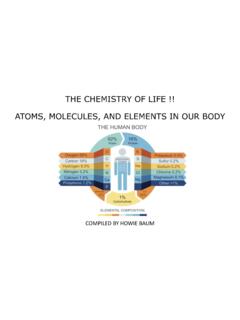
THE CHEMISTRY OF LIFE !! ATOMS, MOLECULES, AND …
www.uc.eduTHE CHEMISTRY OF LIFE !! ATOMS, MOLECULES, AND ELEMENTS IN OUR BODY COMPILED BY HOWIE BAUM. ... hydrochloric acid which it uses to digest our food !! SODIUM CHLORINE = SODIUM CHLORIDE (SALT) Sodium Chlorine Sodium chloride ... THE ESSENTIAL BODY ELEMENTS IN THE PERIODIC TABLE. The 19 elements that are known …

Understanding our exams - Pearson qualifications
qualifications.pearson.comGCSE Chemistry/Combined Science The table below shows the topics that are assessed in each paper in chemistry. Paper 1 Paper 2 Key concepts in Chemistry Key concepts in Chemistry States of matter and mixtures Groups in the periodic table Chemical changes (acids and electrolytic processes) Rates of reaction and energy changes

VCE Chemistry written examination – Data Book
www.vcaa.vic.edu.auCHEMISTRY DATA BOOK 2 Table of contents Page 1. Periodic table of the elements 3 2. Electrochemical series 4 3. Chemical relationships 5 4. Physical constants and standard values 5 5. Unit conversions 6 6. Metric (including SI) prefixes 6 7. Acid-base indicators 6 8. Representations of organic molecules 7 9. Formulas of some fatty acids 7 10.
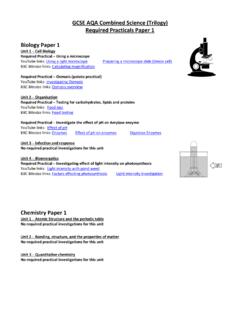
GCSE AQA Combined Science (Trilogy) Required Practicals ...
www.q3tipton.org.ukChemistry Paper 1 Unit 1 – Atomic Structure and the periodic table No required practical investigations for this unit Unit 2 – Bonding, structure, and the properties of matter No required practical investigations for this unit Unit 3 – Quantitative chemistry No required practical investigations for this unit

Periodic Trends: Ionization Energy
www.arrsd.orgperiodic table) with more protons tend to have a greater force holding on to electrons in the same energy level. Therefore, Ionization energy increases from left to right across the periodic table. If an electron is further away from the nucleus, the attractive force decreases, as described and predicted by Coulomb’s Law.