Example: air traffic controller
Data-Free Knowledge Distillation for Image Super-Resolution
Deep convolutional neural networks have achieved huge success in various computer vision tasks, such as image recognition [12], object detection [26], semantic segmen-tation [27] and super-resolution [7]. Such great progress largely relies on the advances of computing power and stor-age capacity in modern equipments. For example, ResNet-
Tags:
Information
Domain:
Source:
Link to this page:
Documents from same domain
RegularFace: Deep Face Recognition via Exclusive ...
openaccess.thecvf.comRegularFace: Deep Face Recognition via Exclusive Regularization Kai Zhao Jingyi Xu Ming-Ming Cheng ∗ TKLNDST, CS, Nankai University kaiz.xyz@gmail.com cmm@nankai.edu.cn
Squeeze-and-Excitation Networks - openaccess.thecvf.com
openaccess.thecvf.comSqueeze-and-Excitation Networks Jie Hu1∗ Li Shen2∗ Gang Sun1 hujie@momenta.ai lishen@robots.ox.ac.uk sungang@momenta.ai 1 Momenta 2 Department of Engineering Science, University of Oxford Abstract Convolutional neural networks are built upon the con-
Class-Balanced Loss Based on Effective Number of Samples
openaccess.thecvf.comand large-scale datasets including ImageNet and iNatural-ist. Our results show that when trained with the proposed class-balanced loss, the network is able to achieve signifi-cant performance gains on long-tailed datasets. 1. Introduction The recent success of deep Convolutional Neural Net-works (CNNs) for visual recognition [26, 37, 38, 16] owes
Finding Tiny Faces in the Wild With Generative Adversarial ...
openaccess.thecvf.comfaces, which are unfriendly for the face classifier. Toward-s this end, we design a refinement sub-network to recover some detailed information. In the discriminator network, the basic GAN [17, 12, 8] is trained to distinguish the real and fake high resolution images. To classify faces or non-
Auto-DeepLab: Hierarchical Neural Architecture Search for ...
openaccess.thecvf.comAuto-DeepLab: Hierarchical Neural Architecture Search for Semantic Image Segmentation Chenxi Liu1∗, Liang-Chieh Chen 2, Florian Schroff2, Hartwig Adam2, Wei Hua2, Alan Yuille1, Li Fei-Fei3 1Johns Hopkins University 2Google 3Stanford University Abstract Recently, NeuralArchitectureSearch(NAS)hassuccess-
ESRGAN: Enhanced Super-Resolution Generative Adversarial ...
openaccess.thecvf.comESRGAN: EnhancedSuper-Resolution Generative Adversarial Networks Xintao Wang 1, Ke Yu , Shixiang Wu2, Jinjin Gu3, Yihao Liu4, Chao Dong 2, Yu Qiao , and Chen Change Loy5 1 CUHK-SenseTime Joint Lab, The Chinese University of Hong Kong 2 Shenzhen Institutes of Advanced Technology, Chinese Academy of Sciences 3 The Chinese University of Hong Kong, …
What Have We Learned From Deep Representations for …
openaccess.thecvf.comwhat these powerful models actually have learned. In this paper we shed light on deep spatiotemporal net-works by visualizing what excites the learned models us-ing activation maximization by backpropagating on the in-put. We are the first to visualize the hierarchical features
Protecting World Leaders Against Deep Fakes
openaccess.thecvf.comProtecting World Leaders Against Deep Fakes Shruti Agarwal and Hany Farid University of California, Berkeley Berkeley CA, USA {shrutiagarwal, hfarid}@berkeley.edu
PointNet: Deep Learning on Point Sets ... - CVF Open Access
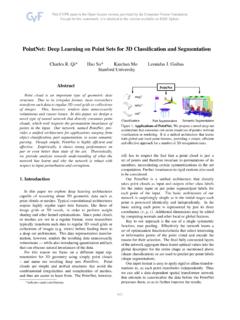
openaccess.thecvf.comPointNet: Deep Learning on Point Sets for 3D Classification and Segmentation Charles R. Qi* Hao Su* Kaichun Mo Leonidas J. Guibas Stanford University
Frustum PointNets for 3D Object Detection From RGB-D Data
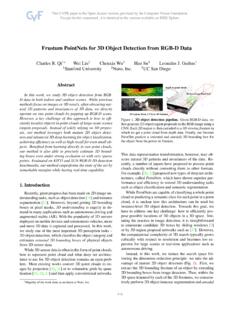
openaccess.thecvf.comFrustum PointNets for 3D Object Detection from RGB-D Data Charles R. Qi1∗ Wei Liu2 Chenxia Wu2 Hao Su3 Leonidas J. Guibas1 1Stanford University 2Nuro, Inc. 3UC San Diego Abstract In this work, we study 3D object detection from RGB-D data in both indoor and outdoor scenes.
Related documents
Image Texture Feature Extraction Using GLCM Approach
www.ijsrp.org[7] H. Hikawa, Implementation of Simplified Multilayer Neural Network with On-chip Learning, Proc. of theIEEE International Conference on Neural Networks(Part 4), Vol. 4, 1999, pp 1633-1637. [8] T. Nakano, T. Morie, and A. Iwata, A Face/Object Recognition System Using FPGA Implementation of Coarse Region Segmentation, SICE
IEEE TRANSACTIONS ON PATTERN ANALYSIS AND MACHINE ...
arxiv.orgfrom the whole point cloud using an aggregation method. Classification is finally achieved by feeding the global em-bedding into several fully connected layers. According to the data type of input for neural networks, existing 3D shape classification methods can be divided intomulti-view based, volumetric-basedand point-based methods. Several
Neural Networks and Deep Learning - latexstudio
static.latexstudio.netThe purpose of this book is to help you master the core concepts of neural networks, including modern techniques for deep learning. After working through the book you will have written code that uses neural networks and deep learning to solve complex pattern recognition problems. And you will have a foundation to use neural networks and deep

Board byte: artificial intelligence - PwC
www.pwc.com.au• Neural networks. are interconnected networks of artificial neurons, or nodes, that simulate human brain cells. They’re designed to learn from labeled patterns in data that flow through the network layer by layer. They record what they learn by weighting or unweighting an input – to determine how correct
InfoGAN: Interpretable Representation Learning by ...
papers.nips.ccOne class of such methods trains a subset of the representation to match the supplied label using supervised learning: bilinear models [18] separate style and content; multi-view perceptron [19] separate face identity and view point; and Yang et al. [20] developed a recurrent variant that generates a sequence of latent factor transformations.

Residual Attention Network for Image Classification
openaccess.thecvf.comResidual Attention Network for Image Classification Fei Wang1, Mengqing Jiang2, Chen Qian1, Shuo Yang3, Cheng Li1, Honggang Zhang4, Xiaogang Wang3, Xiaoou Tang3 1SenseTime Group Limited, 2Tsinghua University, 3The Chinese University of Hong Kong, 4Beijing University of Posts and Telecommunications 1{wangfei, qianchen, chengli}@sensetime.com, …