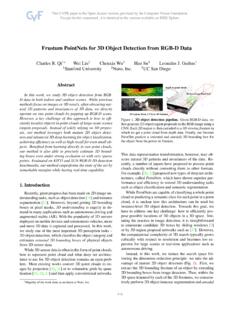
Transcription of Deep Closest Point: Learning Representations for Point ...
1 Deep Closest Point : Learning Representations for Point Cloud RegistrationYue WangMassachusetts Institute of Technology77 Massachusetts Ave, Cambridge, MA M. SolomonMassachusetts Institute of Technology77 Massachusetts Ave, Cambridge, MA cloud registration is a key problem for computervision applied to robotics, medical imaging, and other ap-plications. This problem involves finding a rigid transfor-mation from one Point cloud into another so that they Closest Point (ICP) and its variants provide sim-ple and easily-implemented iterative methods for this task,but these algorithms can converge to spurious local address local optima and other difficulties in the ICPpipeline, we propose a Learning -based method, titled DeepClosest Point (DCP), inspired by recent techniques in com-puter vision and natural language processing.
2 Our modelconsists of three parts: a Point cloud embedding network,an attention-based module combined with a pointer gener-ation layer to approximate combinatorial matching, and adifferentiable singular value decomposition (SVD) layer toextract the final rigid transformation. We train our modelend-to-end on the ModelNet40 dataset and show in severalsettings that it performs better than ICP, its variants ( ,Go-ICP, FGR), and the recently-proposed Learning -basedmethod PointNetLK. Beyond providing a state-of-the-art reg-istration technique, we evaluate the suitability of our learnedfeatures transferred to unseen objects. We also provide pre-liminary analysis of our learned model to help understandwhether domain-specific and/or global features facilitaterigid IntroductionGeometric registration is a key task in many compu-tational fields, including medical imaging, robotics, au-tonomous driving, and computational chemistry.
3 In its mostbasic incarnation, registration involves the prediction of arigid motion to align one shape to another, potentially obfus-cated by noise and modeling and computational challenges hamper thedesign of a stable and efficient registration method. Given ex-act correspondences, singular value decomposition yields theFigure : a moved : rotated human. All methodswork well with small transformation. However, only our methodachieve satisfying alignment for objects with sharp features andlarge optimal alignment; similarly, computing matchingsbecomes easier given some global alignment these two observations, most algorithms alternate be-tween these two steps to try to obtain a better result. The re-sultant iterative optimization algorithms, however, are proneto local most popular example, Iterative Closest Point (ICP)[5,40], alternates between estimating the rigid motion based13523on a fixed correspondence estimate and updating the corre-spondences to their Closest matches.
4 Although ICP mono-tonically decreases a certain objective function measuringalignment, due to the non-convexity of the problem, ICPoften stalls in suboptimal local minima. Many methods[37,13,55] attempt to alleviate this issue by using heuristicsto improve the matching or by searching larger parts of themotion spaceSE(3). These algorithms are typically slowerthan ICP and still do not always provide acceptable this work, we revisit ICP from a deep Learning perspec-tive, addressing key issues in each part of the ICP pipeline us-ing modern machine Learning , computer vision, and naturallanguage processing tools. We call our resulting algorithmDeep Closest Point (DCP), a Learning -based method thattakes two Point clouds and predicts a rigid transformationaligning model consists of three parts: (1) We map the inputpoint clouds to permutation/rigid-invariant embeddings thathelp identify matching pairs of points (we compare PointNet[33] and DGCNN [50] for this step); then, (2) an attention-based module combining pointer network [48,46] predictsa soft matching between the Point clouds; and finally, (3) adifferentiable singular value decomposition layer predictsthe rigid transformation.
5 We train and test our model end-to-end on ModelNet40 [52] in various settings, showing ourmodel is not only efficient but also outperforms ICP andits extensions, as well as the recently-proposed PointNetLKmethod [18]. Our learned features generalize to unseendata, suggesting that our model is Learning salient :Our contributions include the following: We identify sub-network architectures designed to addressdifficulties in the classical ICP pipeline. We propose a simple architecture to predict a rigid trans-formation aligning two Point clouds. We evaluate efficiency and performance in several settingsand provide an ablation study to support details of ourconstruction. We analyze whether local or global features are moreuseful for registration.
6 We release our code to facilitate reproducibility and Related WorkPoint cloud registration methods:ICP [5] is the best-known algorithm for solving rigid registration problems; italternates between finding Point cloud correspondences andsolving a least-squares problem to update the alignment. ICPvariants [37,40,6] consider issues with the basic method,like noise, partiality, and sparsity; probabilistic models [2,15,19] also can improve resilience to uncertain data. ICPcan be viewed as an optimization algorithm searching jointlyfor a matching and a rigid alignment. Hence, [13] proposeusing the Levenberg Marquardt algorithm to optimize theobjective directly, which can yield a better solution. Formore information, [32,37] summarize ICP and its variantsdeveloped over the last 20 methods are prone to local minima due to non-convexity.
7 To find a good optimum, Go-ICP [55] uses abranch-and-bound (BnB) method to search the motion spaceSE(3). It outperforms local ICP methods when a globalsolution is desired but is several orders of magnitude slowerthan other ICP variants despite using local ICP to acceler-ate the search process. Other methods attempt to identifyglobal optima using Riemannian optimization [36], convexrelaxation [27], and mixed-integer programming [21].Recently, descriptor Learning methods have brought sig-nificant progress in Point cloud registration: 3 DMatch [59]proposes Learning a local volumetric patch descriptor to es-tablish correspondences; 3 DFeatNet [56] takes similar ap-proach to Point cloud representation for local regions; PPF-FoldNet [9] uses a folding-based autoencoder to learn a lo-cal descriptor; and 3 DSmoothNet [14] employs a voxelizedsmoothed density value (SDV) representation for descriptorlearning.
8 The critical difference between our algorithm andthese techniques is that we carry out end-to-end registrationprediction while the others target descriptor Learning . Also,these works rely on keypoint detection and outlier removalusing RANSAC. Concurrent work [26] proposes an end-to-end pipeline for Point cloud registration. A significantdifference is that theirs computes loss for each Point samplewhile ours optimizes the registration objective on graphs and Point sets:A broad class ofdeep architectures for geometric data termedgeometric deeplearning[7] includes recent methods Learning on graphs[51,60,12] and Point clouds [33,34,50,57].Thegraph neural network(GNN) is introduced in [39];similarly, [11] defines convolution on graphs (GCN) formolecular data.
9 [24] uses renormalization to adapt to thegraph structure and applies GCN to semi-supervised learningon graphs. MoNet [28] learns a dynamic aggregation func-tion based on the graph structure, generalizing GNN. Finally,graph attention networks (GAT) [47] incorporate multi-headattention into GCN. DGCNN [50] (discussed below) can beregarded as a graph neural network applied to Point cloudswith dynamic branch of geometric deep Learning includes Point -Net [33] and other algorithms designed to process pointclouds. PointNet can be seen as applying GCN to graphswithout edges, mapping points inR3to high-dimensionalspace. PointNet only encodes global features gathered fromthe Point cloud s embedding, impeding application to tasksinvolving local geometry.
10 To address this issue, PointNet++[34] applies a shared PointNet tok-nearest neighbor clus-23524(a) Network architecture(b) Transformer moduleFigure 2. Network architecture for DCP, including the Transformer module for to learn local features. As an alternative, DGCNN [50]explicitly recovers the graph structure in both Euclideanspace and feature space and applies graph neural networksto the result. PCNN [3] uses an extension operator to defineconvolution on Point clouds, while PointCNN [25] appliesEuclidean convolution after applying a learned transforma-tion. Finally, SPLATNet [43] encodes Point clouds on alattice and performs bilateral convolution. All these worksaim to apply convolution-like operations to Point clouds andextract local geometric Learning and pointer networks:Many tasks in natural language processing, including ma-chine translation, language modeling, and question answer-ing, can be formulated as sequence-to-sequence (seq2seq)problems.