Transcription of Dell PowerEdge R320 Technical Guide
1 PowerEdge R320 Technical Guide Get Dell R320 Memory from Cloud Ninjas ii PowerEdge R320 Technical Guide iii This document is for informational purposes only. Dell reserves the right to make changes without further notice to any products herein. The content provided is as is and without express or implied warranties of any kind. Dell, the DELL logo, PowerEdge , EqualLogic, PowerVault, OpenManage, KACE and ReadyRails are trademarks of Dell, Inc. intel , Xeon, Celeron, and Pentium are registered trademarks and Core is a trademark of intel Corporation in the and other countries. Microsoft, Windows, Windows Server,, BitLocker, ActiveX, Internet Explorer, and Hyper-V are either registered trademarks or trademarks of Microsoft Corporation in the United States and/or other countries. Novell and SUSE are registered trademarks of Novell, Inc. in the United States and other countries.
2 IBM, Tivoli, and Netcool are registered trademarks of IBM in the United States. Other trademarks and trade names may be used in this document to refer to either the entities claiming the marks and names or their products. Dell disclaims proprietary interest in the marks and names of others. Copyright 2014 Dell Inc. All rights reserved. Reproduction or translation of any part of this work beyond that permitted by copyright laws without the written permission of Dell Inc. is unlawful and strictly forbidden. ENERGY STAR is a registered mark owned by the government. January 2014 | Version Table of contents 1 System overview ..5 Introduction ..5 Key technologies .. 6 2 System features .. 7 Comparison of PowerEdge systems .. 7 Specifications .. 8 3 Chassis views and features .. 11 Chassis views .. 11 Chassis features .. 12 4 Processor .. 15 Processor features .. 15 Supported processors .. 16 Chipset .. 16 5 Memory .. 17 Supported memory .. 17 Memory configurations.
3 18 Memory speed ..18 Memory RAS 19 6 Storage .. 21 Internal storage .. 21 External storage .. 21 Storage controllers .. 22 Optical drive .. 23 Tape drive .. 23 7 Networking and PCIe .. 24 Embedded NIC controller .. 24 PCIe expansion .. 24 iv PowerEdge R320 Technical Guide 8 Power, thermal and acoustics .. 26 Power consumption and energy efficiency .. 26 Power supply units .. 27 Thermal and 28 9 Rack rails and cable management .. 31 Sliding and static rail systems .. 31 Cable management 33 10 Operating systems and virtualization .. 34 Supported operating systems .. 34 Supported virtualization .. 35 11 Dell OpenManage systems management .. 36 Systems management solutions .. 36 OpenManage systems management .. 37 Dell server management operations .. 42 Appendix A. Additional specifications .. 44 Chassis dimensions and weight .. 44 Video specifications .. 44 Environmental specifications .. 45 Power supply specifications .. 46 Rack rail specifications.
4 46 USB peripherals .. 47 Appendix B. Standards compliance .. 48 PowerEdge R320 Technical Guide Appendix C. Additional resources .. 49 Appendix D. System board block diagram .. 51 Tables Table 1. Key technologies .. 6 Table 2. Comparing the PowerEdge R310 to PowerEdge R320 .. 7 Table 3. Technical specifications .. 8 Table 4. Chassis features .. 12 Table 5. Security features ..14 Table 6. Supported processors .. 16 Table 7. Memory technologies supported .. 17 Table 8. DIMMs supported ..18 Table 9. Memory speed capabilities .. 19 Table 10. Memory RAS features .. 19 Table 11. Supported hard drives .. 21 Table 12. Supported RAID 22 Table 13. Hard-drive backplane options .. 23 Table 14. PCIe slot configurations .. 24 Table 15. Supported NICs and HBAs .. 24 Table 16. Power tools and technologies .. 26 Table 17. Power supply efficiency .. 28 Table 18. Acoustical performance .. 30 Table 19. Supported rack types .. 32 Table 20.
5 Primary operating system support .. 34 v Table 21. Virtualization support .. 35 Table 22. iDRAC7 with Lifecycle controller functions and benefits .. 37 Table 23. Feature comparison for Basic Management, iDRAC7 Express, and iDRAC7 Enterprise .. 38 Table 24. One-to-one and one-to-many operations .. 43 Table 25. Supported video modes .. 44 Table 26. Environmental specifications .. 45 Table 27. Power supply specifications .. 46 Table 28. Rail adjustability range .. 46 Table 29. Industry standards documentation .. 48 Table 30. Additional resources .. 49 Figures Figure 1. Front view without bezel .. 11 Figure 2. Front view with 11 Figure 3. Back view .. 11 Figure 4. Internal view .. 12 Figure 5. LCD control panel .. 13 Figure 6. QRL location ..14 Figure 7. 350W power supply unit .. 28 Figure 8. Sliding rails with optional CMA .. 31 Figure 9. Static rails .. 32 Figure 10. Dell systems management solutions .. 36 Figure 11. Systems management server lifecycle.
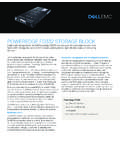
6 42 Figure 12. System dimensions .. 44 Figure 13. R320 system board block diagram .. 51 1 System overview Introduction The one-socket Dell PowerEdge R320 rack server delivers powerful performance and enterprise-class, high-availability capabilities in a 1U chassis. The R320 s configuration flexibility, increased internal storage, and straightforward systems management make it an excellent fit for web hosting and serving, file and print serving, and other general-purpose applications in space-constrained locations. Enterprise features, scalable expandability and value in a dense chassis The R320 features the scalable performance of the intel Xeon processor E5-2400 and E5-2400 v2 product families with enterprise-class memory reliability, availability, serviceability (RAS) features. This server complements its processors with six DIMM slots and two PCI Express (PCIe) slots, providing a substantial memory footprint and wide I/O bandwidth to support memory-intensive applications and databases as well as consolidation and virtualization.
7 For users not needing the enterprise-class high performance of the intel Xeon processor E5-2400 and E5-2400 v2 product families, the R320 also supports the more price-sensitive intel Xeon processor E5-1410 and intel Pentium processor 1400 product family . Users selecting the intel Xeon processor E5-2400 and E5-2400 v2 product families can choose to implement advanced memory protection capabilities (memory sparing and memory mirroring) previously not seen in the one-socket x86 server space. These capabilities are not possible with the intel Xeon processor E5-1410 and the intel Pentium processor 1400 product family . Regardless of the processor type, you can take advantage of other high availability features offered on the R320. To protect your virtualized workloads, the R320 offers redundant SD cards making your hypervisors redundant and failsafe. Other reliability and availability features include hardware and software RAID options, hot-plug hard drives and hot-plug power supplies.
8 Ideal for your applications The R320 features up to 100% more processor cores, enterprise-class RAS features including memory sparing and memory mirroring, and 100% more internal hard drives than the previous-generation R310. Network options span multiple third-party brands and adapter types with 10 GbE NIC, 10 GbE FCoE, and Fibre Channel 8Gb HBA. The R320 delivers failsafe hypervisors to protect virtualized workloads and Dell Fresh Air compliant configuarions, enabling it to operate in extended temperature ranges. This not only helps to save energy costs but also allows the R320 to ride through unforeseen events such as power brownouts. Its innovative, agent-free systems management delivers no-compromise, enterprise-class systems management for hassle-free computing. These combined capabilities make the R320 an excellent fit for web hosting and serving, file and print serving, and work group collaboration and productivity applications, especially where the low profile of a 1U chassis is desired.
9 Simplified systems management, without compromise The Dell OpenManage systems management portfolio includes Integrated Dell Remote Access controller 7 (iDRAC7) with Lifecycle controller . This embedded feature helps IT administrators manage Dell servers in physical, virtual, local and remote environments, operating in-band or outof-band, with or without a systems management software agent installed. OpenManage iDRAC with Lifecycle controller integrates and connects to leading third-party systems management solutions (such as those from Microsoft, VMware and BMC Software), so users can maintain a single point of control and capitalize on an existing systems management investment. OpenManage simplifies the lifecycle of deploying, updating, monitoring and maintaining Dell PowerEdge servers. 7 PowerEdge R320 Technical Guide Key technologies Table 1 summarizes key technologies used in the Dell PowerEdge R320 rack server. Table 1. Key technologies New technology Detailed description New intel processors The new intel Xeon processor E5-2400 and E5-2400 v2 product families, the intel Xeon E5-1410 processor, and the intel Pentium processor 1400 product family offer features such as embedded PCIe lanes for improved I/O performance.
10 See the Processor section for details. intel C600 series chipset The intel platform controller Hub (PCH) chip is implemented on the R320 server. Next-generation PERC options The R320 supports the new PERC controller cards with improved functionality and faster performance. See the Storage section for details. PERC S110 software RAID solution This new software RAID solution supports RAID 0, 1, 5 and 10, and supports a maximum of four hot-plug SATA hard drives or SATA solid-state drives. See the Storage section for details. iDRAC7 with Lifecycle controller The second generation embedded systems management solution for Dell servers provides agent-free hardware and firmware inventory and alerting, in-depth memory alerting, faster performance, a dedicated gigabit port, and many more features. See the Dell OpenManage systems management section for details. Advanced power management The R320 supports advanced power monitoring and power capping tools that can help manage power consumption.