Transcription of Differential and Common Mode Gain lecture - ITTC
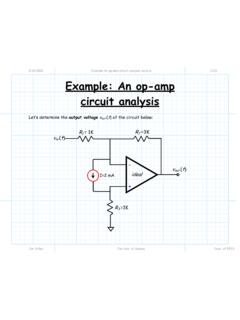
1 2/18/2011 Differential and Common Mode Gain lecture 1/8 Jim Stiles The Univ. of Kansas Dept. of EECS Differential and Common -Mode Gain Recall that in a previous handout, we analyzed this circuit: R2 R1 + - vout ideal v1 v2 R3 R4 2/18/2011 Differential and Common Mode Gain lecture 2/8 Jim Stiles The Univ. of Kansas Dept. of EECS Common mode and Differential mode We found that the output is related to the inputs as: 4222113411outRRRvvvRRRR =+ + This circuit is a weighted difference amplifier, and typically, it is expressed in terms of its Differential gain Ad and Common -mode gain Acm.
2 To understand what these gains mean, we must first define the difference signal ()dvt and Common -mode signal ()cmvt of two inputs 1()vt and 2()vt. 2/18/2011 Differential and Common Mode Gain lecture 3/8 Jim Stiles The Univ. of Kansas Dept. of EECS Definitions The difference, as we might expect, is defined as: 21()() ()dvtvtvt whereas the Common -mode signal is simply the average of the two inputs: 21() ()()2cmvt vtvt+ Using these definitions, we can express the two input signals as: 21()()()2()()()2dcmdcmvtvtvtvtvtvt=+= 2/18/2011 Differential and Common Mode Gain lecture 4/8 Jim Stiles The Univ.
3 Of Kansas Dept. of EECS A new way to express the output Thus, the Differential signal ()dvt and the Common -mode signal ()cmvt provide another way to completely specify input signals 12() and ()vtvt if you know ()dvt and ()cmvt, you know 1() vtand 2()vt. Moreover, we can express the behavior of our Differential amplifier in terms of ()dvt and ()cmvt. Inserting these functions into the expression of the amplifier output ()ovt, we find: 422211341422134142213414221341()()1()()2 211()21outddcmcmdRRRvvvRRRR vtvtRRRvtvtRRRRRRRvtRRR RRRRRRR R =+ + =++ + =++ + ++ + ()()1142324142313 413 4()2()()2cmcmdvtRR RRRRRR RRvtv tRR RRR R ++ =+++ 2/18/2011 Differential and Common Mode Gain lecture 5/8 Jim Stiles The Univ.
4 Of Kansas Dept. of EECS A more Common form Thus, we now have an expression for the open-circuit output in the form: ()()()outcm cmddvtAvtAvt=+ where: Differential gain Common -mode gaindcmAA 2/18/2011 Differential and Common Mode Gain lecture 6/8 Jim Stiles The Univ. of Kansas Dept. of EECS Difference amplifiers should have no Common -mode gain Note that each of these gains are open-circuit voltage gains.
5 * An ideal Differential amplifier has zero Common -mode gain ( , Acm =0)! * In other words, the output of an ideal Differential amplifier is independent of the Common -mode ( , average) of the two input signals. * We refer to this characteristic as Common -mode suppression. Typically, real Differential amplifiers exhibit small, but non-zero Common mode gain. 2/18/2011 Differential and Common Mode Gain lecture 7/8 Jim Stiles The Univ.
6 Of Kansas Dept. of EECS Common -Mode Rejection ratio The Common -Mode Rejection Ratio (CMRR) is therefore used to indicate the quality of a Differential amplifier: 2102 CMRR 10 log()dcmAdBA= Note the CMRR of a good Differential amplifier is very large ( , > 40 dB). For our example circuit, we find that the Differential and Common -mode gain are: ()()123244134123413422dcmRR RRRRARR RRRR RARR R++=+ =+ 2/18/2011 Differential and Common Mode Gain lecture 8/8 Jim Stiles The Univ.
7 Of Kansas Dept. of EECS Common -mode gain depends on design The ratio of these two gains is thus: ()()11232 123444131344123244123422212dcmARR RRRRRR RRARRRRRRRR RRRRRRR R ++ = ++ ++= and therefore CMRR is: 212324410123421 CMRR 10 log()2RR RRRRdBRRR R++= It is evident that for this example, the Common -mode gain Acm is minimized, and thus the CMRR is maximized, when: 1234 RRR R= so that 12340 RRR R =.